
Bream
Abramis brama
Identification
The bream is a deep-bodied, laterally compressed fish with a characteristically slimy body. The color is silvery-grey to bronze in older specimens. The mouth is small and downward-pointing — typical for a bottom feeder — and can be protruded to suck up food from the bed. The most common confusion species is the silver bream: the bream has a smaller eye relative to the head, longer pectoral fins that reach past the base of the pelvic fins, and lacks the red tinge on the fins that silver bream has. Large bream (50+ cm) develop a dark, bronze coloring and are affectionately called ‘dikke platten’ (fat slabs) by Dutch anglers.
Behavior & ecology
The bream is a pronounced shoaling fish and bottom feeder. With its protrusible mouth, it systematically sucks midge larvae, tubifex worms, and small shellfish from the mud — when foraging, it leaves characteristic bubbles at the water surface. Bream travel in large shoals along fixed routes and can cover kilometers in a single night.
Spawning takes place from May to June in shallow, vegetated water. During spawning, bream are particularly active and less wary. After spawning comes an intensive feeding period that continues throughout summer. Bream are most active at dusk and night, though they can be caught during the day, especially in overcast conditions.
Fishing techniques
Bream is the ultimate coarse fish for the feeder angler. The most effective methods:
- Feeder fishing: The top method. An open-end or cage feeder with a fine, clay-based groundbait mix. Short hooklink (30-50 cm) with a small hook (size 12-16). Recast every 3-5 minutes.
- Method feeder: A compact groundbait ball with a short hook pressed into the feed. Particularly effective on ponds and still water.
- Float fishing on the bottom: With a waggler or pole, the hook just on or slightly above the bottom. Classic and effective, especially at shorter range.
- Bait: Maggots and casters are the foundation. Alternate with corn, small worms, or dead maggots. In winter, small portions of bloodworm or joker work excellently.
Groundbait is the key: bream respond strongly to scent and can be drawn to a baited spot. Use a medium rod (3.60-3.90m) with a sensitive tip for the subtle bite.
In the Netherlands
Bream is the most common fish in Dutch inland waters and forms the backbone of the freshwater ecosystem. The species occurs in virtually every water type: canals, ponds, rivers, lakes, and polder waters. There is no closed season. Bream is an important prey species for pike and catfish — a healthy bream population contributes to a healthy predator population. In competitive angling, bream is the most caught species.
What our AI reveals
Our analysis of 76,000+ bream catches across 1,221 locations (96% reliability) produces the strongest fish species model of all species. The habitat model is almost entirely driven by the presence of other fish species — bream is the heart of the Dutch freshwater ecosystem.
Roach (19.0%) is the absolute #1 predictor: the classic pairing found together in virtually every inland water. Silver bream (11.8%) shares exactly the same habitat — unsurprising given the two species are often confused. The high score of perch (11.4%) and pikeperch (3.9%) indicates shared habitat — these species co-occur in the same nutrient-rich waters with sufficient depth and structure. Ruffe (7.5%) and rudd (7.5%) complete the picture of the typical Dutch fish community.
Growth factors
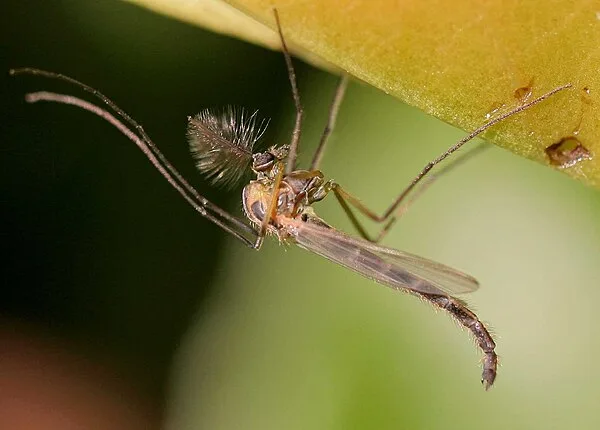 Non-biting midges (Chironomidae)
With an average catch length of 42.5 cm and top specimens over 60 cm (P95), the growth factors are remarkable. Canals (7.3%) are the strongest predictor for larger bream — the consistent depth, flow, and nutrient supply of Dutch canals create ideal growth conditions. Organic matter (5.8%) and nutrients (3.3%) confirm the pattern: nutrient-rich waters produce larger bream.
The presence of carp (3.6%) as a growth predictor indicates waters with sufficient carrying capacity for large bottom feeders. Notable are the non-biting midges (Chironomidae, 3.6%) — their larvae (bloodworms) are one of the most important food sources for bottom-feeding bream. They live in high densities in the soft mud of canals and ponds, exactly where bream prefer to forage.
When our data says to fish
August (18.1%) is the top month, followed by July (17.2%) and May (17.0%) — the summer months clearly dominate. April (13.5%) also scores strongly thanks to warming temperatures and spring activity. The temperature sweet spot is 12.0-17.7°C (middle 50%), but the most active feeding periods occur at 14-22°C.
Canals dominate the catch picture (13.5%), followed by ponds (11.9%), rivers (10.5%), and lakes (8.8%) — bream is the only species so widely spread across all water types.


