Identification
The trout is a sleek, powerful fish with a torpedo-shaped body built for flowing water. In the Netherlands, two forms occur: the brown trout (resident form) and the sea trout (migratory form), both belonging to the same species Salmo trutta. The brown trout has a golden-brown to olive back studded with red and black spots, often surrounded by a light halo. The belly is yellowish to white. The adipose fin near the tail is characteristic of all salmonids. The sea trout is silvery with less prominent spots and can grow considerably larger. Brown trout in Dutch streams typically reach 25-35 cm; sea trout from rivers can reach 50-70 cm.
Behavior & ecology
The trout is a cold-water specialist that demands high water quality. Clear, oxygen-rich, flowing water with a gravel bottom is essential. The trout is a territorial fish that chooses a fixed holding position in the current — often behind a rock, near an undercut bank, or in a deeper pool — and intercepts drifting food from there. The diet consists of insects and insect larvae (caddisflies, mayflies, midges), small crustaceans, and small fish in the case of larger specimens.
Spawning takes place in autumn and winter (October-January) on shallow gravel beds in flowing water. The female digs a redd in the gravel with her tail where the eggs are deposited. Sea trout migrate from the sea into rivers to spawn in headwaters — an impressive migration increasingly observed in the Netherlands thanks to improved fish passes.
Fishing techniques
Trout fishing is specialized and requires a subtle approach:
- Fly fishing: The method of choice. Dry flies on rising fish in summer, nymphs subsurface in spring. Czech nymphing with weighted nymphs along the bottom is highly effective in fast-flowing streams.
- Spinning: Small spinners (size 0-2), micro-spoons, or small plugs. Cast upstream and retrieve with the current. Effective in deeper pools.
- Worm on the drift: A small worm on a light rig, carried along with the current. Traditional and effective, especially in high or colored water.
Use a light rod (1.80-2.70m) with fine line. Wading is often necessary when stream fishing — polarized sunglasses help with spotting fish.
In the Netherlands
Wild brown trout occur naturally in the spring-fed streams of the Veluwe and the streams of Limburg — the only Dutch waters with the right combination of cold temperature, clean water, and gravel bottom. Sea trout are increasingly seen in the major rivers (Rhine, Meuse) thanks to restored migration routes and fish passes. Additionally, there are numerous put-and-take trout ponds where stocked rainbow trout can be caught — though this is a different species (Oncorhynchus mykiss). The wild brown trout is an indicator of clean water and is seen as a symbol of ecological recovery. Brown trout and sea trout have a year-round closed season and may not be kept.
What our models found for Trout
Below is what our models see in the data. These are links: where one thing occurs, the other occurs more often. That is not a cause. Each model answers one question and may not say more than it measured. The label by the heading tells you which question — and how sure the answer is.
Where this species lives Strong model
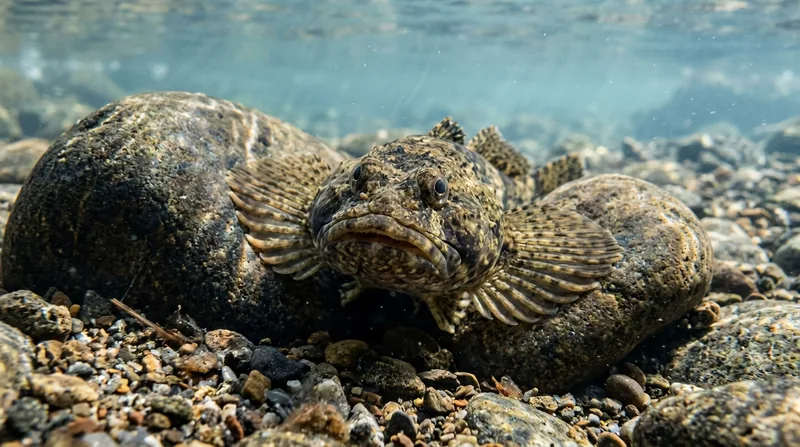 Bullheads (Cottidae)
This is one of only three models on the site that look at salt and fresh water at once. The other two are the smelt and the three-spined stickleback. Like the trout, both move back and forth between the sea and inland water. So it is not a mistake: the trout uses both, so the model trains on both.
The stream side comes first. Bullheads (Cottidae) are the strongest name: small bottom fish of stony streams. High up too are water mites of the family Sperchontidae and caddisflies of the family Hydropsychidae, which spin a catching net in the current. Further down sit blackflies (Simuliidae), the cranefly Dicranota (Pediciidae), moth flies (Psychodidae) and caddisflies of the family Goeridae, which weight their cases with stones so they are not washed away. The stone loach and the chub are in there too.
And then the sea side: the brown shrimp (Crangonidae), sand gobies (Pomatoschistus), the bull-rout, the shore crab (Carcinidae) and the greater pipefish. For those sea animals we cannot measure how strongly they mark trout water. They are in the list, but how much that says, we do not know.
FishBase puts the trout in salt, fresh and brackish water at once: a fish that lives one to five years in fresh water and then six months to five years at sea. Adults there eat molluscs, crustaceans and small fish. So the shrimp and the crab in this model are both its water AND its food.
Where there are many Weak model
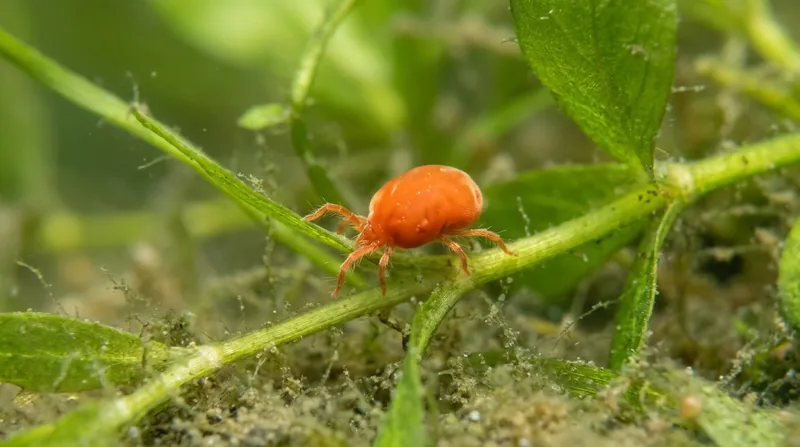 Water mites (Oxidae)
There is little to tell from this model. Only one feature clears the floor: water mites of the family Oxidae. Where there are more of those mites, we count more trout. Beyond that this model says nothing, and that is an answer too.


