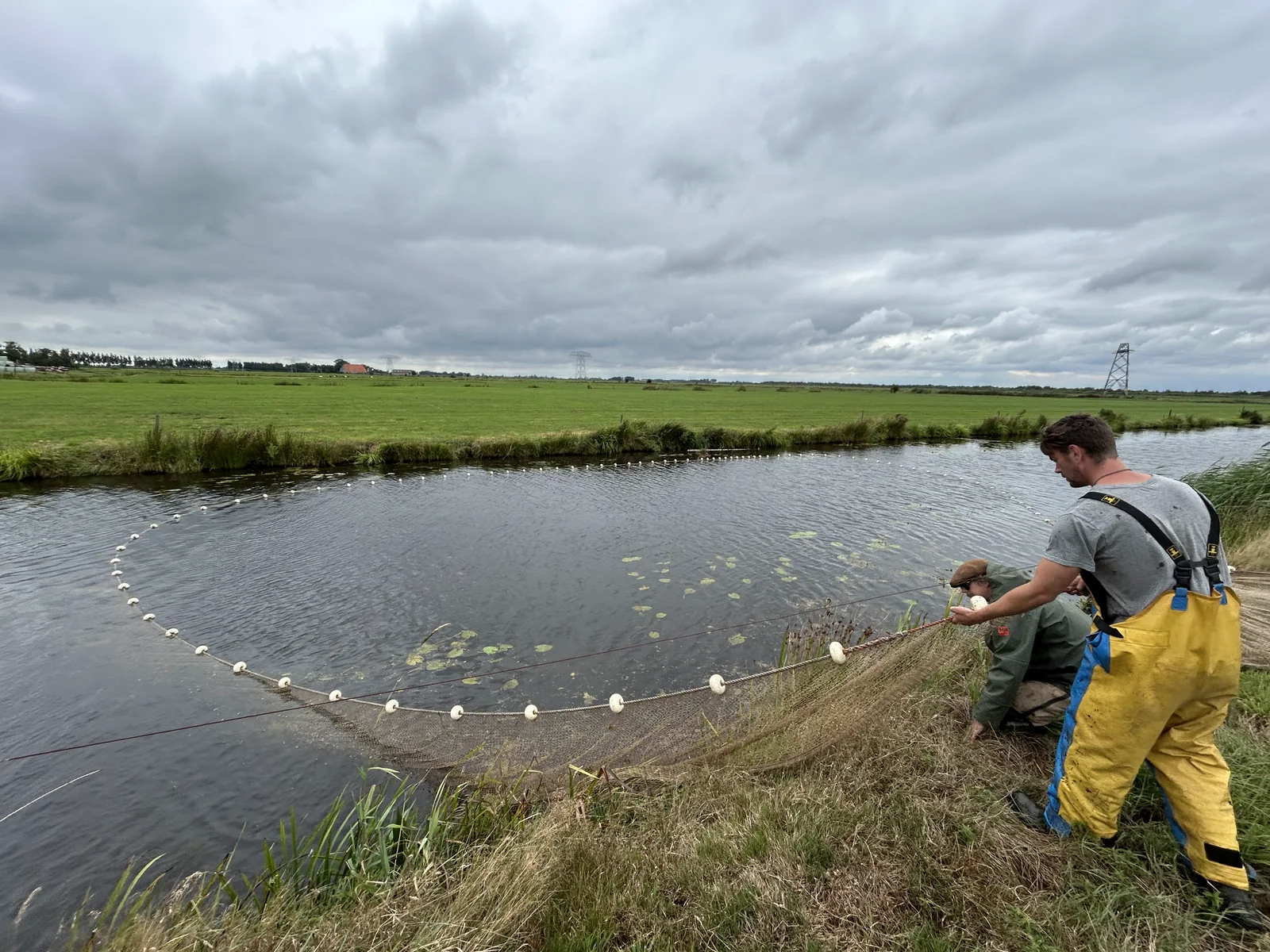
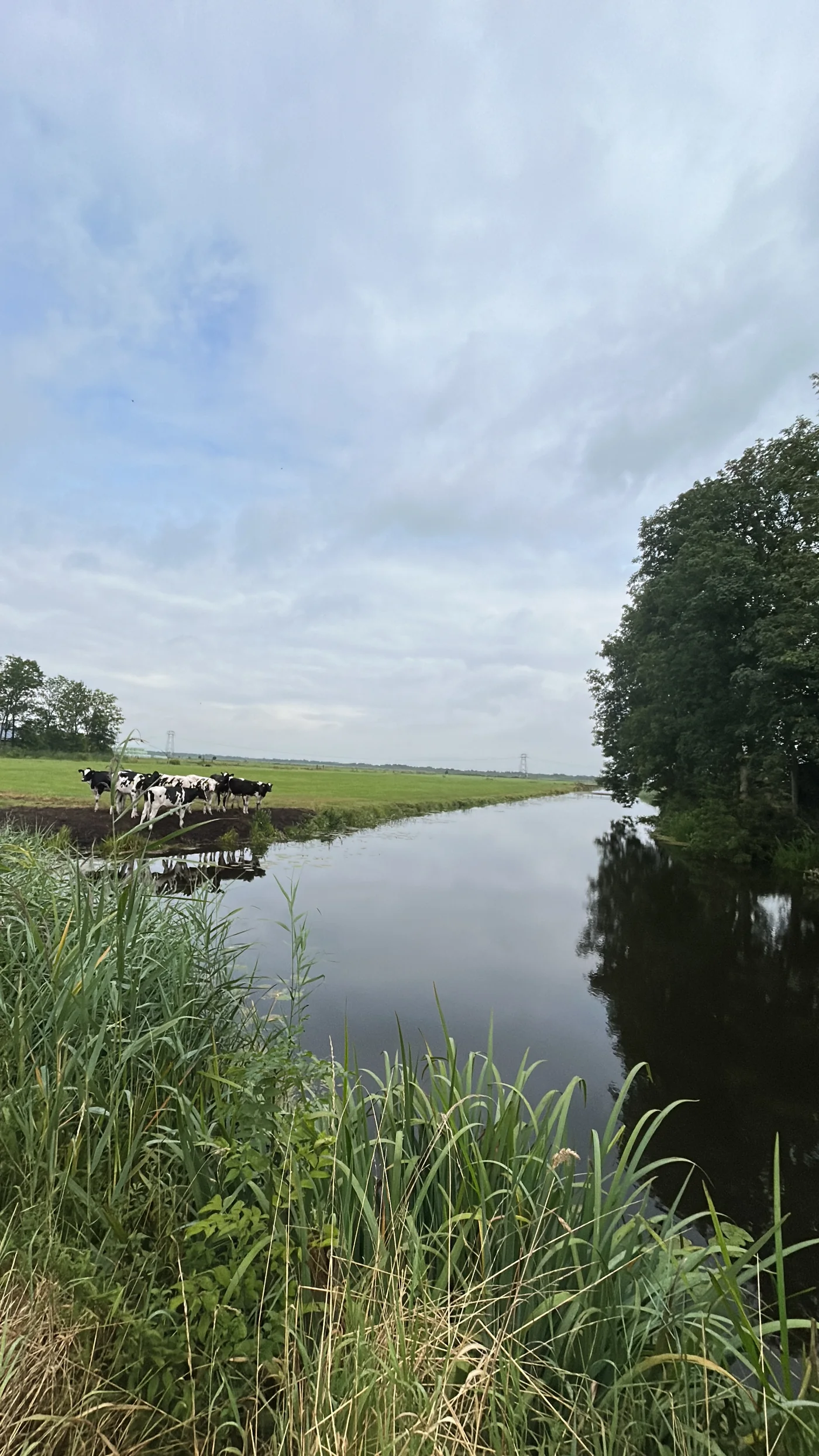
On 18 August 2026 we stood in the polders around the Sneekermeer with a seine net in the water. Small waters, narrow ditches, pasture to the horizon. We went along to see how the measurement itself colours the data. That is what happened. And one remark in passing knocked over an assumption that sits inside our own model.
How we ended up there
We had approached Wetterskip Fryslân with a question about fish data. They pointed us to ATKB. Since 1996 ATKB has been mapping fish stocks in the Netherlands, commissioned by the regional water authorities and for the Water Framework Directive. When we asked whether we could come and watch, the answer was yes.
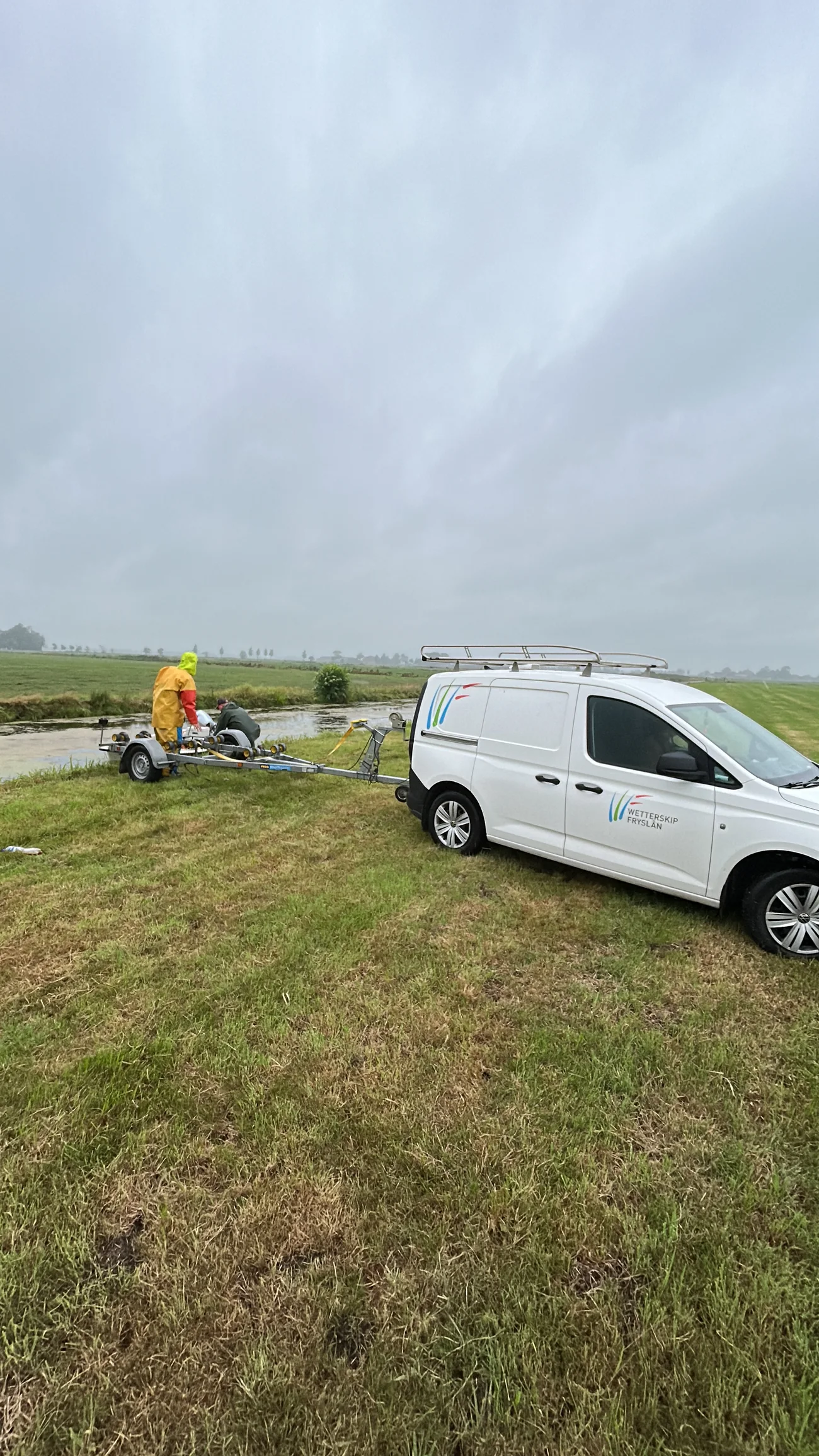
That made this more than a pleasant day out. We spend our days working with files that come out of this work. Seeing once how those files come into being changes how you read them.
Same water, different gear, different answer
A seine stands in the water like a wall: floats along the top, lead along the bottom, then hauled towards the bank. Whatever goes under it or swims around it is not in the net. Several methods get used in the same spot, and they do not give the same answer. Carp is hard to catch with a seine in summer and considerably easier in winter. Eel is hard to catch with a seine at any time; it goes underneath or simply slips away.
For us that has an uncomfortable consequence. If a species is missing from the survey data, that does not establish that it was absent. It may just as easily have been the gear. And the blind spot differs per species, so you cannot lay one correction over the top of it. ATKB knows this and corrects for it; we come to that in a moment. But the correction does not travel with the copy of the data that reaches us.
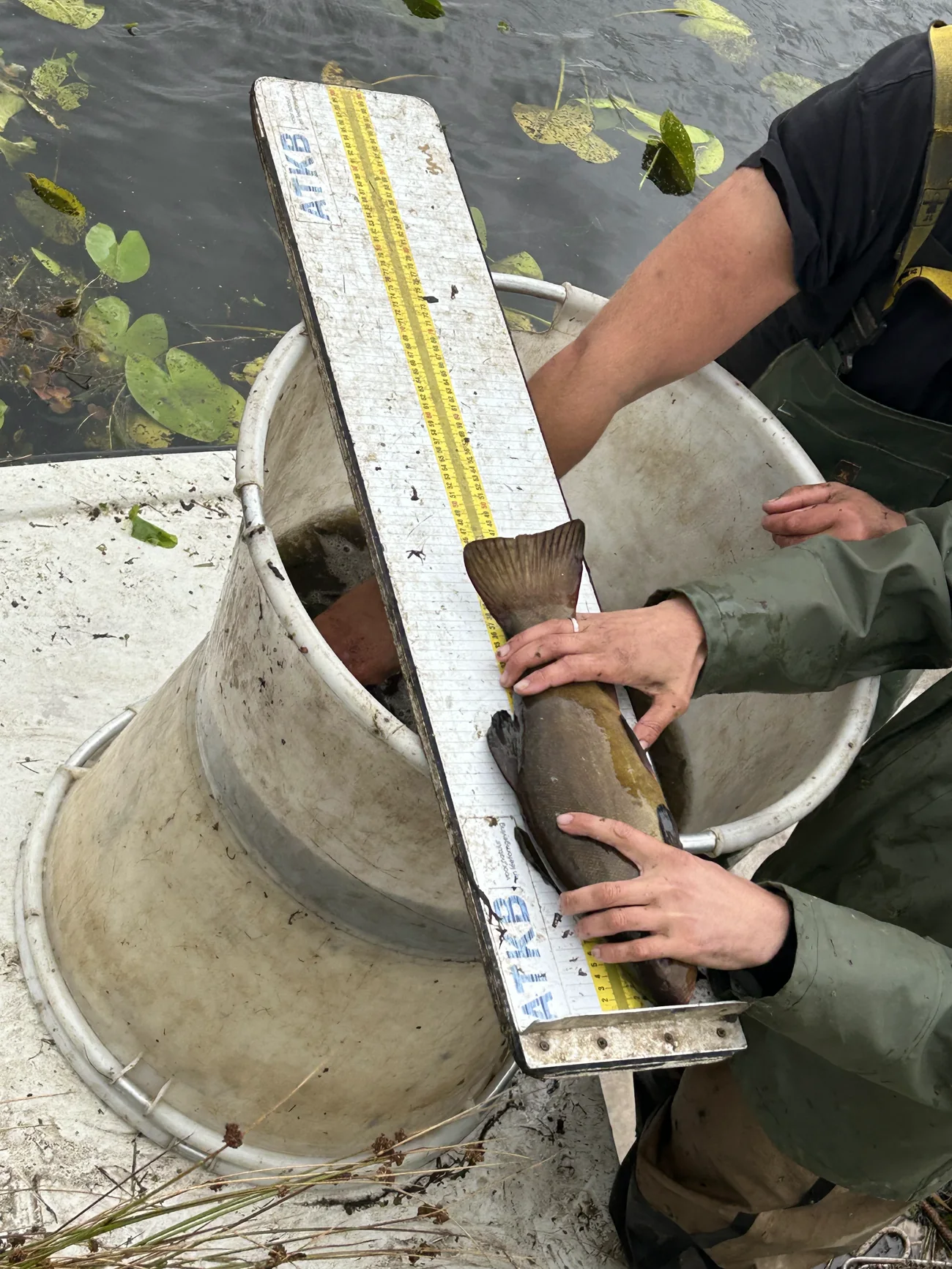
The second method that day was electrofishing, from the boat. It moves slowly along the reed edge; a ring on a pole briefly puts current through the water, fish nearby are stunned for a moment and are scooped up straight away. The reach is small, a couple of metres around the ring at most, so you are really fishing the margin of the water. That shows you different fish than a seine closing off the full width. Which is exactly why the two run back to back in the same place: after the seine haul, the banks of that same stretch were electrofished as well. The seine closes off the width, the electric dip net takes the margin the seine does not reach. So what we watched that day was not a seine measurement, but two gears over one piece of water.
How ATKB compensates for that bias
Koen Simons of ATKB read this piece after publication and sent us the background that belonged underneath it. That some species are easier or harder to catch is well known to ATKB, and it is corrected for. Each gear carries an efficiency factor: figures established in the field and since written into the standard, for the share of the fish present that a gear actually lands. On top of that, the protocol prescribes a minimum area that must be sampled in a given water, and that this area is divided pro rata over the habitats present. On that basis, Koen says, you can assume every species turns up unless it is genuinely scarce.
Those guidelines are set out in the Handboek Hydrobiologie, the Dutch hydrobiology protocol. For the water we were on, that comes down to:
- at least 7.5% of the total length of all watercourses in the water body — length and area amount to the same thing here;
- watercourses up to 8 metres wide: electrofishing only;
- watercourses between 8 and 25 metres: seine and electrofishing;
What that means for us is subtler than we first thought. The gear is in the data that reaches us — “Zegen” (seine), “Elektrisch schepnet” (electric dip net), “Zegen met keernetten” (seine with stop nets) sit in our columns in Dutch, exactly as they arrive. The area fished and the efficiency factor are not. That correction lives in the ATKB report, not in the individual occurrence record we receive through GBIF. So our caution applies to our own data stream, not to their measurement.
Why sampling happens in summer
Fish huddle together in winter and spread out in summer. That is one of the reasons to sample in summer: when fish are dispersed, a sample says more about the whole water. When they clump, you catch either a great deal or almost nothing, depending on whether you happen to be standing in the right place.
The assumption that does not hold
Our size models work with “larger than average for this water”. At the water's edge it became clear why that grates. If a water is full of small fish, that mass drags the average down and at the same time makes the genuinely big fish less remarkable statistically. A water with few but evenly sized fish can then come out looking better.
So what we call “large” depends on the length structure of the whole population, not only on whether large fish are present. Those are not the same thing, and we were treating them as if they were. We are going to revisit that target; what replaces it we do not yet know.
What else is standing in the water
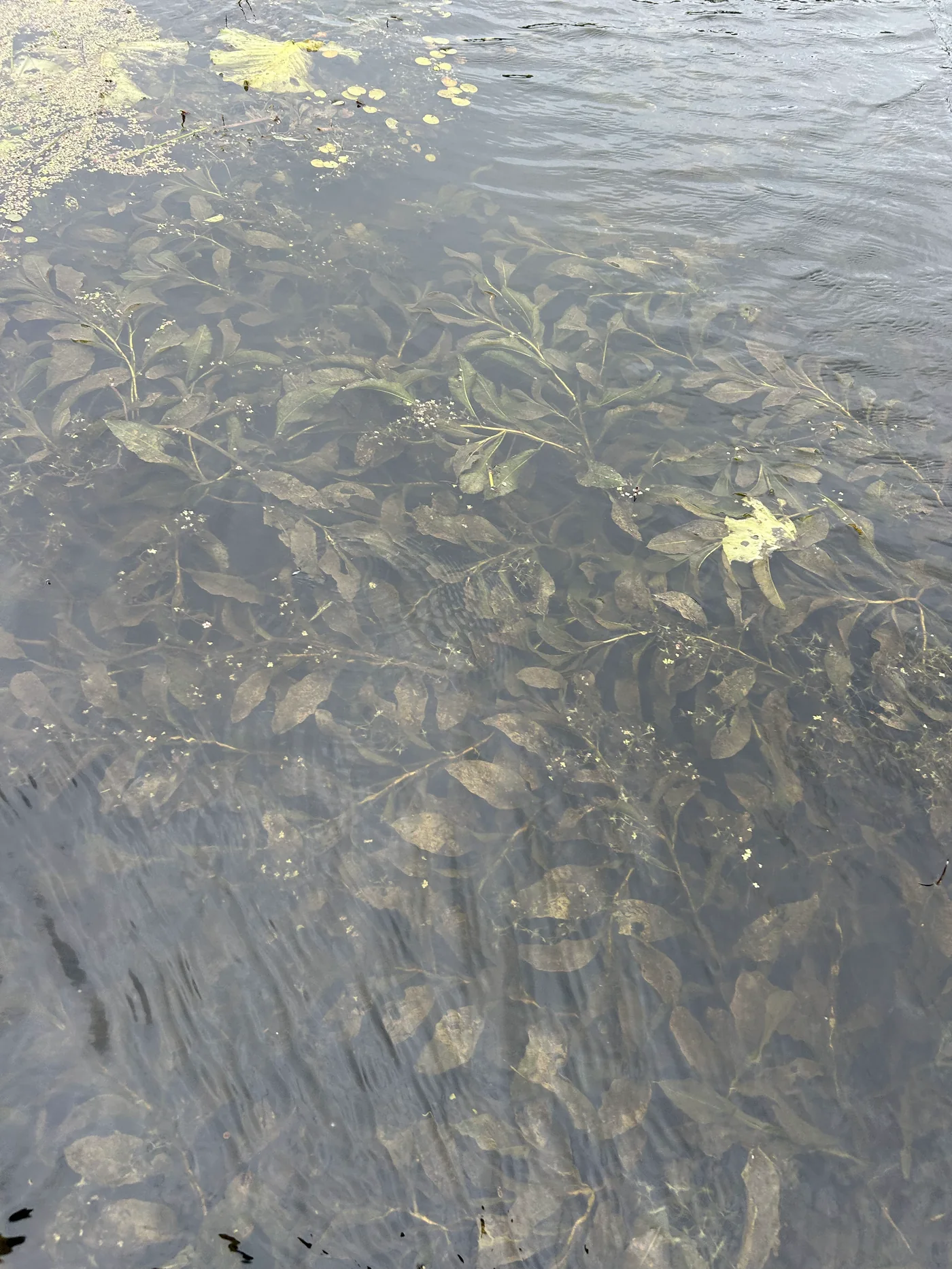
This kind of structure is also what our satellite work is looking for: reed edges, tree lines, submerged water plants. On site you take it in at a glance, where we are trying to derive it from imagery, and that difference is considerable.
What we are going to do with it
We brought one idea back. If you have both survey catches and angler catches for the same place, you can work out per species which gear systematically misses it. Efficiency factors already exist, so that wheel does not need reinventing; what this gives is a second, independent estimate from an entirely different direction, with which we can at least put a number on the gaps in our own copy of the survey data.
The same combination shows something else. Places with many survey records and few angler catches are candidates for under-fished water: there are fish, but almost nobody comes. Both ideas need those two sources side by side, and that is exactly what we are currently asking permission for.
Honest about how this came about: we had prepared a list of questions and forgot to bring it. Everything above simply came up during the work. The section on the protocol was added later, after ATKB had read the published article. So this is not a systematic interview and we do not present it as research, but as what we picked up in a single day. In the first ditch, incidentally, a pike jumped aboard entirely of its own accord.
With thanks to Koen Simons and Matthijs Koole of ATKB for the day and the explanations, and to Wouter Patberg of Wetterskip Fryslân for pointing us their way.
Updated: September 19, 2026