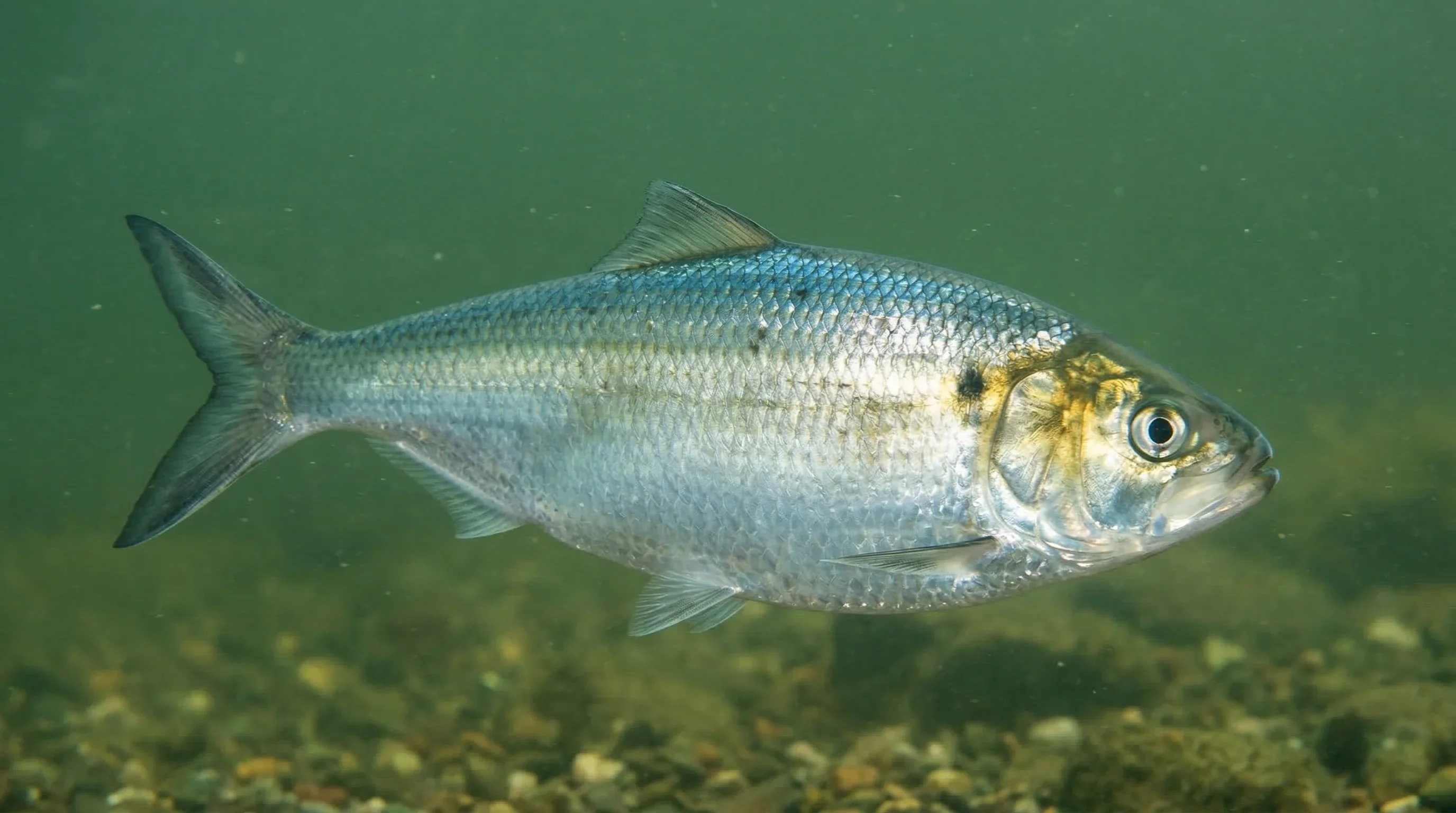
Identification
The bullhead is a small, stocky bottom-dwelling fish of 8 to 15 cm with a remarkably broad, flattened head that makes up nearly a third of the body. The body tapers toward the tail and is scaleless — the skin feels smooth and slimy. The color is brown to grey-brown with dark marbling that provides excellent camouflage on stones and gravel. The pectoral fins are large and fan-shaped, adapted to anchor the fish on the bottom in current. The species has two dorsal fins and a large, round mouth. Not to be confused with gobies, which have visibly scaled bodies.
Behavior & ecology
The bullhead is a territorial bottom fish that lives under stones, among riprap, and in crevices of hard bank protection. During the day it sits motionless in hiding; it only becomes active at dusk. It hunts small invertebrates: amphipods, midge larvae, and water lice. The species is strongly tied to hard substrate — stones, gravel, riprap — and is absent from soft, muddy bottoms. In spring, the male guards a nest cavity under a stone where the female has glued her eggs to the ceiling.
In the Netherlands
The bullhead is protected under the European Habitats Directive (Annex II). In the Netherlands, it occurs in the major rivers (Rhine, Meuse, IJssel), their side channels, and in canals and streams with hard substrate. The species benefits from riprap bank protection along rivers and canals — ironically, this human intervention provides excellent habitat. However, populations are under pressure from water pollution and competition with invasive gobies (round goby, tubenose goby) that occupy the same hiding spots. In the Zwarte Meer near Kampen, a Natura 2000 site designated partly for the bullhead, it has not been found there after 2011. The bullhead has no significance for sport fishing.
What our models found for Bullhead
Below is what our models see in the data. These are links: where one thing occurs, the other occurs more often. That is not a cause. Each model answers one question and may not say more than it measured. The label by the heading tells you which question — and how sure the answer is.
Where this species lives A set, not a ranking Strong model
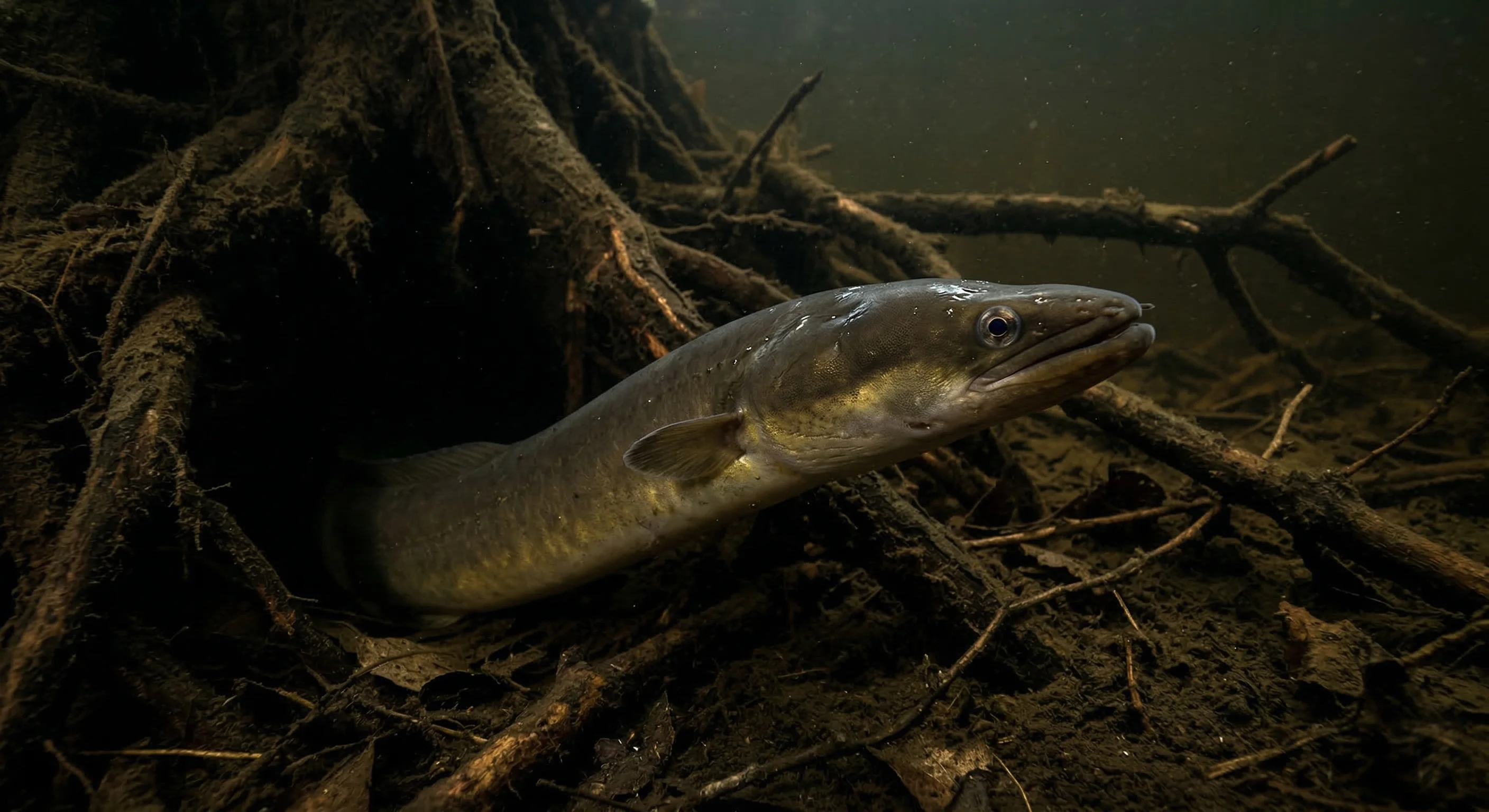 Eel (Anguilla anguilla)
This model is a surprise. Most people know the bullhead as a fish of cold, fast brooks — but this list describes big lowland water: eel, zander, ruffe, smelt, ide, perch, bream and roach.
The invertebrates say the same. The Caspian mud shrimp (Corophiidae) and the zebra mussel (Dreissenidae) are animals of large rivers and lakes. Freshwater shrimps (Gammaridae) are in the list too, and on the bank bittersweet (Solanaceae), a climber of wet margins.
FishBase resolves it. It puts the bullhead in cold, clear and fast-flowing water of small streams to medium-sized rivers, AND on the gravel and rocky shores of cold lakes, AND in slightly brackish water. So both pictures belong to this fish. Our two bullhead columns have each taken one half — see the other bullhead page for the brook side.
One more thing that fits: oxygen is in this model. The bullhead needs cool, oxygen-rich water. Which WAY it points, this model does not say.
Where there are many A set, not a ranking Strong model
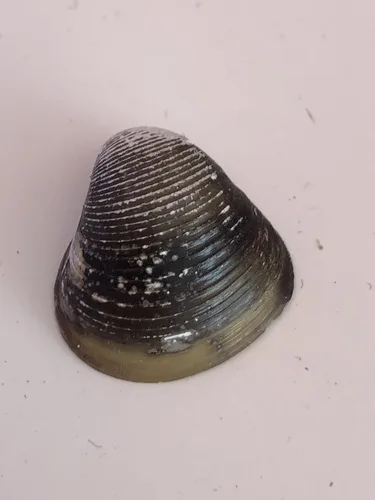 Asian clam (Cyrenidae)
Mayflies of the family Leptophlebiidae and organic matter in the water go with water where we count many bullhead.
The Asian clam (Cyrenidae) goes with water where we count fewer.