Identification
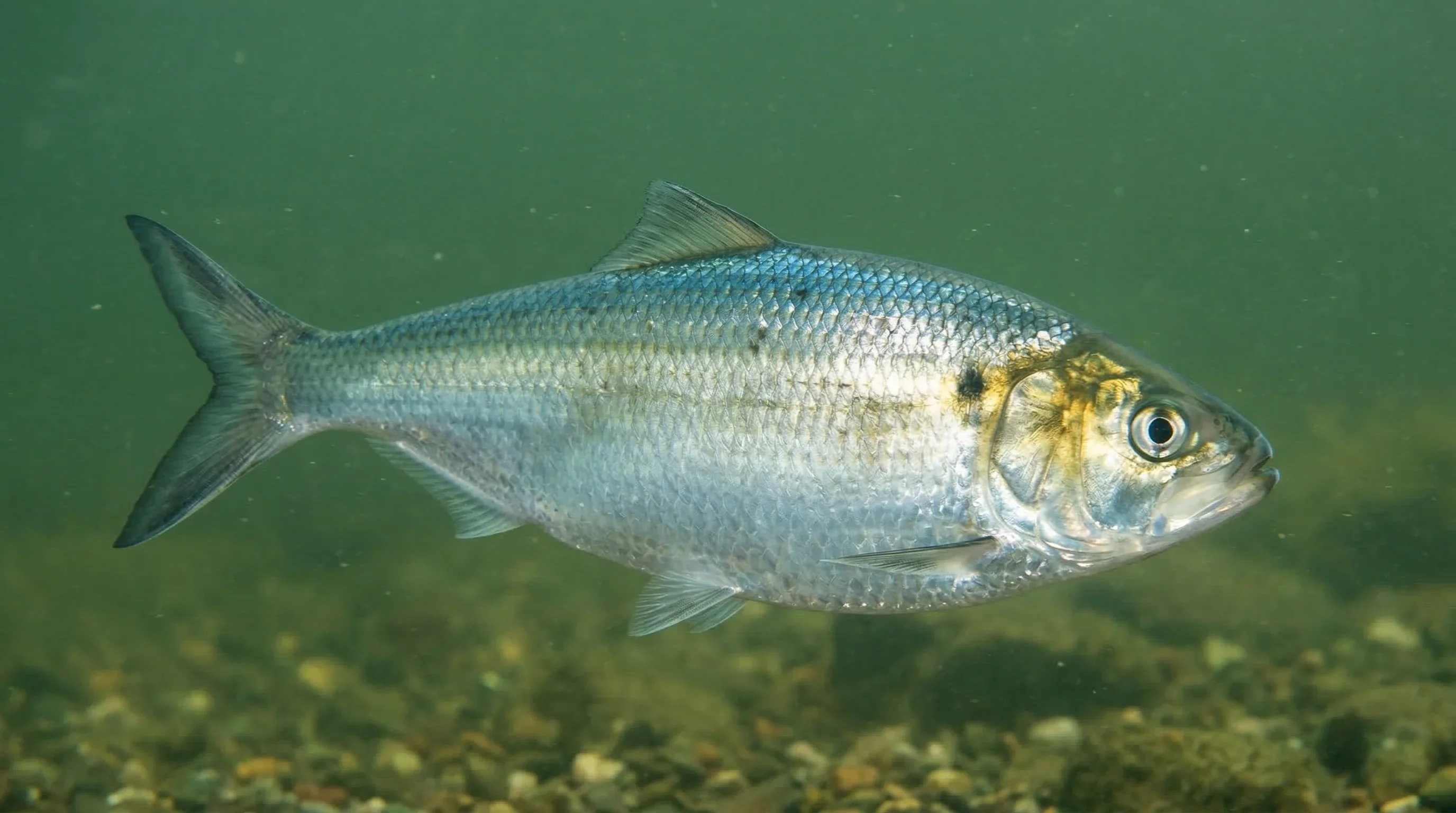
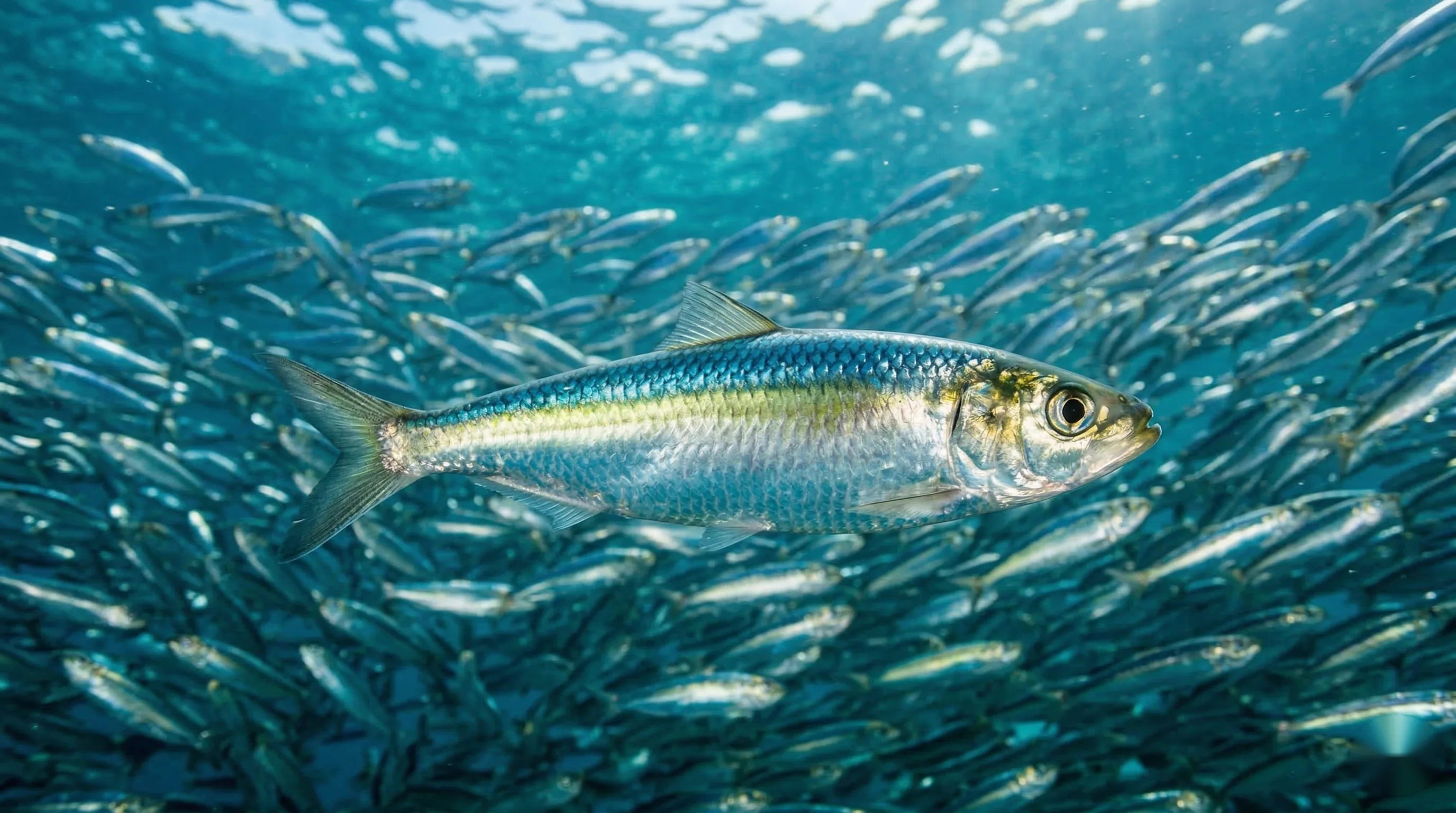
The twaite shad is a herring-like fish of 25 to 40 cm (up to 60 cm maximum) with a silvery, laterally compressed body. The back is blue-green, the flanks silvery with a row of 4 to 8 dark spots behind the gill cover — this spot pattern distinguishes the twaite shad from the Atlantic herring, which has at most one spot. The belly has a sharp keel of keeled scales. The lower jaw clearly projects beyond the upper jaw. The scales are large and detach easily when touched.
Behavior & ecology
The twaite shad is an anadromous migratory fish: it lives in the sea and estuaries but migrates upriver in spring to spawn. Spawning takes place from May to July in fresh or slightly brackish water, preferably on gravel and sand substrates in the tidal zone of rivers. Spawning occurs at night at the water surface with much splashing. The twaite shad feeds on plankton, small shrimp, and fish larvae. Young shad grow up in estuaries and migrate to sea in their first or second year. Adults return annually to the rivers where they were born.
In the Netherlands
The twaite shad is protected under the European Habitats Directive (Annex II and V) and is listed as vulnerable on the Dutch Red List. Historically, the twaite shad was an abundant migratory fish in Dutch rivers — thousands were caught per season in the 19th century. Water pollution, dams, and weirs caused severe population decline. Thanks to cleaner water and fish passages, the twaite shad is slowly returning to the Rhine, Meuse, and their estuaries. The Haringvliet and Western Scheldt are key areas. The twaite shad may not be caught by sport fishers — accidental catches must be released immediately.
What our models found for Twaite shad
Below is what our models see in the data. These are links: where one thing occurs, the other occurs more often. That is not a cause. Each model answers one question and may not say more than it measured. The label by the heading tells you which question — and how sure the answer is.
Where this species lives Strong model
 Anchovy (Engraulis encrasicolus)
This list is almost literally the twaite shad's menu. Pipefish (Syngnathidae) come first, then gobies, rocklings (Lotidae), the sprat, the anchovy and the herring. Further down the flounder, sand gobies, the five-bearded rockling, the brown shrimp (Crangonidae), the cod and the horse mackerel.
FishBase describes the twaite shad as a fish-eater that takes small fishes and crustaceans, with the young taking the fry of herrings, sprats and gobies. Herring, sprat and gobies are all three in this model. So we did not measure its food, but the water its food is in — and here that comes to the same thing.
Note that five animals are in the list twice, once as a species and once as a family: pipefish, anchovy, goby, cod and horse mackerel. It looks like more names than it is. Mean temperature and humidity count too.
Where there are many Weak model
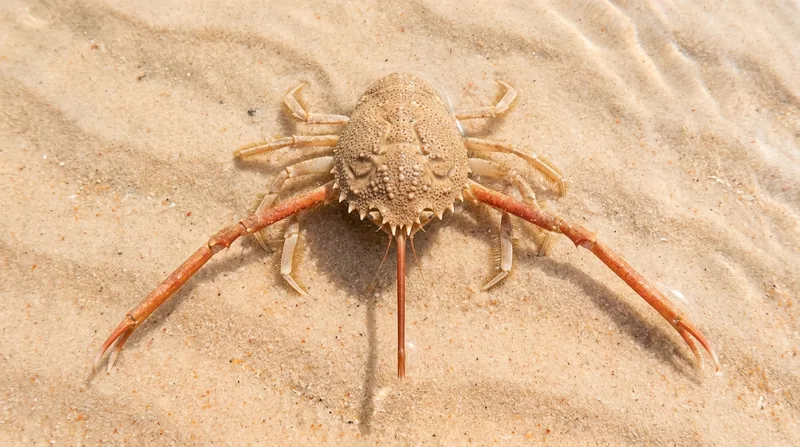 Masked crab (Corystidae)
This model is weak. Plenty of twaite shad goes with swimming crabs (Polybiidae), starfish (Asteriidae), the brown shrimp (Crangonidae) and moon snails (Naticidae). We count fewer with the masked crab (Corystidae), sea urchins (Parechinidae) and brittle stars (Ophiuridae).
One detail is nice: two jellyfish point opposite ways. The moon jelly (Ulmaridae) goes with MORE twaite shad, the lion's mane jellyfish (Cyaneidae) with FEWER. Why, we do not know.