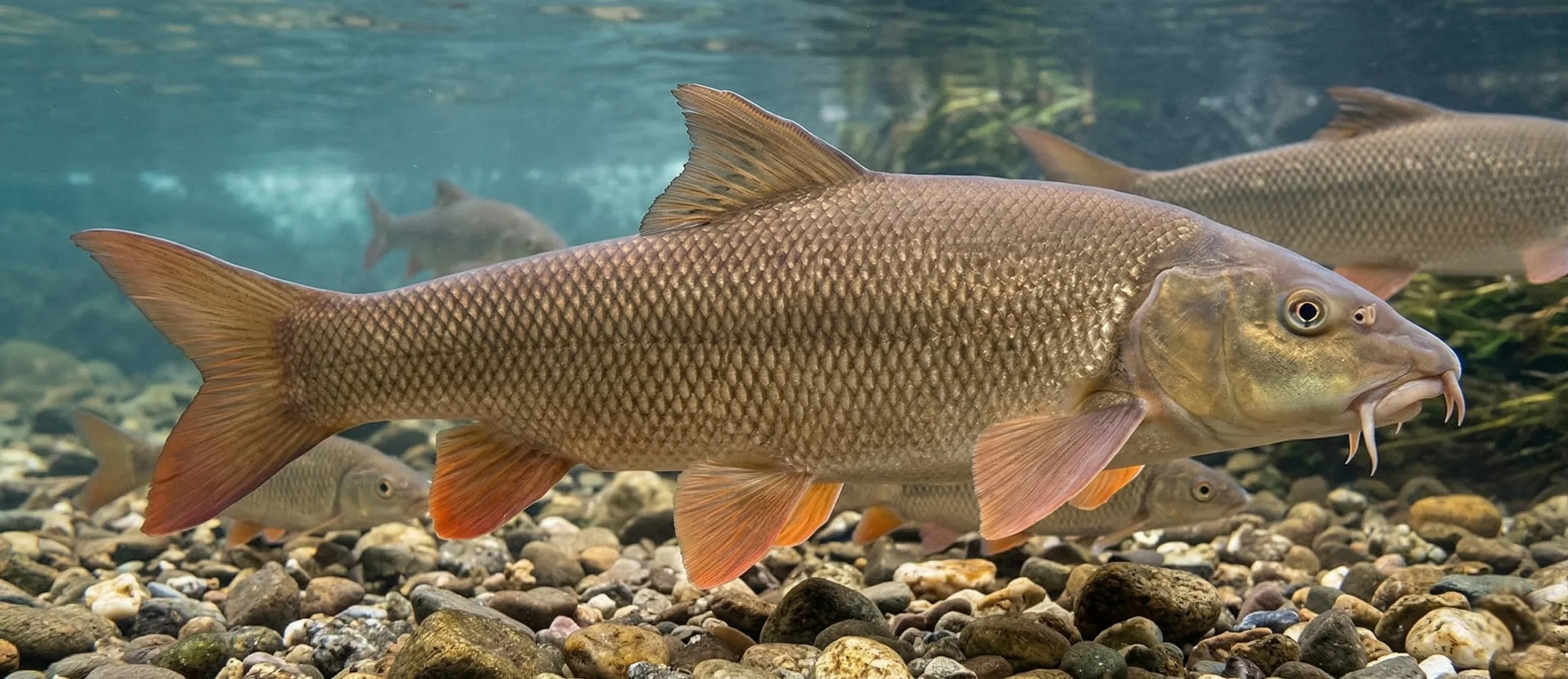
The asp is a fast predatory fish of the carp family. This page is about the fish, not the snake of the same name. In the Netherlands you catch it mainly in the big rivers and the lakes connected to them. You usually fish for it with lures, often just below the surface. This page shows you how to recognise an asp and how to tell it from an ide or a chub. It also covers where and when to catch it, the rules, and how big it can grow.
Identification
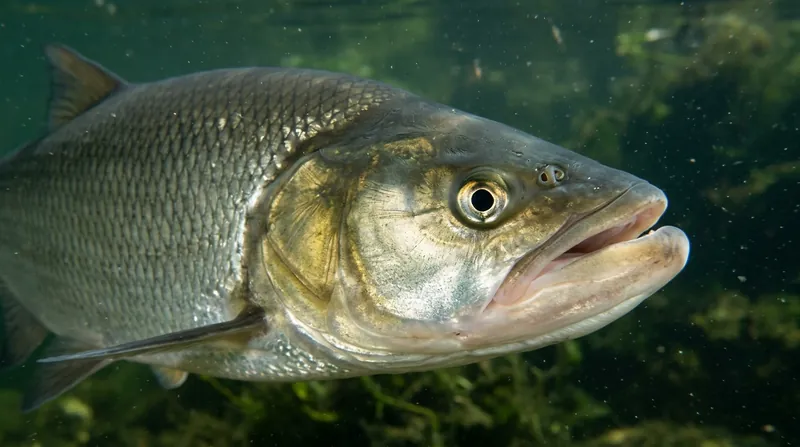 An asp's mouth, close up
The surest way to recognise an asp is its mouth. It is large and slants upwards. It reaches back to below the eye. The tip of the lower jaw fits into a notch in the upper jaw (Sportvisunie). Similar fish of the carp family, such as the ide and the bleak, have a smaller mouth without that notch (RAVON).
The body is long and flattened from side to side, with silver flanks (RAVON). The back is dark grey to green. The fins are large and angular, and the tail fin is deeply forked (risk analysis of exotic fish). The pectoral, pelvic and anal fins are grey to brown (FishBase), but they can also have a reddish sheen (Hessen-Forst). There are 65 to 74 small scales along the lateral line (Sportvisunie). Because it is so fast, Dutch anglers also call the asp the "silver arrow" (Sportvisunie).
What does its Dutch name mean?
In Dutch the asp is called roofblei. Blei is an old Dutch name for a few fish of the carp family, such as the white bream. It was sometimes used for the bleak too, and often for a young bream (Woordenboek der Nederlandsche Taal). A roofvis is a fish that lives on animal food, especially other fish (Woordenboek der Nederlandsche Taal). So a roofblei is a predatory blei. We could not find who coined the name. Scientists long called the fish Aspius aspius. Since a study in 2010 they place it in the same group as the ide, Leuciscus. Now they call it Leuciscus aspius (Perea et al. 2010).
How big do asp get?
Asp grow fast. In the Netherlands an asp is on average 16 centimetres long after one year. After three years it is 40 centimetres, and after five 58 centimetres. From its third year it grows slightly faster here than in the Volga delta (OVB). It can live for more than ten years (IUCN).
In fish surveys, researchers count and measure the fish in a water. That way, researchers have measured more than 3,200 asp. Of the more than 1,500 asp of 20 centimetres or longer, the middle one was 42 centimetres. About 3 in 10 of those were 60 centimetres or longer, and 17 reached 80 centimetres. The longest was 88 centimetres. Researchers measured it in 2021 in the Westerkogge polder southwest of Hoorn. The survey was for the Hollands Noorderkwartier water board. How big the biggest asp ever were is under the records.
Asp, ide or chub?
 A chub, for comparison
You can easily mistake a young asp for a young ide or bleak. The best feature is the bigger mouth, with its typical lower jaw (Natura, 2006). So look at the mouth first. Then look at the scales, and at the anal fin: the fin on the underside, between the pelvic fins and the tail.
- Ide. The mouth is smaller and points straight forward. There are 56 to 61 scales along the lateral line, fewer than on an asp (Sportvisunie). The ide's anal fin is somewhat shorter (risk analysis of exotic fish). Its shape hardly helps: on the ide the edge is straight to concave (RAVON), on the asp concave, like a sickle (Hessen-Forst).
- Chub. The head is broad and fairly flat. The anal fin is rounded, and there are only 44 to 46 scales along the lateral line (Sportvisunie). The dark edges of those large scales give the flanks a net pattern (RAVON).
- Bleak. A small fish, usually about 15 centimetres, with a small mouth that points sharply upwards. On an asp the mouth reaches back to below the eye (RAVON).
- Dace. The small mouth sits just below the tip of the snout, and the eye is yellowish (Sportvisunie).
Asp and ide can interbreed. According to anglers, such hybrids turn up regularly in the Netherlands (risk analysis of exotic fish). A hybrid is harder to identify.
Life and spawning
The asp is one of the few fish of the carp family that live mainly on fish (FishBase). Young asp eat small invertebrates such as opossum shrimps, freshwater shrimps and insect larvae (RAVON). From 20 to 30 centimetres, an asp feeds mainly on small fish that live close to the surface (OVB). Researchers often find bleak, roach and smelt in asp stomachs (risk analysis of exotic fish).
The asp hunts by sight, in open water (risk analysis of exotic fish). Young asp hunt in groups, adults in small groups or alone (FishBase). Young asp are themselves eaten by perch, pike and wels catfish, and by otters and cormorants. A big asp has almost no enemies (risk analysis of exotic fish).
Spawning. The asp spawns early in spring, in March and April. It then swims upstream to flowing water over gravel, or to places with water plants, sometimes covering long distances (RAVON). In the Elbe, one asp swam 166 kilometres from its summer haunt to its spawning ground (Fredrich 2003). A female can lay more than 100,000 eggs. They are sticky and attach to the bottom (risk analysis of exotic fish). The eggs hatch after one to two weeks. The larvae drift downstream to slow-flowing parts of the river, such as side channels, and grow up there (RAVON). In 2009, researchers counted that spring's young fish in the floodplains of the big rivers: the land between the river and the dyke. Young asp turned up in every kind of water connected to the river. They were densest in side channels with flowing water. Along the river banks there were more of them where the water was clearer (Dorenbosch et al. 2011). In the Netherlands, asp breed in the Rhine branches, the Maas and side streams of the Mark, among other places (risk analysis of exotic fish). In canals the current is usually too weak for spawning (RAVON).
The prey eats the eggs. Bleak are the asp's main prey, but bleak in turn eat asp eggs. Once released, the eggs drift for less than a minute before they stick to the stones. In that time bleak snap them up. Czech researchers filmed this underwater. Over the 40 centimetres their cameras covered, a fifth of the eggs were lost on average (Šmejkal et al. 2017). Later they worked out that asp laid 63 percent of their eggs at night. The bleak, in contrast, were at the spawning site mainly by day. The researchers see this as a way to protect the eggs (Šmejkal et al. 2018).
Where to find asp
The asp likes flowing water. You find it mainly in the big rivers, where it hunts small fish in the upper layers of the water (Sportvisunie). At first, catches came mostly from the big rivers. Through open connections and locks it has since reached many canals and river lakes too (Sportvisunie).
On the river, look for it at the groynes, the stone dams that stick out into Dutch rivers. Asp often swim in or next to the current seam at the head of a groyne, where fast water meets slower water. There they hunt small fish that have lost their way in the current (Sportvisunie). At bridge piers, too, look for it in the current seam (Sportvisunie). For predators on the river, Sportvisunie also names side channels, harbours and the mouths of lakes. Prey fish swim in and out there (Sportvisunie).
In river lakes, asp hunt mainly where young fish move over shallow ground. River lakes are the lakes beside a river that are connected to it. They like to patrol the edge of the drop-off and drive the small fish into the shallows. Asp like places where the depth changes suddenly, and cover to wait behind: underwater spits, small jetties, rock dumps, posts and overhanging trees (Sportvisunie).
The entrance of a river lake looks like the best spot. Current, a deep channel, shallows, mussel beds and passing bait fish all meet there. But a lot of people fish there, and that makes the asp extra wary. Quiet bays and dead-end corners at the back of the lake are often at least as good (Sportvisunie).
For a big asp, Sportvisunie points to the river lakes along the Maas (Meuse). There are four big rivers: the Gelderse IJssel, the Rhine, the Waal and the Maas. Of these, the Maas gives asp the best chance to grow big. It has a fairly even flow, clear water, many river lakes and plenty of bait fish. You can catch big asp in the other rivers too. But the chance of a record-sized fish is greatest along the Maas (Sportvisunie).
Where researchers find it. Rijkswaterstaat has the fish in the large waters surveyed regularly. In the Maas and in the Noordwaard in the Biesbosch, the asp is among the ten species caught most often. Along the shores of the IJsselmeer too, but along the Markermeer it is less common (WMR 2024).
The asp can also cope with brackish water. In the Nieuwe Waterweg it normally swims no further than Vlaardingen. But in summer 2014, anglers caught a few big asp there beyond the Maeslantkering storm barrier. Depending on the tide, the water there held 2.0 to 14.5 grams of salt per litre (RAVON).
Places with strong current, such as water inlets and narrows, pay off most just after the lure season opens. You can read more under asp fishing through the year. But you may not always fish near a weir or a pumping station. You can read more under the rules.
Asp fishing through the year
Further down this page is the seasonal patterns chart. For each month, it shows how often a catch reported on mijnvismaat.nl is an asp, compared with the year's average.
Spring. In March and April the asp moves to its spawning grounds in flowing water. You can read more under life and spawning. Anglers have caught big asp in late March. Two of the last three Dutch records fell in the last days of March. You can read more under the records. From 1 April to the end of May, lures are banned on most inland waters. You can read more under the rules.
Early summer. When lures are allowed again, places with strong current pay off best for the first three weeks. Think of water inlets and narrows. From mid-June it can pay to look for calmer water. Think of the groyne fields of the river (the stretches of water between two groynes) and the shallow edges of river lakes (Sportvisunie).
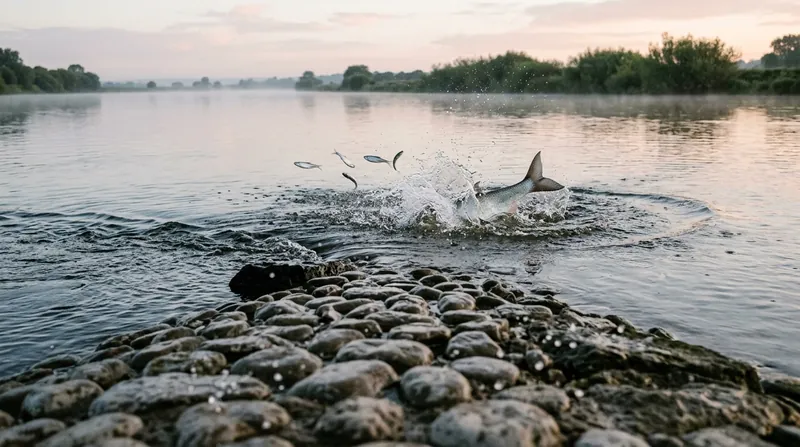 An asp strikes at the head of a groyne
Summer. From late spring into autumn, asp hunt actively for prey fish. Small fish spraying out of the water and loud smacks at the surface give away where they hunt. If you see that, do not stand and watch: get within casting range quickly. Asp often roam in small groups, and a group often hunts in the same place for a few minutes. The biggest fish mostly live more on their own (Sportvisunie).
Late summer and autumn. From August, schools of bait fish often gather along certain banks, for example under overhanging trees. Asp often lie in wait there, even when you cannot see them hunting. The young prey fish grow, and the asp gets more aggressive. So in September and October you can also catch it on lures clearly bigger than the fish it is hunting. Sportvisunie calls September an excellent month for asp in river lakes (Sportvisunie).
Winter. In winter, some asp move to calmer water, such as harbours and old river arms. In a study on the Elbe, about a quarter of the asp followed did so (Fredrich 2003).
Fishing methods and tackle
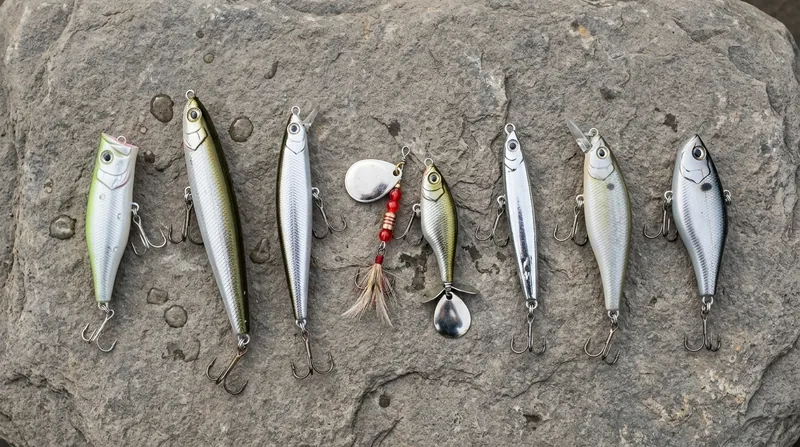 Lures for asp, from popper to casting jig
The rod. A short, light spinning rod is all you need for asp. Sportvisunie suggests 2.10 to 2.30 metres with a casting weight of 5 to 30 grams. On a river lake you rarely need to cast far, and a longer rod mainly strains your wrist and forearm. Pair it with a small reel, size 2500 or 3000, and thin braided line. At the end, tie on a leader: a length of thicker line that protects your main line from stones and other snags (Sportvisunie).
Lures. Start with a lure that works on the surface, even if you see no asp hunting. That often brings the most bites (Sportvisunie). Think of a popper, which pops and splashes. Or a surface plug you work from side to side, known as "walking the dog" (Sportvisunie). Only getting follows or missed takes? Switch to a sinking stickbait and reel it in fast just under the surface. On the river itself, spinners and tail-spinners work well too. Soft plastic shads give relatively many missed bites with asp (Sportvisunie). Shallow-running plugs of up to 12 centimetres also catch asp, and so do rattle plugs reeled in fast and shallow (Sportvisunie). A small casting jig of 7 grams goes up to 40 metres on an ordinary lure rod (Sportvisunie).
Size. An asp can lock on to one kind and one size of bait fish. Without the right lure you get no bite while the fish hunt all around you. So bring lures from 3 to 12 centimetres. On clear river lakes, slim lures often work best (Sportvisunie). In summer an asp also takes lures that look like insects, such as a small beetle struggling on the surface. This works best on warm days (Sportvisunie).
Reel fast. The asp is a very fast fish that hunts by sight (Sportvisunie). So reel in faster than you would for pike or zander, but keep the lure running properly. Vary the speed with a short burst or a sudden stop: an unexpected movement like that can trigger a fierce attack. If a fish hits hard at the surface, do not strike at once but keep reeling steadily. An asp usually hooks itself better than when you strike hard straight away (Sportvisunie).
Approach quietly. An asp bites savagely but can be surprisingly shy, especially in clear water that is fished often. So do not wade straight in. Start casting a good rod's length back from the water's edge, and fish the water close to the bank first (Sportvisunie).
Rules for asp fishing
The asp has no closed season and no minimum size in the Netherlands. The law names it in neither list (Uitvoeringsregeling visserij, articles 5b and 5c). So it has no closed season of its own. But in spring, lures are banned for several weeks on most inland waters. That matters to anyone who fishes for asp with lures. And on a few waters you may not fish at all in April and May. You can read about this below, under April and May.
On most inland waters you need the VISpas, the Dutch national fishing permit. Together with the list of waters it covers, it is your permit. Its conditions add their own rules to the law (VISpas conditions).
May you fish for asp in April and May?
Yes, on most waters, but not with lures. From 1 April to the last Saturday of May, lures are banned on most inland waters. So are a dead fish, a piece of fish and slaughter products such as meat. The only lures allowed are artificial flies smaller than 2.5 centimetres. Worms and maggots are fine (Gezamenlijke Lijst). The ban does not apply in part of Zeeland, for example on the Veerse Meer and the Grevelingenmeer. And lures are allowed on the river Geul and its side streams (Reglement voor de binnenvisserij, article 6).
On a few waters you may not fish with a rod at all from 1 April to 31 May. There are nine of these areas. Examples are De Deelen in Friesland, the Ilperveld, a large part of Waterland and part of the Nieuwkoopse plassen (Uitvoeringsregeling visserij, article 25 and annex 7). The list of waters also closes some waters in spring, such as the Purmerlander Polder near Purmerend (Gezamenlijke Lijst). So always check the water in the VISplanner.
Note: in the law itself, the ban runs to 31 May (Reglement voor de binnenvisserij, article 6). The exception from the last Saturday of May names only pike, zander and perch, not the asp (Uitvoeringsregeling visserij, article 61). Sportvisunie, the Dutch angling federation, writes that from that Saturday you may fish with every kind of bait again (Sportvisunie). Its asp tips for the new season also start on that day (Sportvisunie). To be safe, wait until 1 June before you fish for asp with lures.
With the VISpas, one more rule applies from 1 April to the last Saturday of May. You may not fish in a way that is likely to catch zander. Examples are working a drop-shot rig or a jig head with worms (VISpas conditions, condition 7).
On the IJsselmeer, the Markermeer, the IJmeer and the Oostvaardersdiepen, the VISpas ban lasts longer. There it runs from 16 March to 30 June (Gezamenlijke Lijst).
May you take asp home?
On most waters, yes. Asp is not one of the fish that the VISpas says must always go back, as carp and eel must. But under the VISpas you may keep a fish for only three reasons. You eat it yourself, you use it as bait, or you keep it alive for a while. You may never sell it. The VISpas conditions add that releasing a fish is the starting point. With the VISpas you may have at most 15 fish with you, all species together. At most 5 of them may be longer than 25 centimetres. Want to keep more fish alive for a while, for example in a keepnet? That is only allowed under the VISpas rules for it. Kill a fish you want to eat straight after catching it, with a firm tap on the head (VISpas conditions, conditions 14 to 18).
On some waters you may not take any fish at all. An example is the Grensmaas between the mouth of the Geul and Stevensweert. The list of waters says so for each water (Gezamenlijke Lijst), and so does the VISplanner. Whether asp is good to eat is under In the Netherlands.
Where may you not fish?
On a few rivers the law bans fishing near a weir while it is working. They are the Neder-Rijn, the Maas (Meuse), the Lek and the Overijsselse Vecht. You may not fish within 75 metres downstream of the weir. Nor in a fish pass at the weir: a channel that lets fish swim past it. And not within 25 metres of the fish pass's upper opening (Uitvoeringsregeling visserij, article 28c). On a number of other waters you may not fish close to a pumping station, weir or lock. How far you must keep away differs per water: from 10 to as much as 250 metres. The list of waters says so for each water (Gezamenlijke Lijst).
Fishing from a belly boat? That is not allowed where it could get in the way of commercial shipping. It is never allowed in the fairway of main shipping routes such as the Waal. On the Lek and the IJssel, Sportvisunie advises you to stay out of the fairway (VISpas conditions, condition 12).
Is the asp protected?
No. In the Netherlands the asp is an introduced species, and it is not protected here (RAVON). The EU Habitats Directive lists it, in Annex II and Annex V (Habitats Directive). Some websites say Annex IV, but that is wrong. Annex II is about protected sites. A country names such sites for species that belong there naturally (Habitats Directive, Article 4). No Natura 2000 site in the Netherlands has the asp as a target species. It is not on the Dutch list of Habitats Directive species (Natura 2000). Annex V lists species whose catch may be subject to rules. For such a species, you need a permit in the Netherlands to catch it with methods that do not select what they catch. Think of poison or explosives (Besluit activiteiten leefomgeving, article 11.48). You may fish for asp with a rod as normal, under the rules on this page.
Unhooking and releasing asp
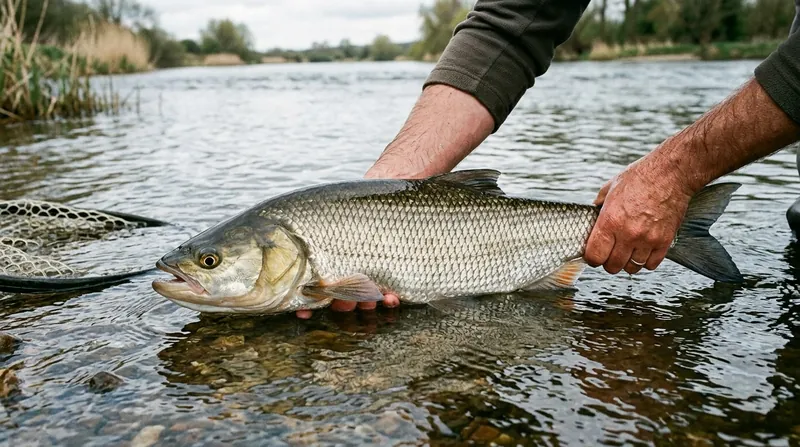 How to hold a big asp: by the tail root, with one hand under the belly
An asp hunts fiercely and fights hard. That calls for control when you land and unhook it. Sportvisunie gives these tips (Sportvisunie):
- Use a roomy, shallow landing net with rubber mesh.
- Unhook the fish in the water if you can.
- Hold a small asp behind the head.
- Hold a big asp by the tail root: the narrow part just in front of the tail. Support the belly with your other hand.
- Never hold an asp by the gills. They are fragile and easily damaged.
- Keep the photo quick. When you release the fish, wait until it swims off by itself.
For every predator, also: never lay it on hard, dry ground. Unhook it in the water, in the net or on a wet unhooking mat. And keep long-nosed pliers and strong cutters within reach (Sportvisunie).
The biggest asp ever caught
The Dutch asp record is 87 centimetres. Oscar Wissink caught it on the IJssel in September 2018. The world record is an asp of 5.80 kilograms, caught by Luca Ronchi in Italy in 2023. The longest asp we found on a national list is 107 centimetres: an Austrian fish from 1987.
42 cm A typical asp: the middle one of more than 1,500 asp of 20 cm or more measured in fish surveys
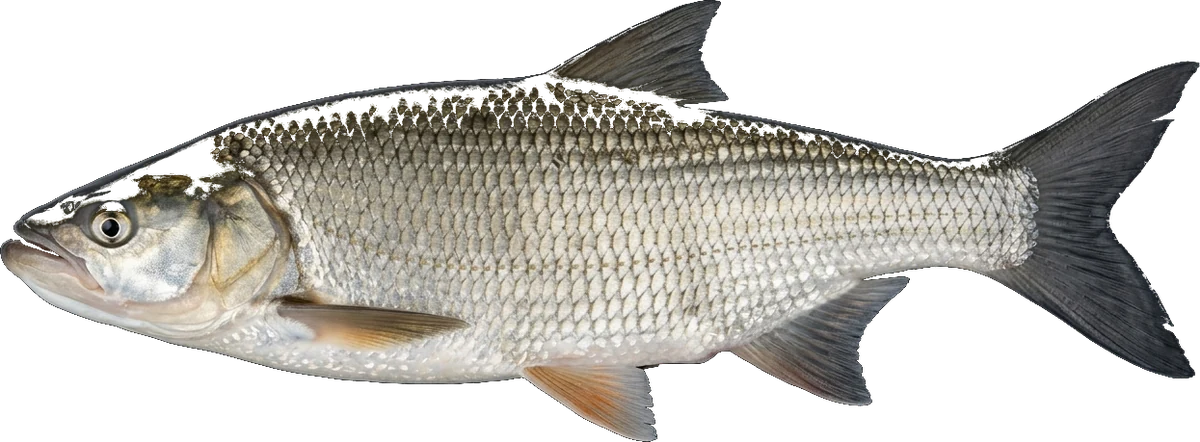
87 cm Dutch record (2018)
88 cm The longest of more than 3,200 asp measured in fish surveys
107 cm The longest we found on a national list (Austria, 1987)
Dutch record
87 cm
Oscar Wissink caught this asp on Sunday 16 September 2018 on the IJssel (Dutch record list; Sportvisserij Nederland). He was fishing for zander from a boat, with a home-made shad on a jig head. After five to ten minutes of fighting, an asp of 87.7 centimetres lay on the measuring board. Then it went back into the water (Beet). The list goes by length only. It rounds down to whole centimetres (Sportvisunie), so it shows the fish at 87 cm.
The record before it was not even half a year old. Han van den Eertwegh caught an asp of 85 centimetres on 30 March 2018. That was just before the predator season closed for the spring (Sportvisserij Nederland; Beet). Before that, Rinus Schutte held the record: 84 centimetres. He caught it on 31 March 2005 with a silver spoon between the groynes (Beet). So anglers caught two of the last three records in the last days of March. That is just before lures are banned for the spring.
In 2021 a fish survey measured an asp of 88 centimetres. That is one centimetre more than the 87 centimetres on the record list. See how big asp grow. But the record list only takes fish caught on a rod (Sportvisunie). You may read about a Dutch asp of 90 centimetres from 2025, caught on bread. It is not on the record list, and we do not know whether anyone submitted it.
World record
5.80 kg
The IGFA, the international body for angling records, keeps the world record. Luca Ronchi caught the asp of 5.80 kilograms (12 lb 13 oz) in Italy on 4 February 2023. IGFA gives only its weight. Under the same date and weight, IGFA also lists a fly-fishing record. IGFA's length record is 69 centimetres, caught in 2021 in the Ticino, a river in Italy. IGFA measures to the fork of the tail, so without the tips of the tail fin (IGFA rules). Its junior length record, 43 centimetres, came from the Volkerak in the Netherlands in 2024.
National lists hold much heavier asp than the world record. The heaviest we found on a national list is the German record: 10.3 kilograms, caught by M. Petrasch in 1974 in the Spree at Köpenick, Berlin (Fisch & Fang). These fish are not on IGFA's list. A fish only goes on it if someone submits it and IGFA approves it. IGFA's previous world record, 5.66 kilograms from Sweden (1993), is still often quoted, but IGFA has replaced it.
Longest on a national list
107 cm
The longest asp we found on a national list is 107 centimetres long and weighs 8.20 kilograms. M. Heide caught it in 1987 in the Danube-Oder Canal in Vienna. It is on the Austrian list kept by Heinz Machacek and Christoph Wimmer (Rekordfische Österreich). The list ranks fish by weight, so this one shares third place. Number one is shorter and heavier: 90 centimetres and 8.76 kilograms, caught in 2007 in the New Danube. The list does not say how it measures length.
Heinz Machacek also keeps his own list of world records. On it, the longest asp caught on a rod is also 107 centimetres, with no angler or water named. The biggest rod-caught asp with a published photo weighed 12.76 kilograms and measured 104 centimetres. It came from the Western Dvina in Belarus, in 2016 (fishing-worldrecords.com).
The top of this page shows 120 centimetres and 9 kilograms as the greatest length and weight. Those figures come from FishBase, a large database of fish. FishBase takes them from two field guides. The 120 centimetres comes from a book from 1999, the 9 kilograms from a book from 1968 (FishBase). We found no rod-caught asp of 120 centimetres on any list. The 9 kilograms has been beaten: the German record weighed 10.3 kilograms. English Wikipedia gives the same 120 centimetres and 9 kilograms, citing FishBase.
A Czech fishing guide mentions an asp from 1916 of 14.2 kilograms and 108 centimetres. The guide says the catch is “described in the literature”, but gives no source and does not say how it was caught (Rybářský rozcestník).
Records by country
Every country keeps its own list, with its own rules. Some lists count length, others weight, so the numbers cannot always be compared.
| Country | Record | Angler | Where caught | Date | List |
|---|---|---|---|---|---|
| Netherlands | 87 cm | Oscar Wissink | — | Sep 16, 2018 | Sportvisunie |
| Austria | 8.76 kg · 90 cm | Nebojsa Zdravkovic | New Danube (Vienna) | 2007 | Rekordfische Österreich |
| Germany | 10.30 kg | M. Petrasch | the Spree at Köpenick (Berlin) | 1974 | Fisch & Fang |
| Hungary | 8.11 kg | Kővári János | the Tisza at Tiszalök | Oct 10, 2006 | MOHOSZ |
| Latvia | 8.12 kg | G. Kolosovs | Daugava | 2006 | LMSF |
| Norway | 5.34 kg | Eivind Thilesen | Øyeren | Aug 31, 2008 | Villmarksliv |
| Poland | 8.49 kg | Sylwester Głos | — | 2014 | Wiadomości Wędkarskie |
| Poland | 90 cm | Rafał Wikluk | — | 2013 | Wiadomości Wędkarskie |
| Sweden | 8.03 kg · 90 cm | Anna Tainio | Lake Mälaren (Stockholm) | Aug 15, 2013 | Sportfiskarna |
| Switzerland | 5.80 kg · 87 cm | Guy Bussinger | Rhine | Dec 15, 2014 | Petri-Heil |
A dash means the list does not give it. Checked on October 18, 2026. A record can be broken at any time, so we check these lists at least once a year.
In the Netherlands
Is the asp an introduced species?
Yes. The asp originally comes from the Danube basin and Eastern Europe (Sportvisunie). The first asp in the Netherlands turned up in 1984, in the Roer in Limburg. These were fish that people had stocked in Germany (RAVON). They had escaped from German fish ponds during a flood (risk analysis of exotic fish). Asp were also stocked in the German Rhine in the late 1970s, and they bred there in the 1990s. From the German Rhine they spread quickly through the Dutch Rhine branches. Whether the Main–Danube Canal, opened in 1992, also helped is uncertain (risk analysis of exotic fish).
Not everyone sees the asp as a newcomer to the Rhine. A German report from 2003 calls it native there. It relies on old descriptions of the fish in the Rhine and the Main, the oldest from 1787 (Schwevers & Adam). The IUCN is an international organisation for nature conservation. Its European Red List, too, places the Netherlands among the countries where the asp is native (IUCN). We found no record from the Netherlands before 1984.
Between 1995 and 2004 the number of sightings rose fast, also in canals and smaller rivers. By 2014 asp lived in many kinds of water, including polder ditches and waters with no link to a river. Polder water inlets and (illegal) stocking probably helped (risk analysis of exotic fish). According to the Dutch Species Register, the asp has bred here on its own for more than ten years, and it is very common. The register records it in all twelve provinces (Nederlands Soortenregister). The longest asp from the fish surveys did not come from a river either, but from a polder near Hoorn. See how big asp get.
Is the asp harmful?
The sources disagree. The Dutch Species Register classes the asp as invasive (Nederlands Soortenregister). That means an introduced species that can multiply fast and harm the species that belong here (NVWA). The register adds that this is an expert's judgement, not an official status (Nederlands Soortenregister). RAVON, a Dutch research organisation for reptiles, amphibians and fish, found no sign that it harms native fish (RAVON). A risk analysis from 2014 rated it a moderate risk and advised keeping an eye on it (risk analysis of exotic fish). According to Wageningen Marine Research, numbers of zander, asp and wels catfish have risen in recent years. That may affect migratory fish, which are already few. This is especially so where the predators gather at weirs and other places that migratory fish find hard to pass (WMR 2024).
More asp, or fewer?
According to the Fish Atlas of the Netherlands (2022), introduced species have increased the most. The asp is one of them (RAVON and Sportvisserij Nederland). Yet along the banks of the Rhine, researchers have hardly caught it since 2011 (WMR 2021). On the Waal, in autumn 2023, researchers caught more than 13,000 fish with a large fixed net in the current. Among them were 90 asp. Of the fish that like current, the researchers caught only the nase more often (Sportvisunie).
Status. The asp is not on the Dutch Red List of fish (Staatscourant). On the IUCN's European Red List it is Least Concern (IUCN). You can read whether it is protected under the rules.
Can you eat asp?
You can. In Europe people catch the asp both for sport and for food (IUCN). It is nutritious, but not a popular table fish. In 2014, researchers expected no market for asp as food in the Netherlands (risk analysis of exotic fish). The Dutch Nutrition Centre advises against regularly eating freshwater fish you caught yourself in Dutch waters, such as eel, perch and trout (Voedingscentrum). According to the Dutch government, you would take in too much PFAS (Rijksoverheid). PFAS are man-made chemicals that can harm people and the environment (Rijksoverheid). The asp is not named there, but the advice covers self-caught freshwater fish in general. What you may take home under the VISpas is under the rules.
What our models found for Asp
Below is what our models see in the data. These are links: where one thing occurs, the other occurs more often. That is not a cause. Each model answers one question and may not say more than it measured. The label by the heading tells you which question — and how sure the answer is.
Where this species lives Strong model
 Ide (Leuciscus idus)
Top of the list is the ide: almost a quarter of this model. On the ide page the asp sits in that same place. The two fish point at each other.
Then come ruffe, zander, gobies and bleak. That last name is interesting, because the asp is one of the rare cyprinids which is piscivore, and FishBase names the bleak as its main prey. So the model puts that prey among the features that mark asp water most clearly.
That is not proof the asp eats the bleak here. Both are fish of open river water, and this model only counts who occurs where, together.
Further down sit the two gobies that mark asp water most clearly: the tubenose goby and the round goby. Both newcomers that arrived along the rivers. American crayfish (Cambaridae), carp and organic matter on the bottom belong to the list too.
Where there are many Weak model
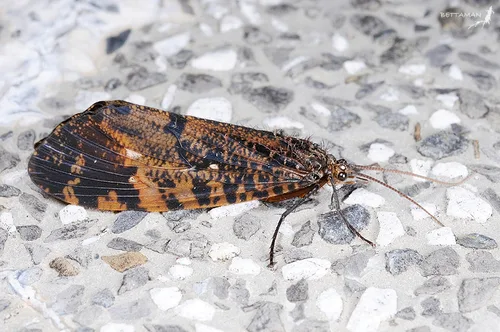 Caddisflies (Phryganeidae)
More asp goes with caddisflies from the families Ecnomidae and Phryganeidae. Moth flies (Psychodidae), leeches from the family Erpobdellidae and single-celled algae from the family Chrysochromulinaceae belong to the list too.
Fewer asp goes with water beetles from the family Hydrochidae and water fleas from the family Sididae. Cranefly relatives (Limoniidae) and leaf beetles (Chrysomelidae) sit there too. This model is weak, so read it as a hint.