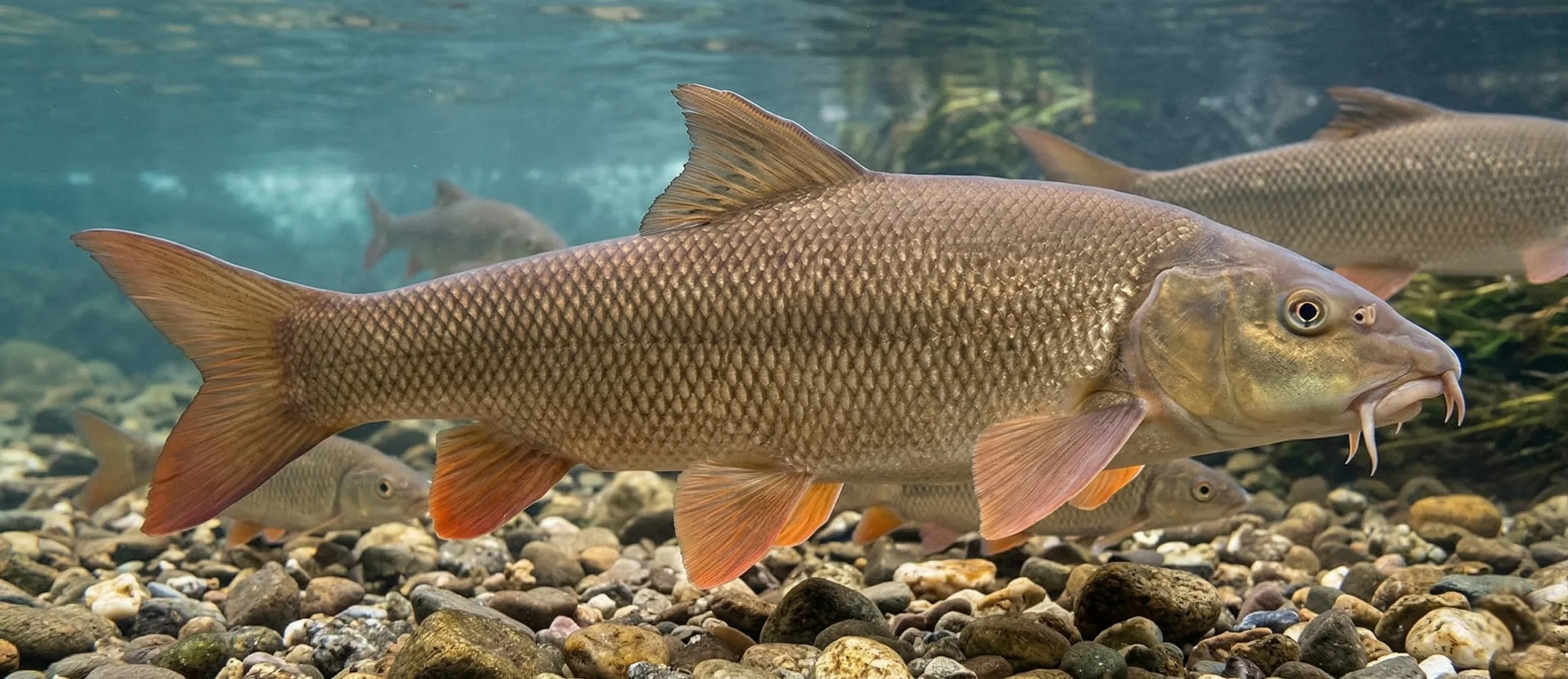
The ide is a sturdy, silver member of the carp family. It is at home in the big rivers and the waters connected to them. You fish for ide with a float, a feeder, bread on the surface or a fly rod. This page shows how to recognise an ide and how to tell it from roach and chub. It also covers where and when to catch one in the Netherlands, and how far ide travel. Then come the rules, and how big ide grow.
Identification
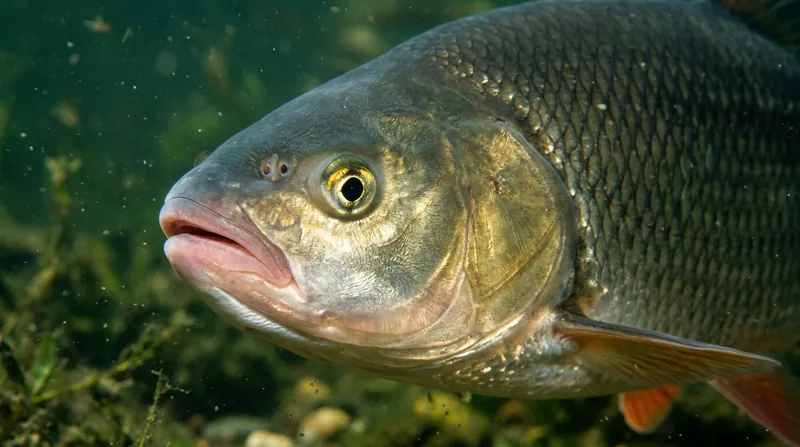 The head of an ide, close up
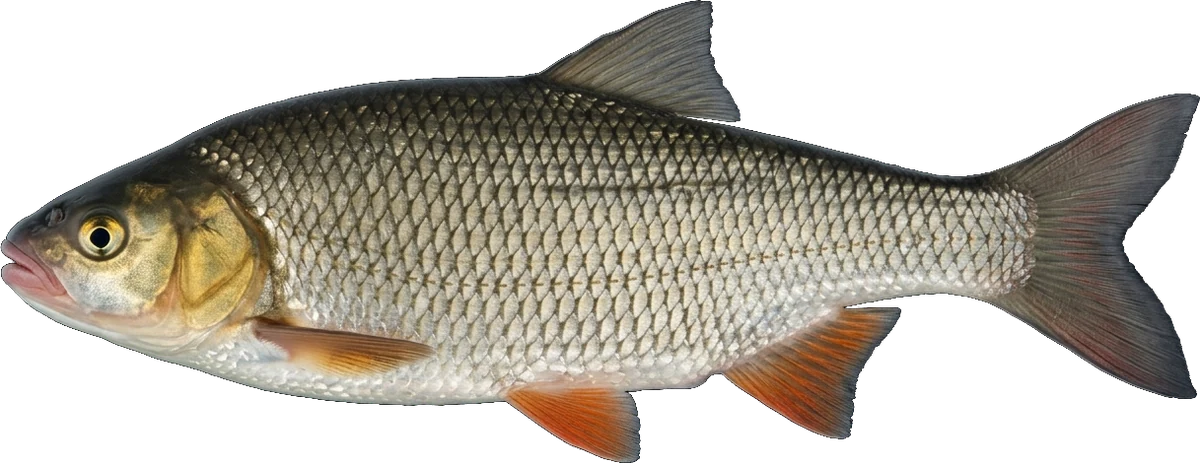
You can tell an ide by its small head with a blunt snout. The mouth sits at the front of the head and points slightly upwards (Kennisdocument winde). It is smaller than an asp's mouth, and the upper jaw has no notch (RAVON). The body is flattened from side to side, with a high back and silver flanks (Kennisdocument winde; RAVON). The scales are small. Along the lateral line, the line along the middle of the flank, there are 55 to 61 of them (RAVON).
Young ide are silvery, older ide bronze (Sportvisunie). Older fish often turn a dark grey-brown to green-brown (RAVON). The pectoral fins, the pelvic fins and the anal fin are red. The dorsal fin is grey. The eye is small and yellow (Kennisdocument winde).
Look at the anal fin too: the fin on the underside, between the pelvic fins and the tail. Its edge is straight or curves inwards, but never bulges outwards (RAVON; Kennisdocument winde). And the dorsal fin starts behind the start of the pelvic fins (RAVON). How to tell an ide from the fish that look like it is under ide, roach or chub.
In the spawning season, when the fish reproduce, the colours are brighter, above all in the males. The flanks then turn copper-yellow. The males also grow small white bumps on the head, gill covers, back, flanks and pectoral fins. They feel like sandpaper (Kennisdocument winde).
What is it called in Dutch?
Winde. Nobody knows for sure where the name comes from. A source from 1897 linked it to the wind. It said fishermen also called the ide noordewind, 'north wind', because they caught it only in cold, dry weather. According to the dictionary, someone may also have made up that story later, because the name sounds like 'wind'. The name may also come from the verb winden, to wind or twist. That would suit the fish's long body (Woordenboek der Nederlandsche Taal). The word is old. The big dictionary of the Dutch language, the Woordenboek der Nederlandsche Taal, gives examples of the word. The earliest comes from a book of 1582. It lists 'winden' among the whitefish (Woordenboek der Nederlandsche Taal).
North of the big rivers, people often call the ide meun (Kennisdocument winde). In English it is also called orfe, and in German Aland, Nerfling or Orfe (FishBase).
How big do ide grow?
According to RAVON, an ide can grow to 70 centimetres, but it usually stays under 60 centimetres (RAVON). In 2006 Sportvisserij Nederland wrote a knowledge document on the ide: a summary of what is known about this fish. That document and Sportvisunie give about 80 centimetres as the greatest length (Kennisdocument winde; Sportvisunie). In its first three years it grows fast: 7 to 8.5 centimetres a year. After that it slows down, and from its tenth year it grows only 1 to 2 centimetres a year. After six years an ide can be 30 centimetres long (Kennisdocument winde).
Ide can also live a long time. The Dutch knowledge document on the ide, from 2006, gives 15 to 20 years as the greatest age. Yet it also reports a Finnish ide of 28 years (Kennisdocument winde). Estonian researchers counted the year rings in the ear stones of ide from the Baltic Sea. Two of those fish were 29 years old. In the past, people counted the rings on the scales. That often puts the age of old fish too low (Rohtla et al. 2015).
In fish surveys, researchers count and measure the fish in a water. Dutch surveys have measured more than 7,900 ide this way. Of the more than 2,200 ide of 20 centimetres or longer, the middle one was 29 centimetres. About 1 in 4 of them was 40 centimetres or longer, and about 1 in 16 reached 50 centimetres. Five were longer than the Dutch record. Whether they were pure ide, we do not know. You can read more under the records.
Ide, roach or chub?
 A roach, for comparison
Young ide above all are easy to confuse with other members of the carp family (RAVON). Roach, rudd and chub have clearly bigger scales (Kennisdocument winde). So look at the scales first, then at the mouth and the anal fin.
- Roach. There are 39 to 48 scales along the lateral line, against 55 to 61 in the ide (RAVON). The dorsal fin starts right above the start of the pelvic fins. In the ide it starts behind them (RAVON). An adult roach usually has an orange-red eye (RAVON; FishBase). In a young roach the eye is still yellow (FishBase), just as in the ide. With small fish, the eye does not help you.
- Chub. The edge of the anal fin bulges outwards. In the ide it is straight or curves inwards (RAVON). The chub has a broad, flat head (Kennisdocument winde). It also has big scales with a dark edge, which give the flanks a net pattern (RAVON). There are only 44 to 46 along the lateral line (Sportvisunie). In Dutch the name meun adds to the confusion: people use it for both fish (Kennisdocument winde).
- Rudd. The mouth points upwards and the fins are bright red (RAVON). There are 40 to 45 scales along the lateral line (Sportvisunie).
- Dace. The small mouth sits just below the tip of the snout. The dace also has a yellowish eye and an anal fin that curves inwards. But it has 48 to 51 scales along the lateral line (Sportvisunie). It grows to only about 30 centimetres (RAVON). In the Netherlands every dace must go back, all year round (Uitvoeringsregeling visserij, article 5c).
- Nase. You can tell it by its fleshy nose and the mouth under the head (RAVON). Every nase must go back too, all year round (Uitvoeringsregeling visserij, article 5c).
- Asp. A much bigger mouth, reaching back to below the eye (RAVON). The tip of the lower jaw fits into a notch in the upper jaw (RAVON). More on this difference under asp, ide or chub.
Hybrids. Ide and asp can breed with each other (risk analysis of exotic fish). In 2023 Sportvisserij Nederland wrote that this is probably the most common hybrid in the big Dutch waters. At first, reports came mainly from the Maas (Meuse), the Waal and the Gelderse IJssel. More and more often, anglers and researchers also find it in canals. They find it in small rivers too, such as the Kromme Rijn and the Linge. It even turns up in the Frisian boezem, the network of canals and lakes in Friesland (Sportvisserij Nederland). Think you have caught a hybrid? Count the scales along the lateral line. In a hybrid the number usually lies between those of the ide and the asp, which has 65 to 74 (Sportvisserij Nederland). Caught an ide of over 60 centimetres? Then read under the records what the record committee says about that.
Life and spawning
The ide eats almost anything it comes across (Kennisdocument winde). Young ide first eat plankton: tiny animals that drift in the water. Then they eat insect larvae, and from about 8 centimetres also bigger larvae and small snails (Kennisdocument winde). According to RAVON, the ide eats mainly animal food, such as insect larvae, snails, mussels and small fish (RAVON). It cracks snails with the teeth in its throat. It also takes small animals that the wind has blown onto the water, such as flies, spiders, wasps, ants and beetles (Kennisdocument winde). Strikingly, the bigger an ide gets, the more plant food it seems to eat (Kennisdocument winde). Sources differ on how much fish a big ide eats. According to FishBase, bigger ide feed mainly on fish (FishBase). According to Sportvisunie, the ide eats mainly insects and small crustaceans, and 'sometimes small whitefish too' (Sportvisunie).
A researcher once looked in the stomachs of ide from the Schildmeer, in the province of Groningen. There were grains of cereal and bits of potato in them. That was three weeks after the grain harvest (Kennisdocument winde).
In the warm months the ide often swims high in the water. In cold weather it looks for deeper water. It likes to stay near overhanging trees and bushes, in channels between water plants and below a weir. It also likes groynes: the stone dams that stick out into the river. It is sometimes described as lively, shy and wary (Kennisdocument winde).
Spawning. In the Netherlands the ide usually spawns in March and April, at a water temperature of 8 to 10 degrees (Kennisdocument winde). According to a tagging study in the Maas (Meuse), the ide usually spawns as early as March. Barbel and chub spawn later, mainly in May (IMARES 2006). Ide spawn in shallow, gently flowing water, over sand, gravel or water plants (Kennisdocument winde). At high water they also spawn on flooded grassland in the floodplains of the rivers (RAVON). The floodplains are the land between the river and the dyke. Usually one female spawns with several males (RAVON). In good conditions they spawn by day and by night (Kennisdocument winde). The eggs sink to the bottom and stick to plants, gravel or stones (RAVON). They hatch after 6 to 21 days, depending on the temperature. If the water turns colder during spawning, spawning stops until the water is warm enough again (Kennisdocument winde).
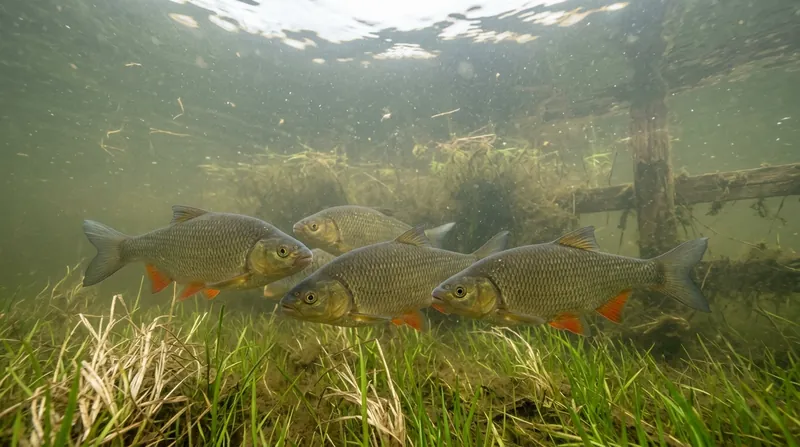 Ide over a flooded floodplain
Young ide. After hatching, the larvae first hang among the water plants. Then they swim in dense shoals near the spawning site, together with young roach (Kennisdocument winde). Young ide grow up in shallow, slow-flowing water along the banks. The bigger they get, the deeper they swim (RAVON).
In the floodplains of the big rivers, researchers call the ide the 'success species' among the river fish that need flowing water. It makes the most of new waters in the floodplains. Young ide live above all in side channels that river water flows through. They also live in backwaters: old river arms that are still joined to the river at one end (Dorenbosch et al. 2011). In 2009 the ide was among the most numerous fish at every surveyed site along the Waal. In the side channels at Beneden-Leeuwen and Gameren, it was even the most numerous of all. The same was true in the groyne bays: the water between two groynes. In 1998 and 1999 it was among the most numerous fish only in the Gameren side channel and in the groyne bays (Dorenbosch et al. 2011).
A migrating fish. In spring the ide often moves upstream in big shoals, to small side rivers, streams or flooded banks (Kennisdocument winde). It sometimes travels more than 100 kilometres (RAVON). Ide from the IJsselmeer and the waters around it often run up the IJssel and the Overijsselse Vecht in large numbers (Kennisdocument winde).
From 2019 to 2021, researchers fitted 113 ide in the Overijsselse Vecht with a small transmitter in the belly. Receivers along the water recorded where they swam (Swimway Vecht). That brought some surprises:
- The first ide from the IJsselmeer reach the mouth of the Vecht as early as late summer. They move upstream when the water is high, even at a high river flow in December, months before spawning. They usually reach their furthest point in March, probably close to their spawning site. In 2019, 8 in 10 ide did so. In 2020 it was 2 in 3, and in 2021 only 1 in 3. Their arrival there seems to coincide with the water warming past 7 to 8 degrees (Swimway Vecht).
- In 2020 and again in 2021, one ide swam from Den Oever to the Vecht at Hardenberg to spawn: almost 150 kilometres. On the way back it swam from the Ketelmeer to Den Oever in a day and a half. That is some 55 kilometres as the crow flies (Swimway Vecht).
- Another ide moves every year from the Frisian boezem, the canals and lakes of Friesland, to the Vecht. It spawns at the Vechterweerd weir and spends the summer in Friesland (Swimway Vecht).
- In spring 2019, six ide stayed longer in the Regge, a tributary of the Vecht. That points to spawning. Four of them came back the next year and swam up the Regge again. Three did so the year after as well (Swimway Vecht).
- In March 2019, 17 of 21 ide passed the Vechterweerd weir at high water. The fish pass, the passage that lets fish swim past the weir, is then under water. It then flows like a side channel. They took 14.5 minutes on average. The four ide that moved at another time took 4.5 hours on average (Swimway Vecht).
Researchers fitted ide in the Maas (Meuse) with transmitters too, mostly in spring 2003. Most of them stayed nearby. But in March and April 2003 a male and a female swam more or less together from Keizersveer to the IJsselmeer. They went from the Maas via the Waal and the IJssel. Shortly afterwards the female swam back along exactly the same route in a few days. One ide swam through the Haringvliet sluices to the sea and was never seen again. At three weirs in the Maas, at Linne, Sambeek and Lith, 40 ide swam up to just below the weir. Only 6 went on through the fish ladder (IMARES 2006).
Where to find ide
The ide likes flowing water best. You find it mostly on the big rivers, so not everywhere (Sportvisunie). According to Sportvisunie it is common. It lives above all in the IJsselmeer and the waters around it, in the Biesbosch and the Haringvliet, and in the big rivers. Because people have stocked it, it can also live in closed-off waters (Sportvisunie). Fly anglers find it in flowing water, on the IJsselmeer and on the Randmeren: the lakes between Flevoland and the old mainland (Sportvisunie). Adult ide live mainly in the main channel of rivers, in their slower lower reaches. They also live in the waters connected to them (RAVON). The ide is not strictly a fish of flowing water, though. According to Wageningen Marine Research it is also at home in slow-flowing rivers and in lakes. It does need to be able to move to flowing water to spawn (WMR 2024).
Where anglers catch it. The ide comes up again and again in Sportvisunie's articles about VISpas waters:
- The Waal near Tiel. Behind the long dams you trot a float down with the current (Sportvisunie). From the groynes you catch ide on floating bread crust (Sportvisunie).
- The IJssel at Deventer. With the feeder, and on summer evenings with small lures (Sportvisunie).
- The Kromme Rijn near Utrecht. A narrow river with big bream and ide. Here ide often fall to bread (Sportvisunie).
- The Eem. Home to fat ide. In spring they move up the river from the Eemmeer (Sportvisunie).
- The Reitdiep and the Zoutkamperril. Whitefish anglers know these waters for their big bream and ide. In spring a lot of fish move up into them from the Lauwersmeer (Sportvisunie). On the Lauwersmeer itself you have a chance of a personal best ide (Sportvisunie).
- The Bernisse. Its many ide are typical of this water (Sportvisunie).
- The Beneden-Mark. Besides roach and bream you have a chance of good-sized ide here. The water is very well suited to the pole (Sportvisunie).
- The Grensmaas. On the quieter stretches towards Maasbracht you sometimes catch ide (Sportvisunie).
- The Midden-Regge in Twente. This wide stream is known for its fine ide (Sportvisunie).
Want to know whether you may fish somewhere with the VISpas? Check the VISplanner.
Where surveys find it. Rijkswaterstaat, the Dutch water authority, has the fish in the big waters surveyed regularly. In the main channel of the rivers, the ide is one of the ten species these surveys catch most often. That holds for almost every stretch of the Rhine, the Waal, the Neder-Rijn, the Lek, the Gelderse IJssel and the Maas (Meuse). Only the Grensmaas is an exception. The ide is also among the ten in the Hollandsch Diep, the Noordwaard in the Biesbosch, the Ketelmeer and the Eemmeer, among other waters (WMR 2024). On the rivers, surveys catch adult ide mostly in the open water of the main channel. Young ide turn up mostly along the banks and in side waters (WMR 2022). On the IJsselmeer, surveys catch ide mostly along the sandy shores: many small ones and quite a few big ones. But their numbers there have fallen in recent years (WMR 2024).
Ide fishing through the year
Further down this page is the seasonal patterns chart. For each month it shows how often a catch reported on mijnvismaat.nl is an ide, compared with the yearly average.
Early spring. As early as March you can catch ide on the surface. Brian Aarsman caught them on the Waal near Tiel with floating bread crust, in water of barely 6 degrees (Sportvisunie). In spring, ide also move up rivers to spawn. On the river Eem they come up from the Eemmeer, along with bream and roach (Sportvisunie). On the Reitdiep and the Zoutkamperril, a lot of fish move up from the Lauwersmeer in spring (Sportvisunie). In the Maas (Meuse), most ide spawn as early as March, before the closed season starts (IMARES 2006). More about this under life and spawning.
April and May. This is the closed season: every ide you catch goes straight back. On most inland waters lures and dead bait are banned then. There you may fish with bread, sweetcorn, maggots and worms. You can read more under the rules. After spawning, ide move back downstream to feed, for example to flooded floodplains (Kennisdocument winde). According to Brian Aarsman, crust fishing gets even better in May and June, when the evenings are longer and warmer (Sportvisunie).
Summer. On warm, long summer evenings on the IJssel you can expect big ide on small lures. Retrieve them fast, on the surface too (Sportvisunie). Lures that look like an insect can work too. A small floating beetle works best on warm days (Sportvisunie).
Autumn and winter. In autumn, ide move to the lower reaches of rivers or to lakes. There they spend the winter in shoals in deep water (Kennisdocument winde). In winter, roach and ide also often gather in marinas. Always ask permission before you fish in a marina (Sportvisunie). Some ide already start moving towards their spawning site in autumn and winter. You can read more about how ide migrate.
Fishing methods and tackle
You can catch ide in many ways: with a float, with a feeder, with bread on the surface, with a fly rod and now and then with small lures. Below are Sportvisunie's tips for each method.
With a float. For ide, fish your bait suspended at mid-depth rather than on the bottom. Use 0.14 mm line (14/00) and a size 12 to 16 hook (Sportvisunie). In running water, choose a rounder float of 1 to 3 grams. It sits more steadily in the current and stays in place better (Sportvisunie).
On the Waal near Tiel, long dams run along the river. Behind them the water flows more evenly than on the river itself, and passing ships do not bother you. The presenters of VIS TV, the Dutch angling programme, fish there with long match rods: float rods with a reel. They use a sturdy float that runs down with the current. That is trotting, and it is often a very effective way to catch big ide and roach (Sportvisunie).
With a feeder. A feeder rod is a casting rod used with a feeder. That is a small cage of groundbait that you cast out with the hook bait. Want a better chance of bigger fish on the IJssel at Deventer, such as bream, ide, barbel and big roach? Then Sportvisunie recommends the feeder. There, choose a rod of about 4 metres and a feeder of at least 150 to 200 grams (Sportvisunie). On the Lauwersmeer, Sportvisunie suggests a 0.16 mm hook length with a size 12 or 14 hook. For bigger ide, step up to 0.18 mm and a size 10 hook. Mix tinned sweetcorn and cooked hemp into the groundbait (Sportvisunie).
Bait. Ide take maggots and worms well, a big lobworm included (Sportvisunie). On the river Eem, tinned sweetcorn works (Sportvisunie). And bread, as flake or crust. You can read more about that below. On the Kromme Rijn, bream and ide also like to take the boilies of carp anglers (Sportvisunie).
With bread. On the Kromme Rijn near Utrecht, ide often fall to bread. Walk along the towpath, feed crusts, and let a floating crust or a slowly sinking flake drift along (Sportvisunie). Flake is a pinch of fresh bread pressed round the hook, and it sinks very slowly (Sportvisunie). On the Valleikanaal, crusts fed into the water drifted with the current until the ide found them. Big swirls showed where the fish were (Sportvisunie).
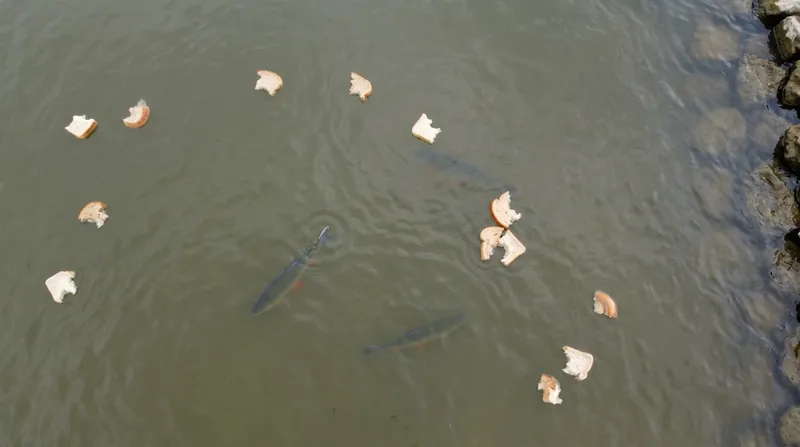 Crusts and ide, seen from above
Floating crust from a groyne. Brian Aarsman fishes for ide with floating bread crust on the Waal near Tiel. He stands on the groynes: the stone dams that stick out into the river. His tips (Sportvisunie):
- A light spinning rod of 2.40 or 2.70 metres with a size 3000 reel is all you need. Load it with 0.10 mm braid. Braid floats, which helps with crust fishing. At the end goes a 1-metre leader of 0.20 mm nylon with a size 8 or 10 carp hook. That is really not overdoing it, Brian says: just look how big an ide's mouth is.
- Feed the crusts on the upstream side of the groyne. There the water turns back into the groyne bay: the stretch of water between two groynes. So the crusts drift to and fro along the groyne. On the downstream side the river often carries them away.
- Dip the crusts in the water first. They get heavier, and you can throw them further.
- Walk along with the drifting crusts, so you can cast quickly when you see a fish feeding. Make sure your shadow does not scare the fish.
- Are a few fish already feeding? Wait a little longer before you cast, so they gain confidence. Then cast your crust a couple of metres beyond the spot where a fish took one.
- Fold a piece of crust double on the hook. Or use a bait band: a small elastic band that holds the bait on the hook.
- Bring small forceps. An ide sometimes swallows the crust in one go.
Watch out for birds, though. With the VISpas you may not fish in a way that makes it likely that birds or waterfowl take your bait. The explanation that comes with the VISpas conditions gives an example: fishing with a floating crust right next to a group of ducks (VISpas conditions, condition 6). That is one reason Brian Aarsman walks along with his crusts: it keeps the gulls away (Sportvisunie).
With a fly rod. For fly anglers the ide is a true sport fish. You catch it on a nymph or a dry fly (Sportvisunie). A nymph such as the goldhead imitates larvae under water. A dry fly floats (Sportvisunie). On the big rivers, fly fishing for bream and ide can be excellent (Sportvisunie). Artificial flies under 2.5 centimetres are allowed in April and May too, when other lures are banned. You can read more under the rules.
With lures. On warm, long summer evenings on the IJssel, you can expect big ide on small lures. Retrieve them fast, on the surface too (Sportvisunie). Do you fish for asp on the Kromme Rijn with fast little plugs, surface lures or small shads? Then you regularly hook a big ide as well (Sportvisunie). Insect lures work too. A 3.5-centimetre hornet imitation drifts with the current like an insect that has fallen into the water. Fish it downstream with little action. The Salmo Bug is a small floating beetle that seems to struggle on the surface. It works best on warm days. For both lures Sportvisunie names the ide, along with perch and asp (Sportvisunie). From 1 April to the end of May, lures are banned on most inland waters. You can read more under the rules.
Mind the ships. On the IJssel, ships cause big waves and a strong pull of the water, above all in the groyne bays. Use a sturdy rod rest that you do not need to push into the ground (Sportvisunie).
Closed season and rules for ide
Every spring the ide has a closed season, from 1 April to 31 May (Uitvoeringsregeling visserij, article 5c). On most waters you may still fish in that period. But every ide you catch goes straight back into the same water (Reglement minimummaten en gesloten tijden, article 2). The ide has no minimum size (Uitvoeringsregeling visserij, article 5b). Some websites, such as RAVON's, still give a minimum size of 30 centimetres (RAVON). But it is not in the current rules (Uitvoeringsregeling visserij, article 5b). The overview below shows the whole year.
- April 1 – May 31 Closed season: catch and release You may fish, but on most inland waters not with lures, a dead fish, pieces of fish or slaughter products. Artificial flies of up to 2.5 cm are allowed, and so is other bait such as worms or maggots. Every fish of this species that you catch goes straight back.
- June 1 – March 31 now Open season The normal rules apply. There is no legal minimum size for this species.
To fish in Dutch inland waters you usually need written permission. Often that is the VISpas, the Dutch angling permit: together with the list of waters it covers, it is your permission. Its conditions add their own rules to the law (VISpas conditions).
Why does the closed season run to 31 May?
For pike, zander and perch the closed season runs to the last Saturday of May, except on the IJsselmeer. That comes from an exception in the law, and it applies to those three species only (Uitvoeringsregeling visserij, article 61). For ide, barbel and chub the closed season runs to 31 May (Sportvisunie). An ide caught in the last days of May still goes back.
May you fish for ide in April and May?
Yes, on most waters. But every ide you catch goes straight back into the same water (Reglement minimummaten en gesloten tijden, article 2). So it may not go into a keepnet or a bucket, not even for a short while.
On a few waters you may not fish with a rod at all from 1 April to 31 May. There are nine of these areas. Examples are De Deelen in Friesland, the Ilperveld, a large part of Waterland and part of the Nieuwkoopse plassen (Uitvoeringsregeling visserij, article 25 and annex 7). The list of waters also closes some waters in spring, such as the Purmerlander Polder near Purmerend (Gezamenlijke Lijst). So always check the water in the VISplanner.
From 1 April to the last Saturday of May, most inland waters also have rules for your bait. You may not fish with lures, a dead fish, a piece of fish or slaughter products such as meat. Of all lures, only artificial flies under 2.5 centimetres are allowed (Gezamenlijke Lijst). Bread, sweetcorn, maggots and worms are not in the ban. Be careful with fake maggots and fake corn, though: strictly speaking they are lures too. So Sportvisunie advises using real bait in that period (Sportvisunie). This ban does not apply in part of Zeeland, for example on the Veerse Meer and the Grevelingenmeer. And lures are allowed on the river Geul and its side streams (Reglement voor de binnenvisserij, article 6). The ide's own closed season applies there too.
Note that in the law itself, this bait ban runs to 31 May (Reglement voor de binnenvisserij, article 6). The exemption from the last Saturday of May names only pike, zander and perch, not the ide (Uitvoeringsregeling visserij, article 61). Sportvisunie writes that from that Saturday you may fish with all kinds of bait again (Sportvisunie). An ide you catch then still goes back, up to and including 31 May. To be safe, wait until 1 June before you fish for ide with lures.
With the VISpas, one more rule applies from 1 April to the last Saturday of May. You may not fish in a way that is likely to catch zander. The conditions give working a drop-shot rig or a jig head with worms as examples. Static whitefishing, with a worm that lies still, is allowed (VISpas conditions, condition 7).
On the IJsselmeer, the Markermeer and the IJmeer, the VISpas ban lasts longer: from 16 March to 30 June. In that period you may not fish there with a dead fish, a piece of fish or lures. Of all lures, only artificial flies under 2.5 centimetres are allowed there (Gezamenlijke Lijst). The Oostvaardersdiepen near Almere and Lelystad fall under the same rules (Gezamenlijke Lijst).
May you take ide home?
From 1 June to 31 March, yes. The ide has no minimum size, so by law you may keep an ide of any length (Uitvoeringsregeling visserij, article 5b). But under the VISpas you may keep a fish for only three reasons. You eat it yourself, you use it as bait, or you keep it alive for a while. You may never sell it. The VISpas conditions add that releasing a fish is the starting point. You may have at most 15 fish with you, of which at most 5 longer than 25 centimetres. That counts all species together. You may only keep more fish alive for a while, under the keepnet rules. Kill a fish you want to eat straight after catching it, with a firm tap on the head (VISpas conditions, conditions 14 to 18).
On some waters you may not take any fish at all, or fewer. The list of waters says so for each water (Gezamenlijke Lijst), and so does the VISplanner. Whether ide is good to eat is under In the Netherlands.
May an ide go into a keepnet?
From 1 June to 31 March, yes, and with the VISpas only between sunrise and sunset. The keepnet must be made of soft, knotless material with a mesh of at most 6 millimetres. It must be at least 2.5 metres long and at least 40 centimetres in diameter. It lies as flat as possible, and at least three quarters of it is under water. Current and waves must not harm the fish, and an injured or weakened fish does not go in. You may only keep a live fish over 30 centimetres in a keepnet, a keepsack or a sling. A keepsack and a sling are soft bags for big fish. Afterwards the fish goes back alive into the same water (VISpas conditions, condition 18). Keep the fish in the net for as short a time as possible (Sportvisunie). In April and May an ide may not go in at all, as explained above.
With the VISpas you may not even have dyed maggots or worms with you (VISpas conditions, condition 8).
Where may you not fish?
On a few rivers the law bans fishing near a weir that is working. They are the Neder-Rijn, the Maas (Meuse), the Lek and the Overijsselse Vecht. You may not fish within 75 metres downstream of the weir. Nor in a fish pass at the weir: a channel that lets fish swim past it. And not within 25 metres of the fish pass's upper opening (Uitvoeringsregeling visserij, article 28c). On a number of other waters you may not fish close to a pumping station, weir or lock. How far you must keep away differs per water: from 10 to as much as 250 metres. The list of waters says so for each water (Gezamenlijke Lijst).
Is the ide protected?
No. The ide is not on the list of protected fish species (Gezamenlijke Lijst), and it is not in the EU Habitats Directive either (Habitats Directive). That directive holds EU rules for protecting animals, plants and the places they live. How the ide is doing is under In the Netherlands.
Unhooking and releasing ide
From 1 April to 31 May every ide goes back. For the rest of the year too, releasing is the starting point under the VISpas (VISpas conditions). This is how to do it (Sportvisunie):
- Touch the fish only with wet hands.
- If you can, unhook the fish while it is in the water. Keep a disgorger or forceps within reach, and a landing net.
- Do not touch the gills or the eyes.
- Keep the fish out of the water for as short a time as possible.
- Is the hook deep? Cut the line as close to the hook as you can. Release the fish if you expect it to survive.
- Put the fish back gently into the same water as soon as you can. If needed, hold it upright until it swims off by itself.
Do you have to lay the fish down, for a photo for example? Then put it on an unhooking mat: a thick, soft mat. Do that above all on a bank of stones or sand. A smaller fish can stay out of the water for a minute, but then it really must go back. Hold a big fish with two hands: one under the head, the other under the belly or the tail (Sportvisunie).
Only put a fish back into the water where you caught it. Fish can carry diseases to other waters (Sportvisunie).
The biggest ide ever caught
The Dutch ide record is 61 centimetres. Tico Wezenberg caught it in July 2021, on bread. The world record is an ide of 3.36 kilograms, caught by Sonny Pettersson in Sweden in 2001. The greatest length we found on a national list is 66 centimetres: a Polish ide from 2018.
29 cm A typical ide: the middle one of more than 2,200 ide of 20 cm or more measured in fish surveys
61 cm Dutch record (2021)
66 cm The greatest length on a national list (Poland, 2018)
Dutch record
61 cm
Tico Wezenberg caught this ide on the afternoon of Friday 9 July 2021 (Dutch record list; Beet). He was at his favourite spot in his village: “a wide ditch with quite a lot of current”. That is where he usually catches his biggest pike. The day before, he had caught an ide there on a spinner. So he went back with his spinning rod and some bread to feed the spot. A big ide was eagerly eating the bread, and within ten seconds it took the crust on Tico's hook (Beet). The list goes by length only and rounds down to whole centimetres (Sportvisunie).
According to Beet, it was “the first official 60-plus ide” (Beet). Yet two longer ide had been on the record list before. You can read more about this below. The experts of the record committee unanimously judged it a pure ide (Sportvisserij Nederland). The record before it was 59 centimetres. Radosław Wieczorkiewicz caught that ide on 29 March 2021 in the Weerijs, a small river in Breda (Beet). Before that, the record stood at 57 centimetres. Jamie Steer caught that ide on the Waal near Zaltbommel in April 2017 (Beet).
A record that got shorter twice. For years the list held an ide of 67 centimetres and 4.1 kilograms from the Hollands Diep. Joost Wenteler caught it in 2009 (Beet). Then came an ide of 62 centimetres from near Zwolle, caught by Dion de Vries in 2017. The record committee called it “fortunately a pure ide” (Beet). Yet both fish disappeared from the list again. Jamie Steer's ide went back into the books “retroactively (again)” (Beet). We found nothing to say why the two longer fish were removed.
Hybrids. With every record claim for an ide, the record committee takes extra care. Crosses between asp and ide are common, and they regularly grow past 60 centimetres (Sportvisserij Nederland). Many ide claims turned out, on closer study, to be such a cross (Sportvisserij Nederland). In 2021 Beet wrote that in the past year it had had to reject several such fish of 60 to 74 centimetres (Beet).
Fish surveys, too, have measured five ide that were longer than the record. The longest was 70 centimetres. See how big ide grow. Whether they were pure ide, we do not know. The 70-centimetre fish came from the Aa of Weerijs near Breda in 2007. The 59-centimetre record of 2021 came from the same small river.
World record
3.36 kg
The IGFA, the international body for angling records, keeps the world record. Sonny Pettersson caught the ide of 3.36 kilograms (7 lb 6 oz) on 24 June 2001 at Grangshammaran, near Borlänge in Sweden. For the ide, IGFA keeps only a weight record, no length record.
National lists hold much heavier ide. The heaviest we found on a national list is the Latvian record: 5.50 kilograms, caught by V. Korotkovs in 1989 in Lake Lubāns (LMSF). The German record weighed 5.1 kilograms. Mario Merkel caught it in October 2010 in a gravel pit at Gleidingen. His bait was red tinned sweetcorn with one grain of fake corn. He put the fish back (Fisch & Fang). These fish are not on IGFA's list. A fish only goes on it if someone submits it and IGFA approves it.
In Great Britain three fish share the record, at 3.77 kilograms (8 lb 5 oz) each (BRFC). Two of them are golden orfe, the orange form bred for ponds, from stocked fisheries (Lymm Angling; Anglers' Net). The third came from a river, the Hull (Angling Times). The Danish record, too, is shown with a photo of a golden orfe (Danske Fiskerekorder).
Greatest length on a national list
66 cm
The greatest length we found on a national list is 66 centimetres. Bartosz Skrzypczak caught that ide in 2018. It is on the official Polish list kept by the magazine Wiadomości Wędkarskie (Wiadomości Wędkarskie). The same angler also holds the Polish weight record, 4.15 kilograms, from the same year. The list does not say whether it is the same fish.
As late as March 2025, that list still held a much longer ide: 82 centimetres and 5.10 kilograms. Jan Zbiegień caught it in 1973 (Wiadomości Wędkarskie, March 2025). It is no longer on it (Wiadomości Wędkarskie). New rules have applied to the list since 1 May 2025. The magazine's medal tables, in force since the same day, still give it as the Polish record (Wiadomości Wędkarskie). We could not find out why it was removed.
The German record fish was even longer: 68 centimetres, according to Fisch & Fang. Fisch & Fang keeps the German list (Fisch & Fang). But the list itself gives only its weight (Fisch & Fang).
The top of this page shows 85 centimetres and 4 kilograms as the greatest length and weight. Those figures come from FishBase, a large database of fish. The 85 centimetres comes from a handbook from 2007. That length leaves out the tail fin. The 4 kilograms comes from a field guide from 1968 (FishBase). The records of Latvia, Germany, Poland and Finland are heavier.
Online you sometimes read that an ide can grow to 1 metre and 8 kilograms. English Wikipedia says so, for example, citing a source we could not open. We found no rod-caught ide of that size on any list.
Records by country
Every country keeps its own list, with its own rules. Some lists count length, others weight, so the numbers cannot always be compared.
| Country | Record | Angler | Where caught | Date | List |
|---|---|---|---|---|---|
| Netherlands | 61 cm | Tico Wezenberg | — | Jul 9, 2021 | Sportvisunie |
| Austria | 3.70 kg · 61 cm | Reinhold Lang | Danube (Upper Austria) | 2001 | Rekordfische Österreich |
| Denmark | 3.75 kg | Peter Juul Hansen | a lake on Funen | Jun 14, 2006 | Danske Fiskerekorder |
| Denmark | 62 cm | Peter Juul Hansen | a lake on Funen | Jun 14, 2006 | Danske Fiskerekorder |
| Finland | 4.136 kg · 60.6 cm | Markku Lampela | the Kemijoki at Kemijärvi | Aug 17, 2015 | Ennätyskalarekisteri |
| Germany | 5.10 kg | M. Merkel | Gleidingen gravel pit | 2010 | Fisch & Fang |
| Hungary | 3.86 kg | Szentpéteri Tamás | Eastern Main Canal (Keleti-főcsatorna) | May 6, 1995 | MOHOSZ |
| Latvia | 5.50 kg | V. Korotkovs | Lake Lubāns | 1989 | LMSF |
| Norway | 3.94 kg | Andreas Ånerud Johansen | Nes (Akershus) | Sep 1, 2017 | Villmarksliv |
| Poland | 4.15 kg | Bartosz Skrzypczak | — | 2018 | Wiadomości Wędkarskie |
| Poland | 66 cm | Bartosz Skrzypczak | — | 2018 | Wiadomości Wędkarskie |
| Sweden | 3.96 kg · 59 cm | Andreas Attnarsson | Nättrabyån (Blekinge) | Mar 29, 2024 | Sportfiskarna |
| United Kingdom | 3.77 kg (8 lb 5 oz) | Michael Wilkinson | Lymm Vale (Cheshire) | 2000 | BRFC |
| United Kingdom | 3.77 kg (8 lb 5 oz) | Lawrence King | Newdigate Farms (Surrey) | May 20, 2018 | BRFC |
| United Kingdom | 3.77 kg (8 lb 5 oz) | Colin Hebb | River Hull | 2021 | BRFC |
A dash means the list does not give it. Checked on October 19, 2026. A record can be broken at any time, so we check these lists at least once a year.
In the Netherlands
Is the ide native to the Netherlands?
Yes. According to the Dutch Species Register, the ide occurs here naturally (Dutch Species Register). In the 1930s it was very numerous in the Rhine and its branches. In the Maas (Meuse) it was less common (Kennisdocument winde). Fishermen used to catch quite a lot of ide in the brackish water of the Zuiderzee. After the Afsluitdijk dam was built, the ide catch on the IJsselmeer fell. It went from 6.7 tonnes in 1935 to 2 tonnes in 1940. That may have been because the gradual change from fresh to salt water at the mouth of the IJssel was gone (Kennisdocument winde). Later the ide declined further because of the Delta Works and the canalisation of rivers. They got weirs and locks, above all the Maas (Meuse). The many weirs between the places where ide live and where they spawn count as the main cause (Kennisdocument winde).
Can an ide live in salt water?
A little. An ide can live in brackish water with up to about 15 grams of salt per litre (Kennisdocument winde). In the Baltic Sea, ide live in brackish water. But when saltier water suddenly flows in, many can die. Along the east coast of the Danish island of Zealand this happens regularly, and then thousands die (IUCN). In the Netherlands, surveys sometimes even catch ide in the Noordzeekanaal, the ship canal from Amsterdam to the North Sea (WMR 2024).
More ide or fewer?
That differs from water to water. In parts of the Rhine system the ide seems to be doing well (WMR 2024). But along the banks of the Zandmaas and the Bedijkte Maas, surveys have hardly caught it in recent years. Along the banks of the lower Gelderse IJssel, it was at first one of the most numerous fish. That was in the first ten years of the surveys. Since 2012, surveys there have caught far fewer. And in the open water of the IJsselmeer and the Markermeer it has disappeared from the catches (WMR 2024). Along the shores of the IJsselmeer, surveys do still catch it. You can read more under where to find ide.
Status. The ide was on the first Dutch Red List of fish, from 1997 (RAVON). The Dutch Red List is a list of threatened species. It is not on the current Red List, in force since 2016 (Staatscourant). It now counts as not threatened (Dutch Species Register). Worldwide and in Europe, too, it counts as not threatened. The IUCN, an international organisation for nature conservation, lists it as Least Concern (IUCN; IUCN). You can read whether it is protected under the rules.
What is a golden orfe?
A golden orfe is an orange-yellow ide: the same species, bred as an ornamental fish (Kennisdocument winde). People have bred colour forms like this since the eighteenth century. Firms in the Netherlands, Belgium, Germany and other countries now breed them for ponds and fisheries. Besides golden orfe, they also breed blue orfe (IUCN). There are also reports of golden orfe in the wild in the Netherlands (NDFF Verspreidingsatlas). In Great Britain, two of the three fish that share the record are golden orfe from stocked fisheries. You can read more under the records.
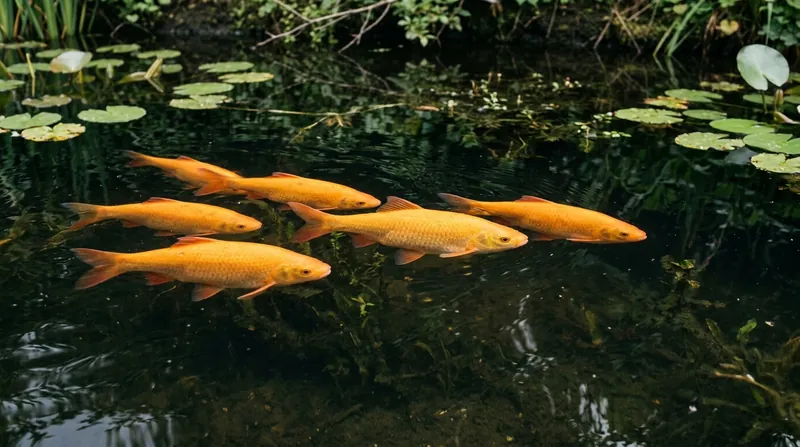 Golden orfe in a pond
Around 1989, golden orfe even kept watch over the water of the Rhine. At the monitoring station at Lobith they swam in a tank with river water flowing through it all the time. In flowing water, fish keep swimming against the current. If the golden orfe could no longer manage that, it could point to polluted water (Botterweg 1989). The device then raised the alarm and took a water sample by itself (Kennisdocument winde).
Can you eat ide?
You can. According to Sportvisserij Nederland's knowledge document on the ide, it is rather bony but tastes good (Kennisdocument winde). According to FishBase, the flesh is not tasty (FishBase). In the Netherlands, commercial fishermen hardly catch ide any more (IUCN). The Netherlands Nutrition Centre advises against regularly eating freshwater fish you caught yourself in Dutch waters, such as eel, perch and trout. Such fish can contain harmful substances such as heavy metals, PCBs, dioxins or PFAS. That is true above all for fatty fish such as eel and trout (Voedingscentrum). According to the Dutch government, you would take in too much PFAS (Rijksoverheid). The ide is not named separately, but the advice is about self-caught freshwater fish in general. What you may take home with the VISpas is under the rules.
What our models found for Ide
Below is what our models see in the data. These are links: where one thing occurs, the other occurs more often. That is not a cause. Each model answers one question and may not say more than it measured. The label by the heading tells you which question — and how sure the answer is.
Where this species lives Strong model
 Asp (Aspius aspius)
The strongest mark of ide water is the asp. A good fifth of this model hangs on that one fish. The asp page shows the reverse: there the ide is the strongest mark.
Two fish pointing at each other. That is because they share the same water. FishBase puts the ide in large lowland rivers and nutrient-rich lakes, and the asp in open water of large and medium-sized lowland rivers.
The other names belong to that same river community: ruffe, zander, bleak and gobies, with the round goby named separately. Plenty of organic matter on the bottom belongs to it too. The round goby is a newcomer that reached the Netherlands along the rivers.
What this model does not say is who seeks out whom. Larger ide feed mainly on fishes, so some of those names could be prey. But they also simply live in the same water. We cannot separate those two here.