Identification
The barbel is a powerful, torpedo-shaped bottom fish unmistakable thanks to the four barbels around its mouth: two long ones at the corners and two shorter ones on the upper lip. The body is elongated and muscular, olive-brown to yellowish-brown with a lighter belly. The scales are relatively small. The deeply forked tail delivers tremendous power — a hooked barbel is one of the hardest fighters in Dutch freshwater. Fish of 50-60 cm are common, specimens over 70 cm are trophies.
Behavior & ecology
The barbel is a dedicated river fish that lives on the bottom of flowing water with gravel or stone substrate. During the day, they often hold in groups behind obstacles or in deeper channels where the current is slightly reduced. At dusk they become active, foraging in the current: insect larvae, crustaceans, snails, and worms are vacuumed from the riverbed with their characteristic underslung mouth.
Spawning takes place in May-June on shallow gravel beds in flowing water. Barbel migrate upstream for this purpose and gather in large groups — a spectacular sight. After spawning, barbel are temporarily weakened and it is recommended to leave them undisturbed.
Fishing techniques
Barbel fishing is specialist work requiring sturdy tackle and river knowledge:
- Feeder fishing: The most effective method. A heavy feeder (80-120g) with a short hooklink and large hook. Maggots, casters, or luncheon meat as bait. Cast upstream and let the feeder settle on the bottom.
- Rolling ledger: A round weight that slowly rolls along the bottom with the current. Ideal for actively searching a stretch of river. Maggots, worms, or cheese on the hook.
- Fly fishing (Czech nymphing): Drifting weighted nymphs close to the bottom. Highly effective in summer on visible barbel in shallow flowing water.
Use a powerful rod (3.60-3.90m, 1.5-2 lbs) with a sturdy fixed-spool reel and braided mainline. Barbel make explosive downstream runs — ensure you have plenty of line on the spool.
In the Netherlands
The barbel is a true river species found primarily in the Meuse, Waal, and Rhine and their tributaries. Smaller populations exist in streams in the Limburg and Gelderland provinces. The species benefits from improved water quality and the construction of fish passes that enable spawning migrations. Barbel have a closed season from April 1 through May 31 to protect spawning. In sport fishing, barbel are considered one of the most prized target species due to their powerful fight.
What our models found for Barbel
Below is what our models see in the data. These are links: where one thing occurs, the other occurs more often. That is not a cause. Each model answers one question and may not say more than it measured. The label by the heading tells you which question — and how sure the answer is.
Where this species lives Strong model
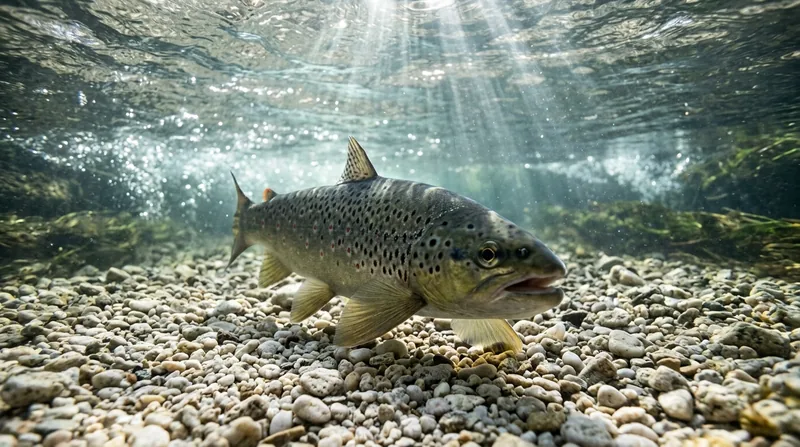 Salmonids (Salmonidae)
This is the clearest running-water model on the site. Chub comes first, then the salmonids. Further down come bullheads and the three-spined stickleback.
The invertebrates point the same way. Caddisflies of the family Hydropsychidae spin a catching net in the current. Blackflies (Simuliidae) anchor their larvae to stones in flowing water. Water mites of the family Sperchontidae belong there too, as do craneflies (Tipulidae).
FishBase puts the barbel in the deeper, faster-flowing upper reaches of rivers with stony or gravel bottom — and calls those stretches barbel zones. There it lives on bottom animals: mayfly and midge larvae, snails, small crustaceans. So this model finds its water and its food at the same time.
Small bottom fish fill out the list: round goby, gudgeon, gobies and stone loach. Three features of the water itself also count — organic matter, salinity and water level — about a seventh of the model between them. Which WAY they point, this model does not say. It gives weight, not direction.


