Identification
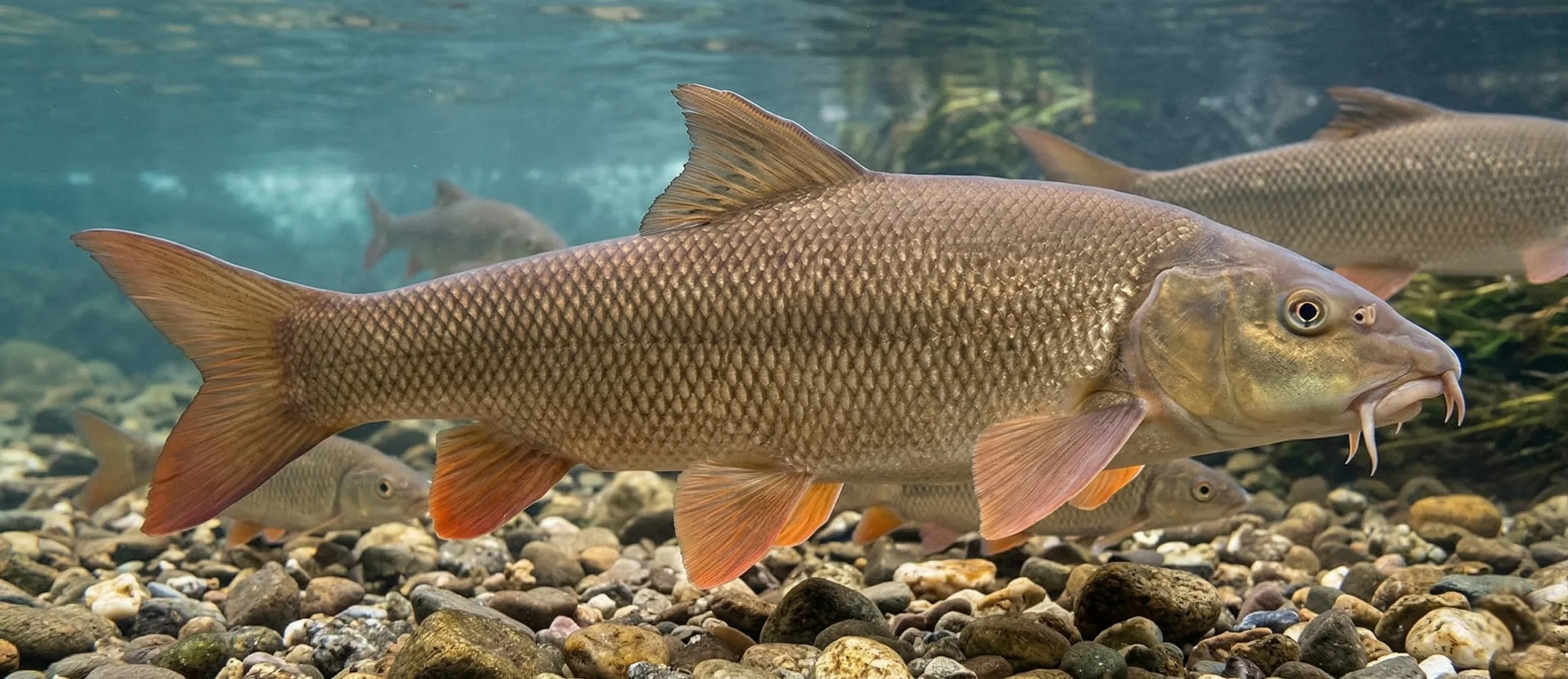
The bleak is a small, slender fish with conspicuously silvery scales that detach easily. The body is elongated and laterally compressed, with an upward-pointing mouth — typical of a surface-feeding fish. The back is blue-green to grey, the flanks gleaming silver. The anal fin is notably long. Bleak are typically caught at 10-15 cm, with specimens up to 25 cm. They can be confused with young roach, but bleak have a more streamlined body and larger, loosely attached scales.
Behavior & ecology
The bleak is a quintessential shoaling fish that lives in large groups near the water surface. They are most active in summer and feed primarily on insects that fall on the water, floating plankton and small crustaceans. Bleak are typical inhabitants of rivers, canals and waterways — anywhere with some flow. In spring (April-May) they spawn in shallow water over gravel or aquatic plants. As a prey species, bleak play a crucial ecosystem role: they are an important food source for pike, pikeperch, asp and cormorants.
Fishing techniques
The bleak is popular among competition anglers due to its fast bites and schooling behavior:
- Match fishing — light float (0.5-2 gram) with a single maggot or pinkie on the hook; fish shallow (30-60 cm deep)
- Pole fishing — the fastest method for bleak; short rig, quick striking and re-casting
- Fly fishing — small dry flies (size 18-22) on a light fly rod; sporting and challenging
The key to bleak fishing is speed: they bite quickly and aggressively. Feed regularly with small amounts of loose maggots to keep the shoal at your swim.
In the Netherlands
The bleak is native to the Netherlands and commonly found in larger rivers, canals and waterways. The species is less abundant in still waters and virtually absent from isolated ponds. There is no closed season or minimum size for bleak. Historically, bleak scales were used for making artificial pearls due to their characteristic silver sheen. The population is stable, although bleak are declining in some river stretches due to canalization and loss of natural banks.
What our models found for Bleak
Below is what our models see in the data. These are links: where one thing occurs, the other occurs more often. That is not a cause. Each model answers one question and may not say more than it measured. The label by the heading tells you which question — and how sure the answer is.
Where this species lives Strong model
 Tubenose goby (Proterorhinus semilunaris)
A good forty per cent of this model hangs on one group: the gobies. The tubenose goby comes first, then the goby family as a whole and further down the round goby. That is three columns for one signal.
Both gobies are newcomers that came into our rivers from the Danube and the Black Sea. So the bleak sits in the same water they do. The rest of the list is ordinary river company: roach, spined loach, carp, ide, silver bream, gudgeon, bitterling, rudd, bream and the three-spined stickleback.
FishBase puts the bleak in the open waters of lakes and medium to large rivers, in shoals just below the surface.
Where there are many A set, not a ranking Weak model
This model is weak. Plenty of bleak goes with water mites of the family Lebertiidae and the Asian clam (Cyrenidae). We count fewer bleak with pygmy backswimmers (Pleidae), flatworms (Dugesiidae), mosquitoes (Culicidae), great willowherb (Onagraceae) and pondweed (Potamogetonaceae).
One thing stands out. Two invasive mussels are in the same list and point opposite ways: the Asian clam goes with MORE bleak, the zebra mussel (Dreissenidae) with FEWER. Both arrived along the same rivers. Why they part company here, we do not know.