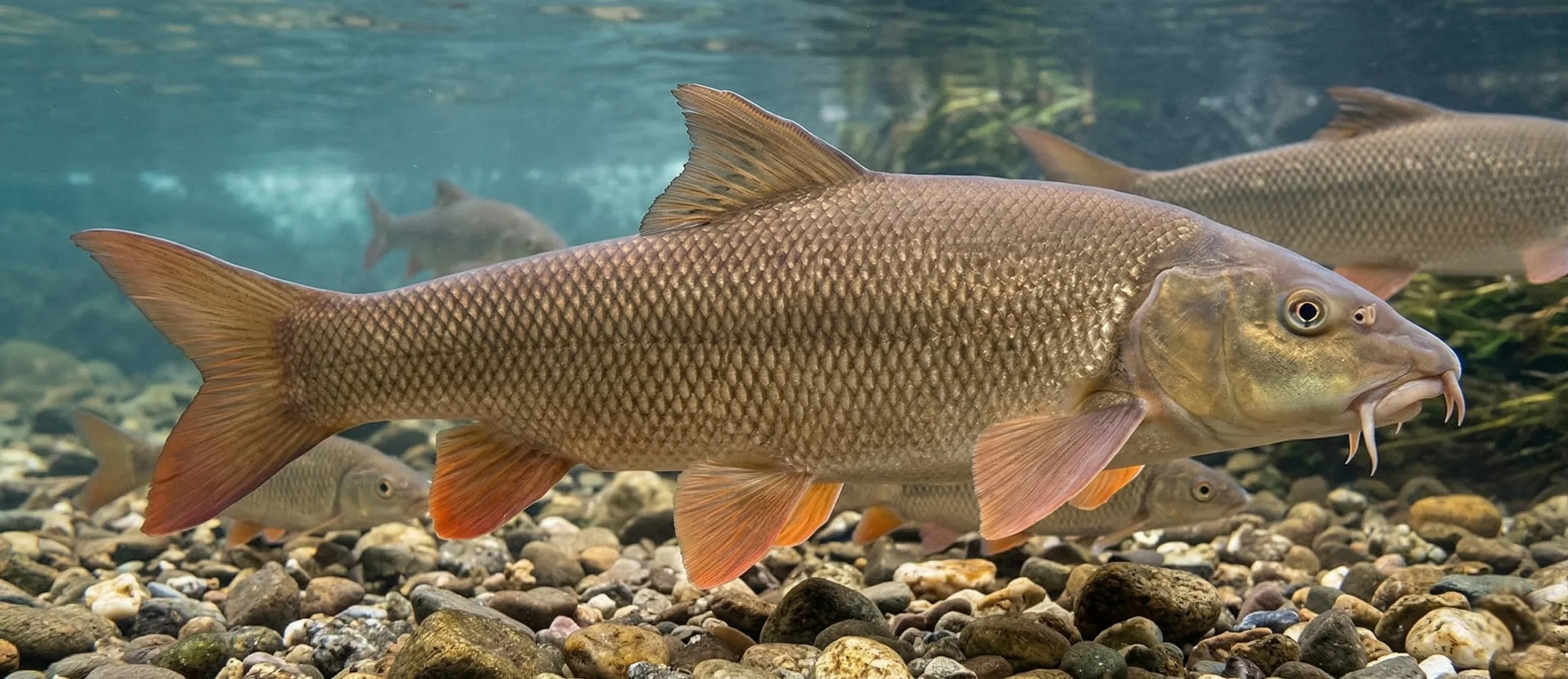
The carp is the big, strong fish of Dutch ponds, lakes, canals and rivers. Carp fishing is one of the most popular kinds of angling in the Netherlands. This page covers how to recognise a carp, where to find it, how to catch it and which rules apply. It also covers how big carp get. At the bottom you can see what our models found in the data.
Identification
 Four barbels and a mouth it can push forward
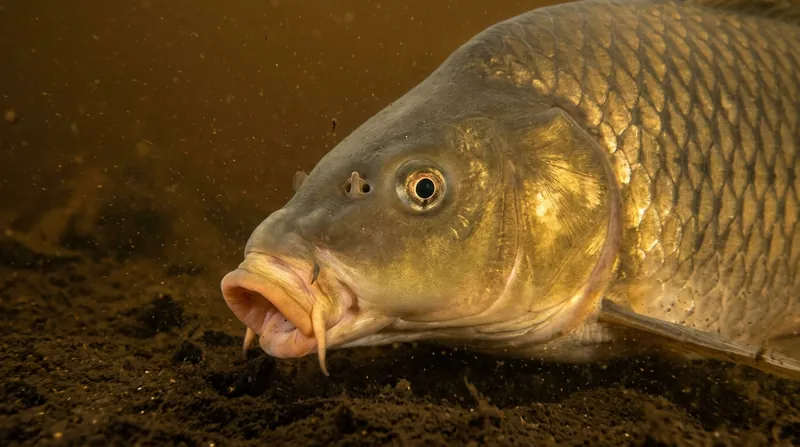
A carp has a strong body with large scales and one long dorsal fin. The first ray of that fin is hard and serrated (Sportvisunie). A wild carp is brownish-green on the back and golden-yellow underneath, and its lower fins have a reddish tinge (FAO). Young carp often have a dark spot at the base of the tail (RAVON).
The surest sign is at the mouth. A carp has four barbels: two short ones on the upper lip and two longer ones at the corners of the mouth (RAVON). It can push its mouth far forward, like a tube (Sportvisserij Nederland). It has no teeth in its mouth (Wikipedia). Instead it grinds its food with strong, molar-like teeth in its throat (FishBase).
Common, mirror or leather carp?
 A mirror carp: big, scattered scales on smooth skin
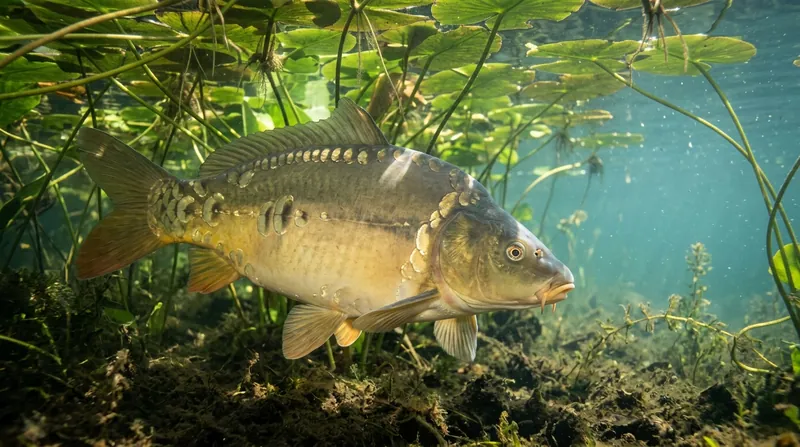
A carp is naturally scaled all over. Breeding has also produced carp with only a few scales, or none (RAVON). In Dutch waters you will meet four forms: the fully scaled common carp, the mirror carp, the linear carp and the leather carp (Sportvisunie). A linear carp has a single row of large scales along its lateral line (Wikipedia). They are all the same species. Among carp anglers the mirror carp is especially popular, for its colours and its scale patterns (Sportvisunie).
The carp that reached the Netherlands in the Middle Ages and then went wild are called wild carp, or boerenkarper in Dutch (Deltares). They are slimmer than farmed carp. In the past they seem to have lived mainly in slightly salty waters, such as the Zaanstreek, near Workum and in Zeeland (Sportvisserij Nederland). In a study, wild carp turned out to be much harder to catch than farmed carp. The farmed carp were less bothered by disturbance in and around the water (Sportvisserij Nederland).
Is a koi a carp?
A koi is a carp bred for its colours: orange, yellow, white or black (RAVON). But which carp? That is not certain. Koi may descend from the Amur carp (Cyprinus rubrofuscus), a close relative of our carp, or from crosses between the two. Now and then a koi escapes from a garden pond into open water (IUCN).
Carp, crucian carp, gibel carp or grass carp?
 The crucian carp: no barbels and a rounded dorsal fin
A few fish look like a carp. Look at the mouth first: a carp has barbels, crucian and gibel carp do not (RAVON).
The crucian carp has a rounded, convex dorsal fin; the gibel carp has a concave one. Young crucian carp, like young carp, often have a dark spot at the base of the tail; young gibel carp do not (RAVON). Both stay much smaller than a carp. A gibel carp can reach about 45 centimetres, a crucian carp 60 centimetres and a carp about 120 centimetres (Sportvisserij Nederland). A goldfish in its natural colours cannot be told apart from a gibel carp (RAVON).
It can get harder still, because these fish can interbreed (Schiphouwer et al.). That is a threat to the crucian carp. Where it lives alongside carp, the two can cross (RAVON), and the crucian carp is listed as vulnerable on the Dutch Red List (RAVON).
A young tench can look like a young carp. A tench has barbels too: two, and they are not always easy to see (RAVON). But a tench has tiny scales and a short dorsal fin (RAVON).
The grass carp has a slim, torpedo-shaped body and large scales with dark edges. It has no barbels. Grass carp have been stocked in the Netherlands since 1968 to keep water plants down, and they do not breed here (RAVON). Like a carp, a grass carp must always go back (Sportvisunie).
Behaviour and spawning
The carp likes warm water. So it prefers shallow water that is still or flows slowly (Sportvisserij Nederland). It eats mainly insect larvae, small crustaceans, molluscs and worms (Sportvisunie), and plant matter too (FishBase). It finds most of its food on the bottom, rooting through it with its protrusible mouth in search of small animals (RAVON). But it also sucks insects off the surface. Carp are most active at dawn and dusk (FishBase).
In summer a carp hardly ever swims alone; it moves in small groups and can cover long distances in a day (Sportvisserij Nederland). Carp can live for decades: the scientific literature gives ages of up to 50 years (FishBase).
Carp also learn. A carp that has been hooked before becomes even more cautious and harder to catch. Dutch anglers call this hengeldressuur (Sportvisserij Nederland).
 Spawning: carp at the shallow edge of a lake, among grass and reeds
When do carp spawn?
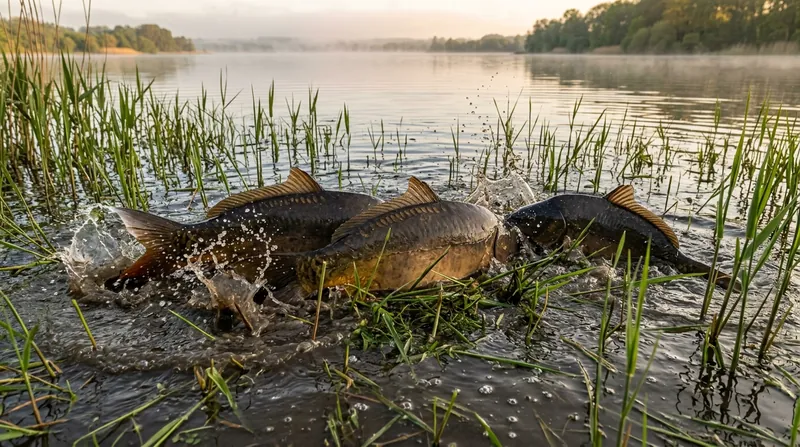
Late in spring. Spawning only starts when the water reaches 15 to 19 degrees, and carp prefer 18 to 22 degrees. In the Netherlands that is usually from mid-May to the end of June (Sportvisserij Nederland). In poor conditions, spawning can be delayed until August. That happens, for example, when there are too few plants, or when the water level is low or keeps changing (Deltares). The carp then move in small groups into shallow water (Sportvisserij Nederland). A female spawns with a few males among dense plants, and the sticky eggs stay attached to the plants (FishBase). This often happens early in the morning, and the eggs hatch after 3 to 10 days, depending on the temperature (Deltares).
Even so, breeding often fails in the Netherlands. The water is often too cold for the young fish (Sportvisunie), and many of them are eaten (Sportvisserij Nederland). It works best in shallow, warm water with plenty of plants and few predators, especially where the water is slightly salty (Schiphouwer et al.). That is why carp have been farmed and stocked in the Netherlands for centuries (Sportvisunie). More on that under carp in the Netherlands.
Where to find carp
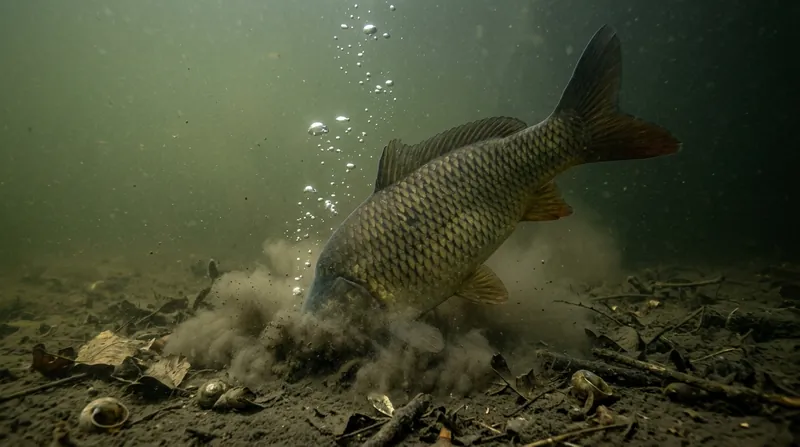 A feeding carp: silt and bubbles give it away
Carp now live in almost every part of the Netherlands (Sportvisunie): in ponds and town canals, in small lakes and polder water, and in big canals, rivers and lakes. They like warm, shallow water that is still or flows slowly (Sportvisserij Nederland), preferably with a muddy bottom (FishBase).
Where in that water? Reed beds are always worth trying, especially where the stems are not too dense. Carp also like to lie under overhanging branches and bushes. Bridges are real hotspots, especially when the water gets colder. In the polders, try the culverts, the pipes that carry water under a road or dike. Sand and gravel pits are often hard work, but a carp caught there is usually a big one (Sportvisunie).
Carp often give themselves away. Watch for moving reed stems, small clouds of mud, bubbles rising and carp showing at the surface (Sportvisunie, Sportvisunie). Those bubbles usually do not come from the fish itself. They are gases from the mud, released when a carp roots in the bottom. You see them best early in the morning (Angling Times). But not every bubble is a feeding carp: a fish scraping its belly through the mud can make bubbles too (VISblad).
Keep quiet on the bank. Carp are usually very shy by nature and swim off at any strange movement or noise in or near the water (Sportvisserij Nederland).
For how to find carp on a big water, see our page on the IJsselmeer. What our models see in carp water is at the bottom of this page.
Carp fishing through the year
Watch the water temperature above all. A carp usually starts to feed when the water reaches 13 to 14 degrees, and feeds most at 23 to 28 degrees. Below 8 degrees it usually stops looking for food, although carp have been seen feeding under the ice (Sportvisserij Nederland). A sudden cold snap can make carp less active. If the temperature stays level or the water warms a little, you often catch more (Sportvisunie).
Spring. The top layer of the water warms up first, and it often holds more oxygen, which makes it attractive to carp (Sportvisunie). Don't feed too much in spring: too much bait fills the fish up fast. Start with a small handful and only add more once the fish are eating (Sportvisunie).
Spawning time. Spawning starts when the water reaches about 18 degrees. The carp are less active then, but a few days before and after they are extra hungry (Sportvisunie). If you see carp spawning, leave them alone and fish elsewhere. Spawning takes a lot out of a carp, and it can lose scales and split fins (Angling Times).
Summer. The carp is active. In calm, warm weather it often swims just under the surface (Sportvisserij Nederland). This is the time for surface fishing. When the water gets very warm, it holds less oxygen and carp become less active (Sportvisunie). Want to fish at night? Read the night fishing rules first.
Autumn. The water cools and carp move to the deeper spots, where the water stays warm the longest (Sportvisserij Nederland). In September carp can still feed well, but even then don't put in a lot of bait at once: start small (Sportvisunie).
Winter. Carp gather in deeper water and eat very little (Sportvisserij Nederland). You can still catch them. Feed very little: according to carp angler Remond van Dijk, a can of sweetcorn or a scoop of hemp is more than enough. You want the fish to get used to the bait, not to fill up on it (VISblad). Look for spots that are slightly warmer. A reed bed on the sunny side can be a degree warmer, and carp find such spots without fail, Van Dijk says (Sportvisunie). Expect few bites: for carp angler Henri Kellij, one fish per session in winter is often a good result (Sportvisunie).
Methods and tackle
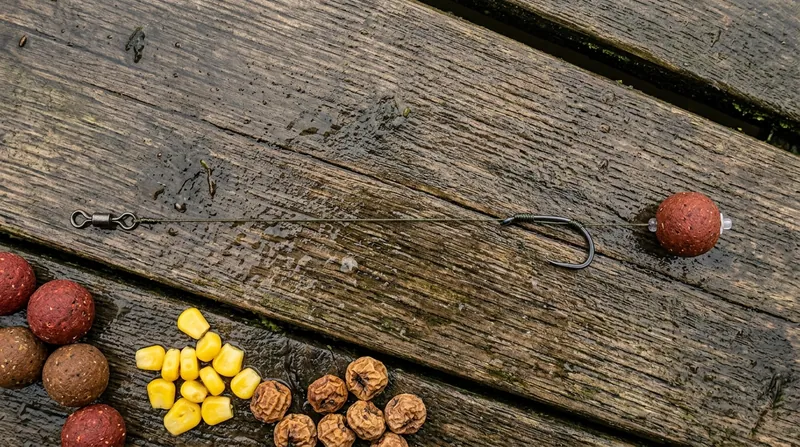 The hair: the bait sits on its own short line, not on the hook
Many carp anglers fish static: bait on the bottom and a self-hooking rig, so the carp hooks itself as it picks up the bait (Sportvisunie). The bait does not sit on the hook but on a hair, a short loop of line that sticks out below the hook. Leave about a finger's width between bait and hook, so the hook point stays free and pricks well (Sportvisunie). The hair rig was invented in England in the late 1970s by the carp anglers Len Middleton and Kevin Maddocks (American Carp Society).
The heavy lead is part of the system: its weight is what makes the carp hook itself. The Dutch federation advises lead-free weights of 80 to 100 grams (Sportvisunie). Make your rig fish-safe: if your line breaks, the carp must at least be able to shed the lead (Sportvisunie).
Which bait? The most popular bait is the boilie, a boiled ball of paste in many colours and flavours. Sweetcorn works well too, tinned or boiled maize (Sportvisunie). Tiger nuts have one big advantage: of all seeds and nuts, they are the one other fish leave alone best (Sportvisunie). But prepare them properly: soak them for at least 12 hours, then boil them for about half an hour (Sportvisunie). A dry nut can swell up in a carp's stomach. According to the tackle maker Korda, that is one of the reasons some fisheries ban tiger nuts, and properly prepared they cause the fish no problems (Korda). Some waters ban them altogether (CarpFarm Lake).
Method feeder. This is a flat feeder with groundbait moulded around it. Your hookbait sits in the middle of that little pile of feed. The short hooklength and the weight of the feeder make the rig largely self-hooking (Angling Times). Use a feeder of 15 to 30 grams and a hooklength of 5 to 10 centimetres (Sportvisunie). With a method feeder you can fish for carp with fairly light tackle (VISblad).
Tackle. For static fishing, use a carp rod of 3.30 to 3.60 metres with a test curve of 2 to 3 lb. The test curve tells you how stiff a rod is. Use a reel from the 4000 to 8000 range, loaded with 0.25 to 0.35 mm nylon or 0.18 to 0.25 mm braid. Near snags, fish heavier (Sportvisunie). A landing net, an unhooking mat and a weigh sling always belong in your kit (Sportvisunie).
Float fishing for carp
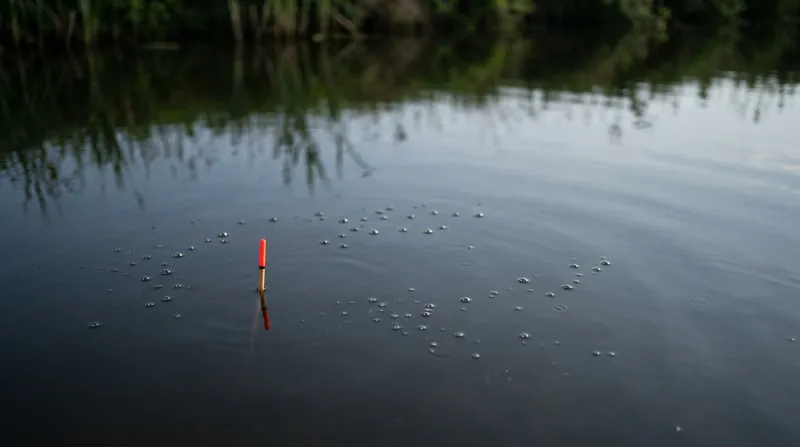 Set right: only the tip of the float shows above the water
Float fishing is an active way to fish for carp. You move from spot to spot, so take very little gear (Sportvisunie). And you see the bite happen: the float trembles, then slides away (Sportvisunie). It often works well on smaller waters: ditches, small town canals, polder water and ponds in towns and parks. They often hold plenty of carp, and there is usually one close to home (Sportvisunie). Take the ditches and small canals of the Haarlemmermeer polder, around Hoofddorp and Schiphol airport. According to the Dutch angling federation, they are full of carp, and the VISpas covers most of them (Sportvisunie).
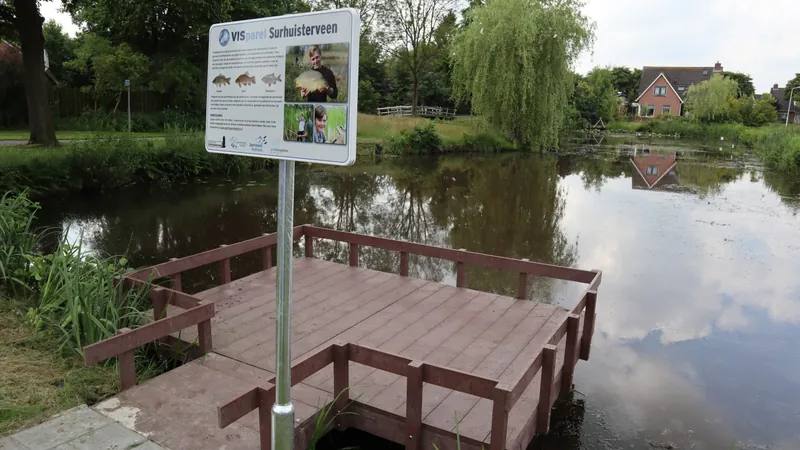 VISparel Surhuisterveen: the sign and the fishing platform. Photo: Sportvisserij Fryslân
VISparels. A good place to start is a VISparel. That is a town or village pond that clubs and federations have made easy to fish, often with the council. The idea is a spot close to home, with fishing platforms and enough fish to actually catch something. VISparels are mainly meant to get young people fishing (Sportvisunie). In Surhuisterveen, the club, the council and the federation opened the VISparel together in 2021. They put up the VISparel sign in the photo, and common and mirror carp were stocked there that year (Sportvisserij Fryslân). At some VISparels you fish lead-free (Gezamenlijke Lijst). And with the VISpas, every carp goes back here too (VISpas conditions).
Fish tight against a reed bed, or against a bed of water plants such as water lilies or bulrushes. Carp look for food along the reeds and for cover under the floating leaves (Sportvisunie). Does a polder ditch look the same all along? Then look for whatever breaks it up: a culvert, a small bridge, a reed bed or the mouth of a side ditch (Sportvisunie). Near reeds, weed and bridges, use strong tackle. Then you can keep the carp out of the reeds and weed, and it comes to no harm (Sportvisunie). There is more on good spots under Where to find carp.
The strength of float fishing is a few small baited spots along the bank that you fish one after another. Scatter three or four handfuls of sweetcorn or chickpeas on each spot, then fish each one for 30 to 45 minutes. That way you work through 8 to 10 spots in a day. And there is a good chance a carp is already on the bait when you reach a spot. You go to the carp, instead of waiting all day for one to swim past (Sportvisunie). In March the water is still cold. Carp angler Bente Morsch then fishes each spot for only about ten minutes, which covers at least five spots an hour (Sportvisunie).
Bait for float fishing. Float anglers mostly use natural baits: sweetcorn, tiger nuts or chickpeas. A big worm can also work surprisingly well (Sportvisunie). Sweet tinned corn is popular. If other fish keep taking it, use hard maize instead. Soak it for 12 hours and boil it for 30 minutes, just like chickpeas (Sportvisunie). Put two or three grains on the hook, or thread them onto a hair with a baiting needle. Right after casting, throw a small handful of corn around the float (Sportvisunie). If a wary polder carp ignores your corn, it will often still take a worm, especially in spring (Sportvisunie).
Which float? On shallow water you can use a fixed float. On deeper water, use a sliding float, which runs freely on the line. Pick one with a bright yellow or orange tip, so you see the bite best (Sportvisunie).
Setting the float. Usually you present the bait on the bottom. Pinch a small shot onto the line 15 centimetres from the hook. Then add more shot above it until the float sinks slowly. The float stops sinking as soon as the bottom shot touches the bottom. Now slide the stop knot above the float up the line, until just the tip of the float shows above the water (Sportvisunie). The float then rests on that bottom shot. When a carp takes the bait, the float can rise: a lift bite (Sportvisunie). It can also go under or slide away at an angle, so watch the tip closely (Sportvisunie). If the carp are swimming at mid-depth, set the float so the bait hangs about 40 centimetres below the surface (Sportvisunie).
Striking and playing the fish. Sit low and move slowly, so you don't scare the fish. A cap and polarised sunglasses help you see much better (Sportvisunie). A few small dips, then a float sliding under at an angle: that is often the moment to strike. Strike at once. In open water, let the carp run. If it heads for weed or snags, slow the spool with your finger. Set the drag on your reel beforehand, so it gives line when you pull hard. Then your line won't break when the carp bolts (Sportvisunie).
What to take. Use a rod of 3.30 to 4 metres with a test curve of 1.5 to 2 lb. An ordinary reel in the 4000 to 6000 size is fine. Load it with 0.22 to 0.30 mm nylon or 0.18 to 0.20 mm braid. Use a thick-wire hook in size 6 to 10, because carp are very strong. A large landing net with fine, rubber-coated mesh protects the carp's slime layer. And pick an unhooking mat that rolls or folds up, so it fits in your bag (Sportvisunie).
Surface fishing for carp
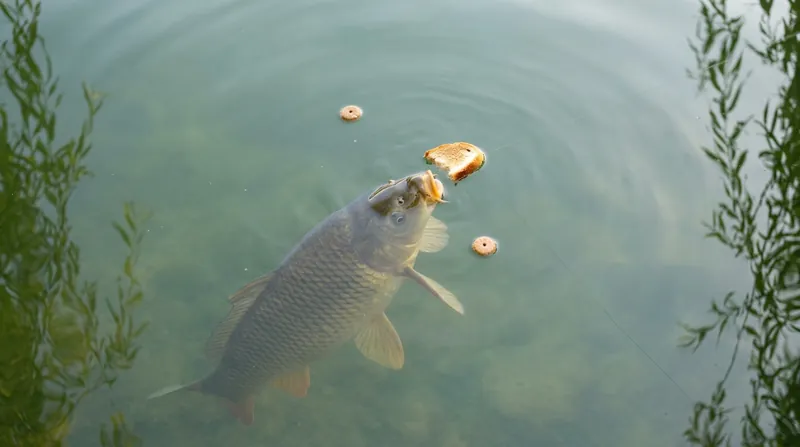 Surface fishing: a carp comes up to a floating bread crust
In surface fishing you watch a carp take your floating bait, and then you strike. The Dutch angling federation calls it the most exciting way to fish for carp (Sportvisunie). You need very little: a rod, a net, an unhooking mat and some floating bait. If the weather is right, a few hours after work can give you a good chance of a carp (Korda).
When? Carp come up to the surface mainly after a few warm, sunny days in a row. Around midday it can then be hard to get a bite, because the fish would rather sunbathe. Your best chance is often early morning or evening. You don't need sun as such: on warm, cloudy days you will often see them up top too, though they don't always feed (Korda). In spring and early summer, carp also often swim high in the water (Sportvisunie). A strong wind makes it hard work: casting is more difficult, and the waves make the fish harder to find (Sportvisunie).
Where? You can catch carp off the top in any kind of water. But clear, still water is best, because you spot the fish sooner. Carp in town waters are usually easier to bring up than carp in big lakes or murky polder water. Think of the town waters of Amsterdam, Utrecht, Den Bosch, Zwolle or Arnhem (Sportvisunie).
Bread crust. The classic bait is a piece of bread crust. Some anglers call it old-fashioned, but it still catches well (Korda). Bread crust is still popular too: Instagram is full of carp caught on a crust of white bread or on dog biscuits (Sportvisunie). Especially where people feed birds, carp are used to bread (Sportvisunie). Just don't fish a floating crust there when ducks are close by. The VISpas does not allow it (VISpas conditions). Roll a piece of crust up tight, so the hook sits firmly hidden in it (Sportvisunie). A crust is heavy enough to cast without extra weight. It goes further than most baits, especially after a quick dip in the water. But it soon goes soggy and falls apart (Korda). Wet a crust and gently squeeze it out, and it sinks slowly: useful for a carp swimming at mid-depth (Sportvisunie).
Dog and cat biscuits. Floating pet biscuits work well too. They are too hard to put on a hook, so you fix them in a bait band, a small rubber ring (Sportvisunie). Start by scattering a few biscuits. According to the Dutch federation, they release oil and salt, and that often brings the carp up for a look (Sportvisunie). Don't throw them onto the fish's heads; let them drift over to the carp (Korda).
Casting and striking. Don't cast too soon. Wait until the carp are really eating the biscuits, then pick the fish you want to catch. Cast beyond it and wind in a little line, very gently, so you don't spook it. The golden rule: don't strike too early, but wait until the carp has closed its mouth (Sportvisunie). Need to cast further? A controller, a weighted float on the line, gives you casting weight and shows you where your bait is (Korda). One step further is stalking. You creep right up to a carp and hold your bait under the rod tip, right by its mouth (Sportvisunie).
Mind the birds. The VISpas conditions forbid fishing in a way that makes it likely a bird or any animal other than a fish will take your bait. Their own example is a floating crust next to a group of ducks. Stay with your rod, too. In a busy town canal, you may not lay down a rod with a floating crust and walk away (VISpas conditions). On some waters, fishing with floating bait is banned altogether. So check the list of waters that comes with your VISpas (Gezamenlijke Lijst).
Rules for carp fishing
For most inland waters in the Netherlands you need a VISpas: together with its list of waters, it is your fishing permit. Its conditions add rules of their own on top of the law.
Is there a closed season for carp?
No. Dutch law sets no closed season and no minimum size for carp (Uitvoeringsregeling visserij, articles 5b and 5c). You can fish for carp all year round. But with the VISpas you may never take a carp home, whatever its size (VISpas conditions).
Can you keep a carp?
No. If you fish with a VISpas, every carp must go straight back, unharmed, into the same water. You may take a photo first. The same rule applies to grass carp and eels (VISpas conditions). For that photo you may keep a carp briefly in a sling (a floating weigh sling) or a carp sack. But not for hours, for example to wait for better light. And you may only use them between sunrise and sunset. These rules for carp sacks and keepnets became stricter in 2026 (VISpas conditions). So between sunset and sunrise you may not keep a carp in a carp sack or sling at all, not even briefly. If you catch one at night, take the photo straight away and put it back at once.
Can you fish for carp at night?
Only if whoever holds the fishing rights allows it (VISpas conditions). With the national NachtVIStoestemming, the night fishing permit, you may fish at night on waters marked with a moon symbol in the VISplanner app or in the list of waters. On other waters it is not allowed, or only with extra permission from the local club or federation (Sportvisunie). Nature reserves can have their own rules. Night fishing means fishing from two hours after sunset to one hour before sunrise (Sportvisunie). You may stay on the same spot for at most three times 24 hours. Avoid loud noise and bright lights (VISpas conditions).
Want to fish from a bivvy or another shelter? That is allowed on waters marked with the shelter symbol. Where the symbol is missing, it is either not allowed or not known, so check the rules for the water and the local council (Sportvisunie, VISpas conditions). Being allowed to night fish somewhere does not mean a tent is allowed there too (Sportvisunie).
How many rods?
With the VISpas you may fish with two rods at most. With the Derde Hengeltoestemming (the third-rod permit) you may use a third rod on waters marked with a 3 in the VISplanner. The two outer rods may be no more than 10 metres apart. And never leave a rod unattended: you must be able to see it clearly and reach it quickly. With a free-spool reel and a bite alarm, 25 metres can still be acceptable (VISpas conditions).
What differs from water to water?
A lot. Whether you may use a bait boat is up to whoever holds the fishing rights, so always ask (Sportvisunie). There is no national ban on barbed hooks, but some waters have their own rule (Sportvisunie). The carp code of conduct that comes with the VISpas asks you to always use an unhooking mat. On some waters the mat is compulsory, or carp sacks are banned outright (Gezamenlijke Lijst). So always check the VISplanner for the water you fish.
Unhooking and releasing carp
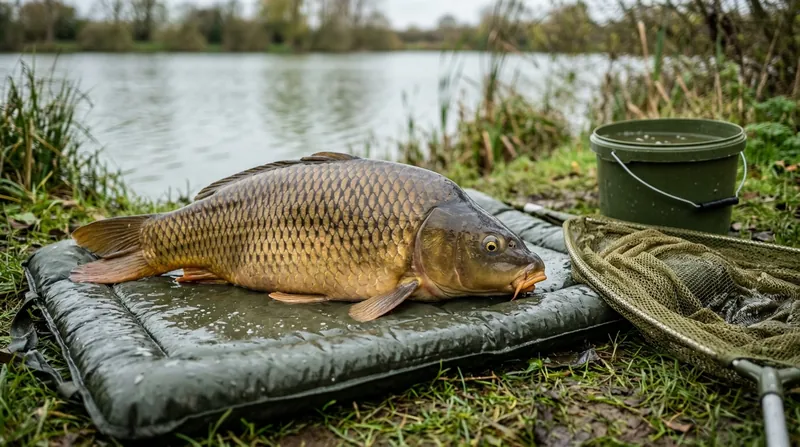 Low and wet: a carp on a wet unhooking mat
Every carp goes back, so do it in a way that harms it as little as possible. Wet the unhooking mat first and lay the fish on it gently. The mat protects it from the hard ground and keeps its slime layer intact (Sportvisunie). That slime is its main protection against bacteria, viruses and parasites, so keep the fish wet (Dutch carp anglers' association (KSN)). Handle it only with wet hands and keep it out of the water for as short a time as possible (Sportvisunie).
The hook is often in the front of the mouth and comes out easily. If it is stuck, use unhooking forceps (Sportvisunie). Want a photo? Don't lift the fish high; hold it low over the mat or over the water (Angling Trust). Hold a big fish with two hands, one under the head and one under the belly (Sportvisunie).
Then, if needed, support the carp in the water until it swims off under its own power (Sportvisunie). Only let go once it has fully recovered (Sportvisunie). Always return a carp to the water you caught it in. Fish can carry diseases you cannot see from the outside (Sportvisunie).
And the carp sack? It is allowed, but only briefly, for a photo (see the rules). Researchers found that carp kept in a sack become stressed, and that a long stay can damage their tissue. After release the carp recovered quickly, and none died. Even so, the researchers advise against sacks: take the photo straight away and release the fish at once (Rapp et al.). If you do use a sack, put only one carp in it. Hang it in water with plenty of oxygen, and never among water plants (Dutch carp anglers' association (KSN)).
The biggest carp ever caught
The Dutch carp record is 108 centimetres. Joop Butselaar caught this fully scaled carp in October 2000 at the Nieuwkoopse Plassen. The world record is a carp of 34.35 kilograms, caught by Leo van der Gugten in 1987 at Lac de St. Cassien in France. The longest carp we found listed as a record is 119 centimetres: the Swiss record from 2019.
62 cm A typical carp: the middle one of more than 11,000 carp of 20 cm or more measured in fish surveys
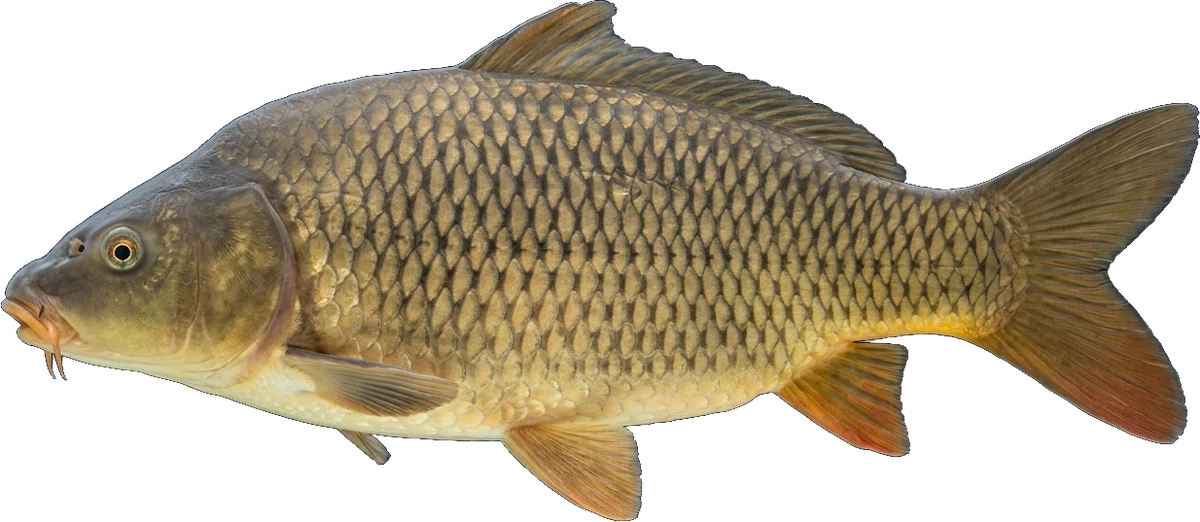
103 cm The longest of more than 45,000 carp measured in fish surveys
108 cm Dutch record (2000)
119 cm The longest we found listed as a record (Switzerland, 2019)
Dutch record
108 cm
Joop Butselaar caught this fully scaled carp on 23 October 2000 at the Nieuwkoopse Plassen, a lake district south of Amsterdam. It was 108 cm long and weighed 31.4 kilograms (Beet). It was a well-known fish. From 1997 to 2001 several anglers caught it, and each time it went back. Until 2000 it kept getting heavier: in 1997 it weighed just over 25 kilograms. Butselaar already held the previous record himself, with the same carp (Beet).
The Dutch record list goes by length only, in whole centimetres. Carp anglers usually weigh their fish instead of measuring it (Beet), yet no Dutch list keeps a weight record for carp. So the heaviest Dutch carp only appear in the carp media. According to the carp site KWO, the biggest was ‘De Zwarte’, a mirror carp also known as ‘The Black Mirror’. In October 2020 the Belgian angler Ian Thiels caught it at 37.8 kilograms, and the carp site CarpFeeling called it a new Dutch record (CarpFeeling). In 2023 it weighed about 41 kilograms (KWO). In 2024 it was found dead (KWO). It was never on a record list.
World record
34.35 kg
The IGFA, the international body for angling records, keeps the world record. Leo van der Gugten caught the 34.35-kilogram carp on 21 May 1987 at Lac de St. Cassien in the south of France. According to the French carp site colinmaire.net, he was Dutch and the fish was a mirror carp. The record has stood for almost forty years.
Heavier carp have been caught. National lists hold heavier fish than the world record, such as Germany's (41.45 kilograms) and Switzerland's (35.5 kilograms). But a fish only reaches the IGFA list if it is submitted there and approved, and IGFA accepts no fish from small waters stocked for commercial purposes (IGFA rules).
A well-known heavier carp is a mirror carp of 51.2 kilograms. The Dutch angler Michel Schoenmakers caught it on 23 November 2018 at Euro Aqua, a members-only private lake near Lake Balaton in Hungary (Euro Aqua, Euro Aqua). It is on no official record list. Euro Aqua feeds its carp all year with its own boilies, and by its own account they grow fast and heavier than normal as a result (Euro Aqua).
English Wikipedia names a different fish as the largest carp ever recorded: 45.59 kilograms, caught by Colin Smith in France in 2013. The catch was real: it was reported at the time as 45.5 kilograms, from a commercially run fishery (Carpzilla). But the Wikipedia sentence has never cited a source; an anonymous editor added it in 2013 (Wikipedia). Like the Euro Aqua fish, it is on no official record list.
IGFA also keeps a separate length record: 106 cm, caught in the United States in 2025. IGFA measures length to the fork of the tail, not to its tip (IGFA rules). With the whole tail fin, that carp would be about 115 cm (FishBase), longer than the Dutch record.
Longest on a record list
119 cm
The longest carp we found listed as a record is the Swiss record: 119 cm and 35.5 kilograms. Ramiz Avdija caught it from the bank of Lake Murten on 16 October 2019. He took the fish home, where it was measured and weighed in front of witnesses (Petri-Heil). The Swiss fishing magazine Petri-Heil keeps the list.
Longer carp have been reported, but not as records. The Austrian list names three carp of more than 120 cm, but none as an angling record. Two come from commercial ponds stocked with big fish; the third, over 125 cm, was found dead in the Zeller See in 2014. The Hungarian list names a 111 cm mirror carp from Lake Balaton, caught in 2016. Since 2024 that list has asked for length to be measured to the base of the tail fin (MOHOSZ). How this fish was measured, we don't know, so we can't be sure it was shorter than the Swiss carp.
The top of this page gives 40.1 kilograms as the maximum weight. That figure comes from FishBase, a large database on fish, which took it from a 2007 collection of world records. Heavier carp have been caught since, such as the German record of 41.45 kilograms from 2012.
Records by country
Every country keeps its own list, with its own rules. Some lists count length, others weight, so the numbers cannot always be compared.
| Country | Record | Angler | Where caught | Date | List |
|---|---|---|---|---|---|
| Netherlands | 31.40 kg · 108 cm | Joop Butselaar | — | Oct 23, 2000 | Sportvisunie |
| Austria | 33.72 kg | Maximilian Gann | a natural lake near Braunau am Inn | 2025 | Rekordfische Österreich |
| Denmark | 25.95 kg | Allan Christiansen | — | May 8, 2025 | Danske Fiskerekorder |
| Denmark | 100 cm | Casper Michaelsen | a lake on Zealand | Apr 28, 2025 | Danske Fiskerekorder |
| Finland | 101 cm | — | a lake | May 29, 2025 | Ennätyskalarekisteri |
| Germany | 41.45 kg | M. Winnikes | a gravel pit in the Rhine valley | Nov 24, 2012 | Fisch & Fang |
| Ireland | 14.24 kg | Aaron Cummins | Loughgall, Armagh | Oct 26, 2014 | ISFC |
| Latvia | 23.67 kg · 96.5 cm | V. Vorobjovs | Daugava | 2024 | LMSF |
| Norway | 13.60 kg | Edvard Lindheim Gisnås | Ulsrudvann | Sep 10, 2014 | Villmarksliv |
| Poland | 39.60 kg | Karol Chojecki | — | 2024 | Wiadomości Wędkarskie |
| Poland | 112 cm | Tomasz Kosyl | — | 2026 | Wiadomości Wędkarskie |
| Sweden | 32.45 kg · 99 cm | Anders Lundmark | Stubbetorpssjön (Blekinge) | Sep 23, 2017 | Sportfiskarna |
| Switzerland | 35.50 kg · 119 cm | Ramiz Avdija | Lake Murten | Oct 16, 2019 | Petri-Heil |
| United Kingdom | 31.071 kg (68 lb 8 oz) | Mike Nixon | Waterside Fishery, Chesham | 2026 | BRFC |
A dash means the list does not give it. Checked on September 26, 2026. A record can be broken at any time, so we check these lists at least once a year.
In the Netherlands
The carp comes originally from the rivers around the Black Sea and the Caspian Sea (FishBase). According to historical research, people carried carp alive and kept them at castles and monasteries. That is how the carp had reached the Rhine region by the twelfth century (Hoffmann). The oldest Dutch record of carp dates from 1342. And in 1405 a wagon with four horses carried some 3,000 carp from the Land van Cuyk to Nijmegen (Sportvisserij Nederland).
So is the carp a Dutch fish? Opinions differ. The Dutch Species Register calls it an exotic species: a species from elsewhere that has maintained itself here for at least a hundred years (Dutch Species Register). The Dutch angling federation Sportvisunie says it can be seen as native. In its view, the carp probably spread here on its own from the Rhine region in the Middle Ages (Sportvisunie).
The IUCN Red List classes the carp as Least Concern (FishBase), and in the Netherlands it is not threatened either (Dutch Species Register). That is not true of the real wild carp. European carp are thought to descend from the wild river form of the Danube. That form has become very rare and probably no longer exists in pure form (FishBase).
Carp fishing is very popular. In 2014 an estimated 300,000 to 400,000 anglers in the Netherlands fished for carp (Sportvisunie). To keep numbers up, the Sportvisunie and angling clubs stock some 13,000 kilograms of carp every year. Most go into open water, such as canals, big rivers and the Randmeren lakes. Around 2000, mirror carp projects started across the Netherlands. Caught a mirror carp? Take a clear photo of its side, note its length and weight and send them to the Matching Community web app. That helps show what stocking mirror carp achieves (Sportvisunie).
You may not stock carp yourself. Stocking fish needs written permission from whoever holds the fishing rights (Fisheries Act 1963, article 17). Even then it follows a plan. Carp root in the bottom. A lot of carp in a shallow lake can make the water cloudy and the water plants disappear. When carp and bream are removed, such a lake often turns clear again and the plants come back (Sportvisserij Nederland). How big that effect is depends mainly on how many carp there are and on the water itself (Sportvisunie). In one American lake the carp stock grew to about 100 kilograms per hectare. At the same time, plant cover fell by about half (Bajer et al.). That is why Rijkswaterstaat, the water boards and the Sportvisunie have used a guideline since 2016 to work out how much carp a water can carry (Sportvisunie). In clear waters with plenty of plants the Sportvisunie aims for about 80 kilograms of carp per hectare, mostly bigger fish (Sportvisunie).
Found dead carp?
Sometimes many carp die in one water at the same time. One possible cause is koi herpesvirus (KHV). It only makes carp and koi ill, often with many deaths, usually when the water is between 15 and 28 degrees. It is not dangerous to people (Wageningen University & Research). But fish can also die from a lack of oxygen, for example after a heatwave or a thunderstorm. If you see dead or sick fish, report it to the water authority and to your angling club and regional federation (Sportvisunie). At home, rinse wet gear such as your landing net and unhooking mat with warm water, and let it dry fully. That way you don't spread fish diseases (Gezamenlijke Lijst). What our models see in carp water is below.
What our models found for Carp
Below is what our models see in the data. These are links: where one thing occurs, the other occurs more often. That is not a cause. Each model answers one question and may not say more than it measured. The label by the heading tells you which question — and how sure the answer is.
Where this species lives Strong model
 Prussian carp (Carassius gibelio)
In this model, carp water is marked by small fish. Three-spined stickleback comes first, then Prussian carp, tubenose goby, gudgeon and bleak. Roach, bream and tench weigh heavily too. But they live in nearly every Dutch water. So they separate carp water from nothing.
Prussian carp is the odd one out, and the interesting one. It is a relative of the carp with a strange way of breeding. The females need sperm from related species to start their eggs. The male passes on no DNA. Whether carp is used for that, we do not know. We only know they share the water.
Nutrient richness also counts in this model, and that is where cause and effect need care. Carp root through the bottom: they uproot plants and spit sediment back into the water. So they do not only belong to rich, murky water — they also make it. Which way it points here, this model cannot say.
Where there are many A set, not a ranking Weak model
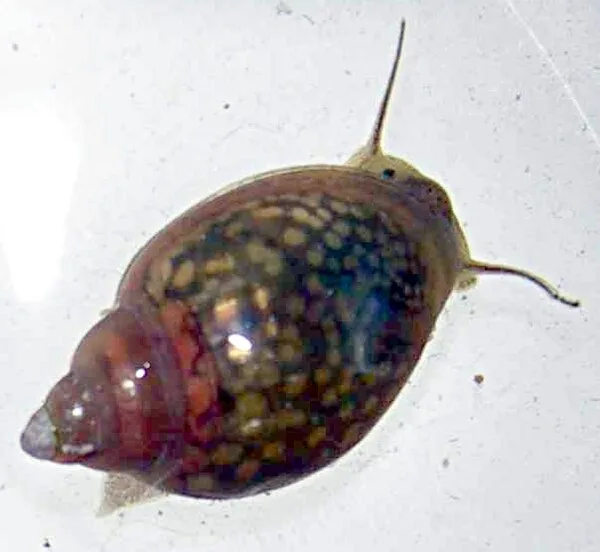 Bladder snails (Physidae)
This model only looks at places where carp have already been caught. Plenty of carp goes with bladder snails (Physidae) and plants from the bedstraw family (Rubiaceae).
The list for fewer carp is longer: cryptomonads (Cryptomonadaceae), tube-net caddisflies from the family Polycentropodidae, biting midges (Ceratopogonidae) — and chlorinated compounds in the water. That last one is neither animal nor plant. It comes from us, and it is the only thing on this list you could change.
Where they grow big Strong model
 Tench (Tinca tinca)
This model points one way. Big carp go with tench and perch, with horseflies, large biting flies (Tabanidae), with a bottom rich in organic matter, and with eel. Further down the list come mosquitoes (Culicidae) and phantom midges (Chaoboridae).
Together that is the picture of old, quiet, rich still water with a soft bottom. Tench and eel belong there, phantom midge larvae live in the mud of deeper pools, and horseflies and mosquitoes along a marshy bank. Where there is plenty to eat on and in the bottom, carp are bigger on average.
One thing seems to contradict that. Organic matter goes with bigger carp, but moth flies (Psychodidae) go with smaller ones. Those are larvae that live in rotting matter and cope with foul, oxygen-poor water. Perhaps it is not a contradiction but a sliding scale: food at one end, pollution at the other. We have not measured that.