Identification
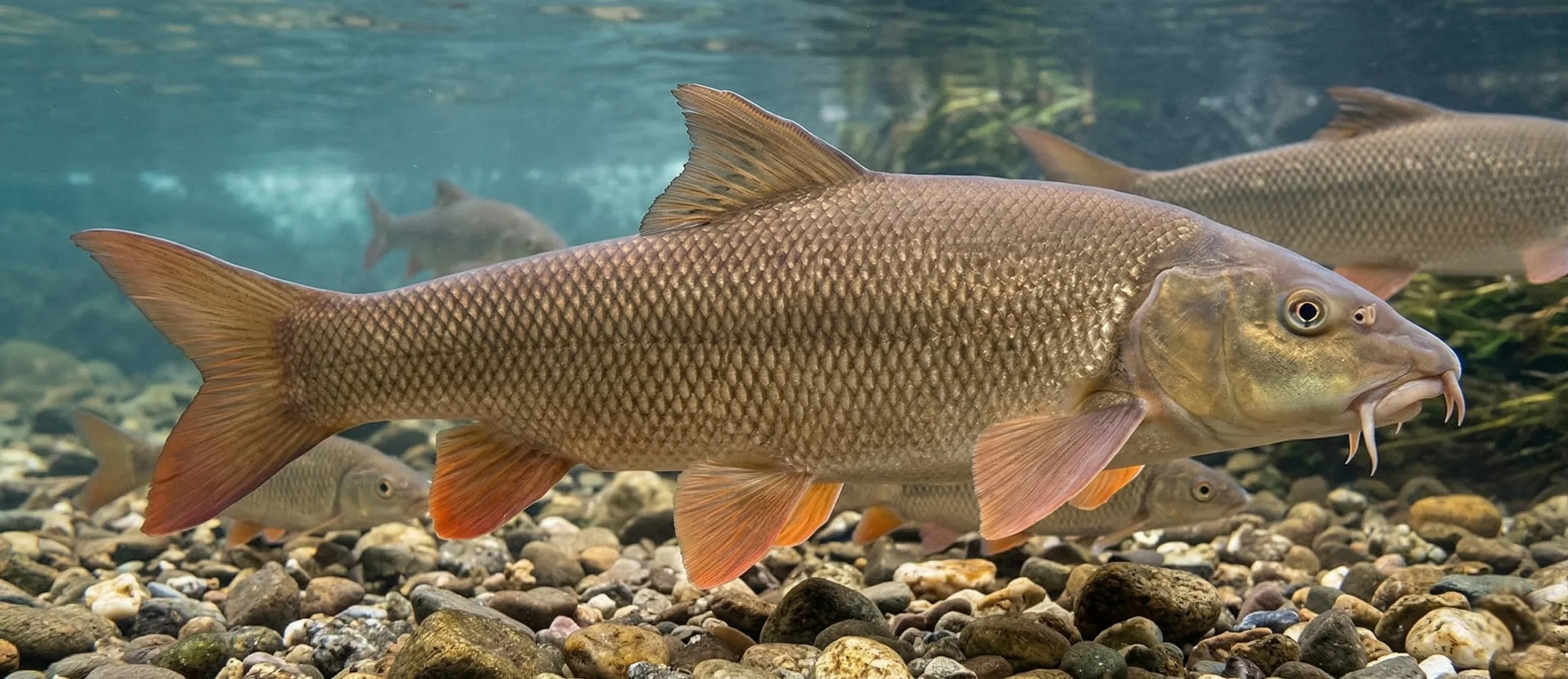
The chub is a powerful, streamlined cyprinid with a broad, flat head and a large terminal mouth. The body is silvery with a dark green to brown back and notably large, dark-edged scales forming a net-like pattern. The anal fin is distinctly convex — the key difference from the dace, which has a concave anal fin. Adult specimens average 25 cm, but chub over 50 cm are possible in good waters.
Behavior & ecology
The chub is an omnivorous opportunist that increasingly switches to fish as it grows older. Young chub eat insects, larvae and plant material, while large specimens eat small fish, crayfish and even mice. The species is exceptionally intelligent and wary — large chub are known as one of the most difficult freshwater fish to catch. They like to station near overhanging trees, bridges and other structures where food falls into the water. Spawning takes place in May-June on gravel bars in flowing water.
Fishing techniques
The versatility of the chub makes it catchable with virtually any technique. Fly fishing with dry flies and nymphs is classic and effective, especially in streams. Lure fishing with small plugs and spinners works well for larger specimens. Floating bread crust on the surface is a deadly method in summer.
- Spring/summer: fly fishing (dry flies, nymphs), floating bread crust
- Summer/autumn: small plugs, spinners, soft shads
- Natural bait: maggots, casters, worms, cheese, bread crust
Chub are extremely wary — a stealthy approach and fine tackle are essential. The best spots are near overhanging trees, weirs and bridges in rivers and streams.
In the Netherlands
The chub naturally occurs in the rivers and streams of southern and eastern Netherlands, especially in Limburg, Gelderland and Overijssel. The species prefers clean, flowing water with a gravel or sand bottom. The largest specimens are caught in the major rivers (Meuse, Waal, Rhine), while the Limburg streams are classic chub waters. The species benefits from improved water quality and has expanded in recent decades. The chub plays an important role in the river ecosystem as a link between insects and larger predatory fish.
What our models found for Chub
Below is what our models see in the data. These are links: where one thing occurs, the other occurs more often. That is not a cause. Each model answers one question and may not say more than it measured. The label by the heading tells you which question — and how sure the answer is.
Where this species lives Strong model
 Stone loach (Barbatula barbatula)
The strongest name in this model is the stone loach, a small bottom fish of running water. The model counts it twice: once as a species and once as a family. Together that is a good quarter of the whole model.
After it comes a whole stream community. The banded demoiselle (Calopterygidae) is a damselfly that raises its larvae in flowing water with plants. Caddisflies of the family Hydropsychidae spin a catching net in the current. Blackflies (Simuliidae) anchor their larvae to stones. And water mites of the families Sperchontidae and Lebertiidae live only in water that moves.
Two other invertebrates say the same thing. Caddisflies of the family Psychomyiidae build sand tunnels on wood and stone. And larvae of the cranefly Dicranota (Pediciidae) hunt among the gravel. Gudgeon, three-spined stickleback, ide and gobies fill out the list.
FishBase calls the chub most abundant in small rivers and large streams of barbel zone, but also puts it along the shores of slow-flowing lowland rivers and even in very small mountain streams.
That explains something that looks odd. On the barbel page the chub is the strongest name of all. The other way round it is not: the barbel is nowhere in this list. The chub lives in barbel water AND in a lot of water beyond it. So it predicts the barbel, and the barbel does not predict it.