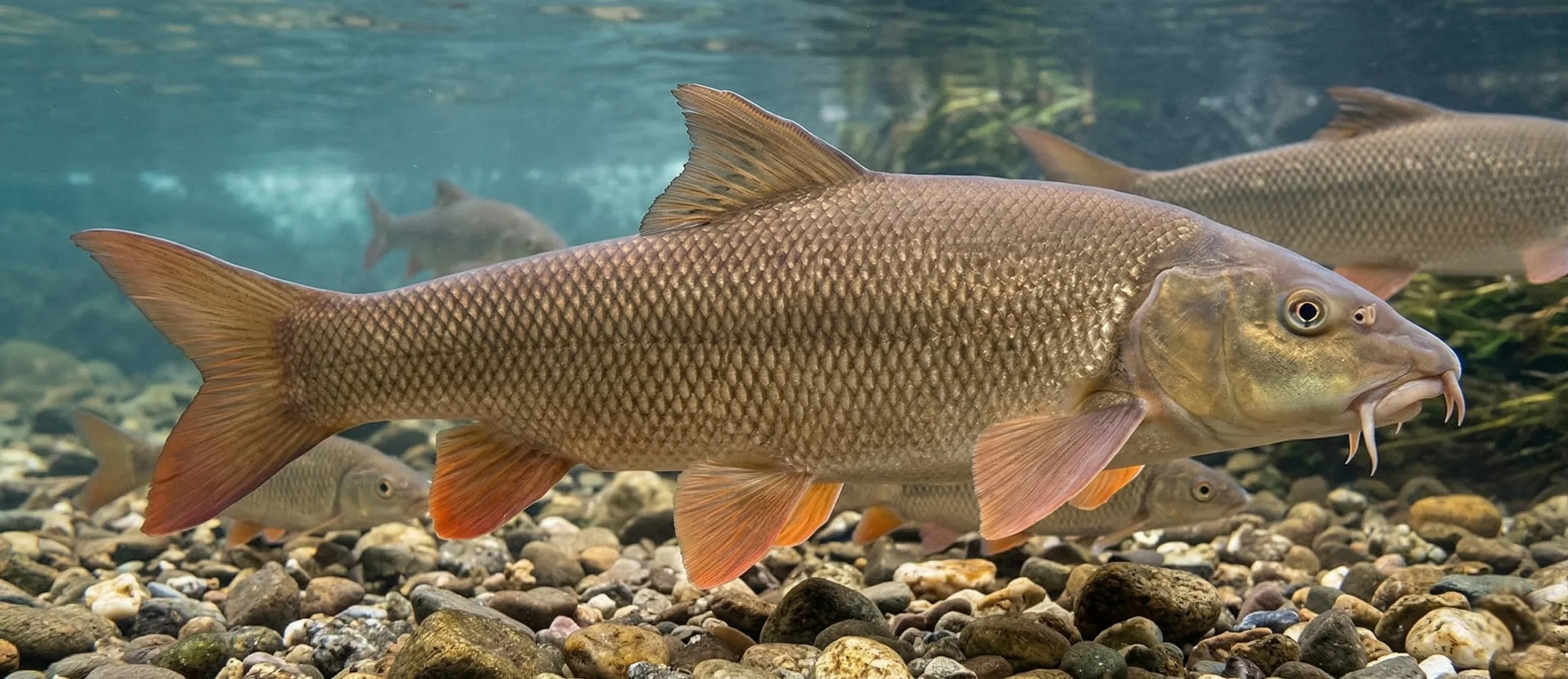
Bream is a coarse fish you catch all over the Netherlands: in the polders, in canals, on the rivers and in big lakes. You fish for bream with a feeder rod or a pole, with groundbait and bait on the bottom. On this page you read how to recognise a bream and how to tell it from a white bream. You also read where and when to catch it, what you may take home, and how big it can grow.
Identification
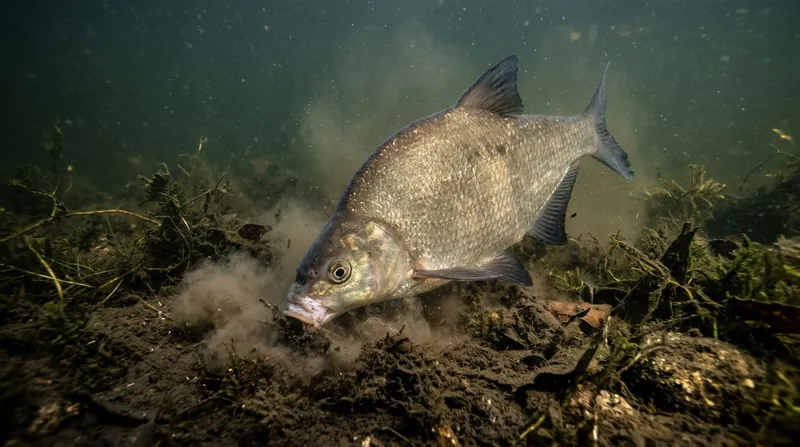 A bream with its mouth pushed out into the mud
You know a bream by its tall, flat body. It is strongly flattened from the sides, and its body is 30 to 40 percent as deep as it is long. The head is small, and bigger bream often have a kink behind the head (Kennisdocument brasem). The mouth sits low on the head and can be pushed out like a short trunk (Visionair). That is how a bream takes its food from the bottom; see life and spawning. Bream have no barbels (Sportvisunie).
Look at the anal fin too: the fin on the underside, between the pelvic fins and the tail. On a bream it is long, sometimes a quarter of the body's length. The dorsal fin is short and triangular. Young bream are silvery grey; in older fish the flanks turn yellowish brown or bronze (Kennisdocument brasem). An old bream can be dark grey to dark brown (RAVON). At spawning time the males get small white bumps on the head and body, called spawning tubercles (Kennisdocument brasem). In English the fish is also called common bream or bronze bream, and in Dutch brasem (Kennisdocument brasem).
How big do bream get?
In the Netherlands a bream usually grows no longer than 60 centimetres (RAVON). The Dutch record is 77 centimetres; see the records. How fast it grows differs a lot from water to water. In its first year a bream grows 5 to 7 centimetres on average. The Dutch angling federation's knowledge document calls growth fairly good when a bream is 12 centimetres after 2 years and 40 centimetres after 8 years. In the best conditions a bream can already be 20 centimetres after 2 years (Kennisdocument brasem). On the IJsselmeer it can be faster still. Most bream that commercial fishers catch there in set nets are 2 years old and already 28 to 32 centimetres (CVO report 2026).
Fish surveys in the Netherlands have measured more than 560,000 bream. Of the more than 100,000 bream of 20 centimetres or longer, the middle one was 36 centimetres. About 1 in 30 of those was 60 centimetres or longer, and only 13 reached 70 centimetres. How big the biggest bream ever were is under the records.
Seabream and gilthead seabream: are they bream?
No. Seabreams are a family of sea fish of their own, the Sparidae (Wikipedia). The blackspot seabream and the gilthead seabream belong to it. Gilthead seabream is one of the most important farmed fish in salt water (FishBase). The bream on this page belongs to a quite different group, the carp-like fishes (FishBase). The white bream really is its relative (Kennisdocument kolblei); see bream or white bream.
Bream or white bream?
 A white bream: a large eye, and orange-red where the pectoral fin begins
A young bream in particular looks a lot like a white bream, also called silver bream (RAVON). The two often swim together, too: white bream often live in shoals of bream (Kennisdocument kolblei).
Look at the eye first. In a bream the eye is smaller than the distance from the eye to the tip of the mouth (Sportvisunie). In a white bream the eye is larger than that distance (Sportvisunie). In small fish the difference is less clear (Kennisdocument brasem). A white bream also has fewer rows of scales between the lateral line and the dorsal fin (RAVON). The lateral line is the line of dots along the flank.
Then look at the fins. A white bream often has red patches, mostly where the pectoral and pelvic fins begin (Kennisdocument kolblei). In a bream the pectoral and pelvic fins are light grey and the other fins dark grey, with no red. But colours are not a firm feature (Kennisdocument brasem). Biologists also look at the throat teeth, at the back of the throat. In a bream they stand in one row (Kennisdocument brasem), in a white bream in two (Kennisdocument kolblei).
There is a rule you sometimes hear: in a bream the pectoral fins reach past the start of the pelvic fins, and in a white bream they do not. The Dutch biologist Redeke checked this long ago on a large number of fish. In his words, the feature does not hold "at all": there are bream with shorter and with longer pectoral fins (Kennisdocument brasem).
Caught a 'small bream' in one of the big rivers? Look again. In the Waal, the IJssel, the Lek and the Nederrijn there is often more white bream than bream. In big lakes it is the other way round (Kennisdocument kolblei).
Hybrids. Bream also cross with other fish. The cross between roach and bream is the most common hybrid in the Netherlands (Sportvisserij Nederland). Such a hybrid has a shorter anal fin than a bream, with 15 to 18 soft rays: the thin rods that hold up the fin. The biologist Heckel once described it as a species of its own, Abramis leuckarti. In Dutch it even had a folk name: amelom or amelong (Redeke, De Levende Natuur). Crosses of bream and white bream occur too (Redeke, De Levende Natuur).
Zope, white-eye bream and vimba bream. These fish look like a bream too, but you rarely catch them. The zope has a small mouth that points upwards, and a very long anal fin with 37 to 46 rays (RAVON). The white-eye bream also has a long anal fin, with 41 to 48 rays (RAVON). And the vimba bream is less deep-bodied (RAVON) and has a fleshy, dark nose (RAVON).
Life and spawning
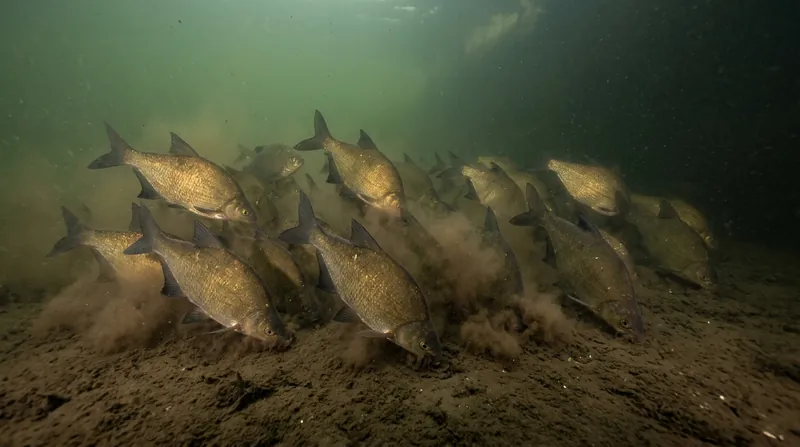 A shoal of bream rooting in the bottom
Bream spend most of their lives in shoals. After spawning, a shoal breaks up into smaller groups of fish of about the same length and age. Only very old bream live in small groups or alone (Deltares). An older bream stays in deeper, open water by day, and near the banks at night. This shows most clearly in bigger waters (Kennisdocument brasem).
What do bream eat? A young bream filters zooplankton out of the water: tiny animals that float in it (RAVON). From about 2 centimetres it also eats small midge larvae. A bream of three years or older mostly feeds in deeper places. It then eats midge larvae, tubifex worms, small snails and small mussels (Kennisdocument brasem). Bigger bream sometimes eat small fish too (FishBase).
A bream finds its food mostly by touch. With its muscular mouth it pulls larvae from up to 10 centimetres deep in the bottom. While it feeds it hangs almost still, head angled down or almost straight onto the bottom. It sucks up bottom material with its extended mouth, and that flows through a fine sieve in its gills. This lets it take in very small bits of food (Kennisdocument brasem). It also swallows a lot of dead matter from the bottom. That can be 80 to 90 percent of what is in its stomach and gut (Deltares). In the dark a bream finds food on the bottom just as well as in daylight (Kennisdocument brasem).
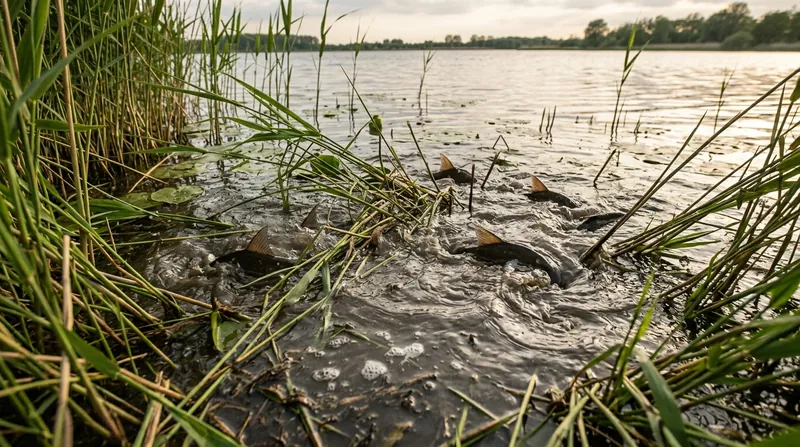 Bream spawning among the reeds
Spawning. In the Netherlands bream usually spawn from late April to mid-June. The water is then about 12 to 20 degrees, and most bream spawn at around 16 to 18 degrees (Kennisdocument brasem). In lakes the bream often move into the canals and ditches around them to spawn. In rivers they also spawn on flooded grassland at high water (RAVON). They do not need water plants: on the IJsselmeer, bream spawn on the basalt blocks of the dikes, among other places (Kennisdocument brasem).
On the spawning ground, each big male holds a patch of its own of 1 to 5 square metres and chases other males away. The males draw a female in by swimming quickly to and fro. Spawning happens mostly in calm weather, in the evening and at night, with splashing and quivering. The eggs are sticky and pale yellow, 1.5 to 2 millimetres across, and hatch after 3 to 13 days. Usually only 1 percent of the eggs and larvae, or less, survive until the young can swim freely (Kennisdocument brasem).
Bream mature late: usually only at 6 or 7 years old (Kennisdocument brasem). On the IJsselmeer they can be younger. There, half of the bream of 30 centimetres are mature. Of the bream aged 2, 37 percent are mature (CVO report 2026). A bream can live for about 15 years. Now and then a bream of 20 to 26 years has been reported, and in Finland even one of 32 (Kennisdocument brasem).
What eats bream? Young bream, of 1 and 2 years old, are the ones most often eaten by predatory fish, such as pike, zander, perch and eel. Pike under 45 centimetres eat a lot of young bream. But with its deep body a bream is hard to swallow. It used to be thought that a bream longer than 20 centimetres had little chance of being eaten. Yet a cormorant can eat bream of more than 30 centimetres (Kennisdocument brasem). Anglers use bream as bait themselves: when fishing for wels catfish, bream is the favourite bait fish on many waters, from about 20 to 25 centimetres (meerval.nl).
Where to find bream
Bream like nutrient-rich lakes, canals and slow-flowing water with a muddy bottom (Deltares), and deeper, murky water (Sportvisunie). Young bream feed mainly along the bank, older bream more in the deeper parts (Deltares). On the IJsselmeer, the Markermeer and the IJmeer, bream prefer a muddy bottom, while perch and zander look for sand (Sportvisunie).
Canals. Along the side of a canal the bottom slopes down. Big canals, such as the Amsterdam-Rhine Canal, often have two of these slopes, one below the other. Coarse fish often sit on the first or the second. Junctions and harbour mouths are good spots too (Sportvisunie). Use a plummet to find the foot of the slope; that is often where you catch the most fish (Sportvisunie).
Rivers. On a river, coarse fish often sit where flowing and still water meet: the current seam. You find it behind the end of a groyne, by bridge piers and at harbour mouths. A groyne is a stone dam that sticks out into the river. In high water the fish sometimes lie deep in the bays between two groynes (Sportvisunie). In one episode of the Dutch angling programme VIS TV on the river Eem, many bream first lay in a shallow, weedy side arm. When showers had cooled that water, the anglers found big bream feeding in a deep outer bend with current (Sportvisunie).
Sand-pit lakes. Many lakes in the Netherlands were dug for sand, and they hold a lot of coarse fish. You often find them on the slope, 3 to 6 metres deep. The water is usually clear there, so fish as light as you can (Sportvisunie).
Polders and towns. With a pole you often need not go far: a pond, a town canal or a ditch near home can be good. Good spots offer cover, food and depth: the edges of water plants, bridges and culverts, places where ditches meet, and quays and sheet-pile walls (Sportvisunie).
Inflowing water. Water flows in at a pumping station, a weir or a cooling-water outlet. That draws coarse fish, because it brings food, and cooling water is warmer too. You often find big bream there (Sportvisunie). But on a number of waters, fishing near pumping stations and weirs is banned; see the rules.
In winter coarse fish move to deeper water. Marinas are good spots then: the water is deep, and the boats give cover. Fish close to the jetties and the boats, and look for the deepest spots (Sportvisunie).
Bream fishing through the year
Further down this page is the chart of seasonal patterns. For each month, it shows how often a catch reported on mijnvismaat.nl is a bream, compared with the year's average.
Spring. In spring, coarse fish often sit a little shallower than in winter (Sportvisunie). Then the bream shoals move to the places where they spawn. Spawning usually starts at the end of April and goes on until mid-June. When exactly depends on the water temperature (Deltares). What happens then is under life and spawning.
Summer. After spawning, the big shoal breaks up into smaller groups of fish of about the same length and age. The adult bream then live mostly in open water (Deltares). On a big water with a lot of large coarse fish, heavy feeding can work then. Herwin Kwint advises it for the Lauwersmeer, especially in the warmer months: begin with five to ten extra-large feeders, filled to the brim (Sportvisunie).
Winter. In winter coarse fish look for deeper water; see where to find bream. With a banjo feeder you feed a little, precisely. Sportvisunie calls it very suitable for cold water, but on fairly shallow water, down to about 1.5 metres. A maggot feeder releases maggots slowly. It is ideal in the cold months, or when the fish are not keen to feed, and best for fishing close to the bank (Sportvisunie).
Fishing methods and tackle
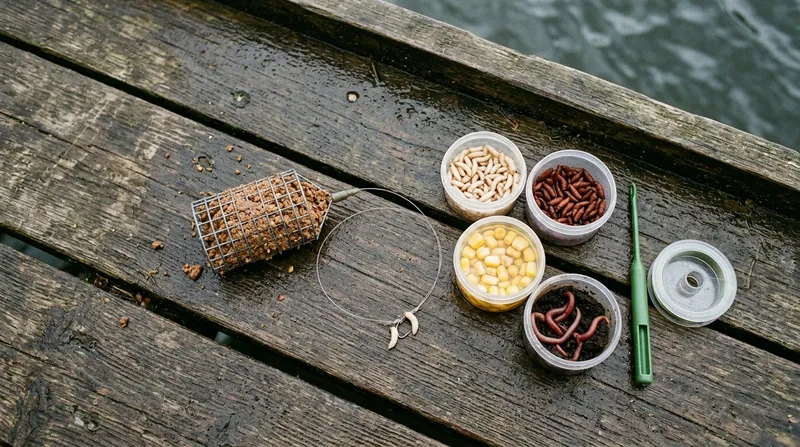 Feeder fishing for bream: feeder, hook length and bait
There are two ways to catch bream: with a feeder rod or with a pole. Both work the same way. You draw the fish to one spot with groundbait, and your bait lies on the bottom there.
Feeder fishing. Choose a feeder rod of 3.5 to 4 metres. Use a light or medium rod on still or slow water, and a heavier one on a river. Put a reel on it with a line clip on the spool (Sportvisunie). A feeder hangs on the line: a small cage you fill with groundbait, with the hook a short way behind it. The feeder carries the groundbait to the bottom, right next to your bait. The rod rests on a stand, and you see a bite on its sensitive tip (Sportvisunie).
On still water, use a feeder of 20 to 40 grams; in current, up to 80 grams. Always use lead-free feeders. The hook length is 60 to 100 centimetres long and about 0.12 or 0.14 millimetres thick, with a hook in sizes 12 to 18 (Sportvisunie). Remember: the higher the number, the smaller the hook (Sportvisunie).
This is how you build up your fishing spot. First cast four or five feeders filled only with groundbait to the same spot, and empty each one on the bottom with a sharp pull. On flowing water, do it six or seven times. Then fish with hook length and bait. Put your line in the line clip after the first cast, and every feeder lands at exactly the same distance. Small taps on the tip mean a fish has found your bait. When the tip really bends round, strike with a firm sweep backwards. Do you expect big fish, or are you fishing on flowing water? Then set your clutch well, and make sure you know how to use the line clip safely (Sportvisunie).
On a river you need heavier tackle. Feeder angler Levi van Delft fishes there with a rod of at least 4 metres and a casting weight of 100 to 120 grams. He starts with a hook length of 80 centimetres. If he misses bites, he shortens it to 50 centimetres (Sportvisunie).
With a pole. A pole is a long rod without a reel: you fish close to the bank, with a float. Bream look for food in the bottom, so your bait should lie on the bottom. Sportvisunie suggests 0.14 millimetre nylon and a hook in sizes 14 to 22 for bream (Sportvisunie). Measure the depth first with a plummet, and set the float so the bait lies exactly on the bottom (Sportvisunie).
Groundbait. For the pole, mix groundbait from crumbs and flours, such as breadcrumb, biscuit meal and coconut flour. Add maggots or sweetcorn. Wet it until you can squeeze it into balls the size of a mandarin. Throw the groundbait straight under your rod tip, and top up with a little every ten minutes (Sportvisunie). For the feeder you can buy ready-made bream groundbait and add maggots, casters or sweetcorn (Sportvisunie). Do not feed too much, so the fish keep feeding without filling up (Sportvisunie). On some waters feeding is limited, only allowed with a feeder, or banned altogether; see the rules.
Bait. Big white maggots are the best all-round bait for coarse fish. Casters, which are maggots that have turned into pupae, mostly catch bigger fish. A small brandling worm attracts bream strongly; put a maggot on after it so the worm cannot crawl off the hook. Sweetcorn is very selective for big bream. If small fish keep taking your bait, fish with corn and leave the maggots out of your groundbait (Sportvisunie). Worms also often bring big bream (Sportvisunie). With the VISpas you may not even carry dyed maggots or worms (VISpas conditions).
Rules for bream fishing
Bream has no closed season and no minimum size in the Netherlands. Dutch law lists it in neither list (Uitvoeringsregeling visserij, articles 5b and 5c). So under the law you may fish for bream all year. On most inland waters you do need a VISpas, the Dutch angling permit. Together with the list of waters it covers, it is your licence, and its conditions add their own rules to the law.
May you take bream home?
On most waters, yes. Bream is not one of the fish you must always put back, as carp and eel are under the VISpas. But you may only keep a fish to eat it yourself, to use as bait, or to keep it alive for a while. Selling is never allowed (VISpas conditions). The conditions add that putting a fish back is the starting point. And on some waters, taking any fish home is banned altogether. The list of waters says so under that water (Gezamenlijke Lijst), and so does the VISplanner. Whether bream is good to eat is under In the Netherlands.
How many bream may you take?
With the VISpas you may have at most 15 fish with you, of which at most 5 longer than 25 centimetres. That counts all species together. So you may keep at most five bream longer than 25 centimetres. Kill a fish you are going to eat straight after catching it, with a firm tap on the head. You may only keep more fish alive for a while, under the keepnet rules (VISpas conditions). Some waters allow fewer fish to be taken, or none (Gezamenlijke Lijst).
May you keep bream in a keepnet?
Yes, but with the VISpas only like this:
- only from sunrise to sunset;
- in a keepnet of soft, knotless material, with a mesh of at most 6 millimetres;
- the net is at least 2.5 metres long, with a diameter of at least 40 centimetres;
- it lies as horizontally as possible in the water, at least three quarters under water;
- current and waves must not harm the fish, and the fish have enough room and oxygen;
- an injured or weakened fish does not belong in the keepnet;
- afterwards the fish go back alive into the same water.
A live fish longer than 30 centimetres may only be kept in a keepnet, a retaining sack or a sling, not in a bucket or tub. If an enforcement officer or inspector asks, you put the fish back at once (VISpas conditions). In some places keepnets are banned altogether; town councils do that to fight poaching (Sportvisunie). How to use a keepnet well is under putting fish back.
May you use a bream as bait?
Yes. With the VISpas you may keep a fish to use as bait. But it counts: bait fish are part of the 15 fish you may have with you at most. You may keep a bait fish alive if it has enough oxygen and room. The rules for keeping fish apply then too: only from sunrise to sunset, and a live fish longer than 30 centimetres only in a keepnet, a retaining sack or a sling. Before you fish with a bait fish, kill it with a firm tap on the head. Put any live bait fish you have left back into the water they came from (VISpas conditions). Fishing with a live fish is banned (Gezamenlijke Lijst). And in spring, on most inland waters, you may not fish with a dead fish for a while either; see April and May below.
And in a fishing match?
A match needs written permission from whoever holds the fishing rights. That match permission can also allow the keepnet to stay in the water after sunset. Taking part in a match where the fish are taken away to decide the result is never allowed. And if a match is set out along a water, keep that stretch free, or clear it if you are already there. Depending on the match and on how wide the water is, that can apply to the whole water, with the banks on both sides (VISpas conditions). In Sportvisunie's feeder matches, all fish are weighed after the match and put back straight away (Sportvisunie).
How many rods may you use?
With the VISpas you may fish with two rods, each with at most three hooks, unless the list says otherwise for a water. With the extra Derde Hengeltoestemming (third-rod permit) some waters allow three. The outermost rods may be at most 10 metres apart. Besides your rods you may have three top sets ready: the top sections of a pole, so you can switch quickly. And never leave a baited rod unattended (VISpas conditions).
May you fish for bream at night?
Only with permission from whoever holds the fishing rights. With the national NachtVIStoestemming (night-fishing permit) on your VISpas, you may fish at night on the waters marked with a moon symbol in the list. Night then means from two hours after sunset to one hour before sunrise (VISpas conditions). On a few waters the law bans night fishing altogether, even with permission. The IJsselmeer is one of them (Uitvoeringsregeling visserij, article 24 and annex 2), and for that rule the Markermeer and the IJmeer count as part of the IJsselmeer (Reglement voor de binnenvisserij, article 1). And after sunset you may not keep fish in a keepnet under the VISpas.
May you fish for bream in April and May?
Yes. But from 1 April to the last Saturday of May, on most inland waters, you may not fish with artificial lures, a dead fish, a piece of fish or slaughter products. Only artificial flies smaller than 2.5 centimetres are allowed (Gezamenlijke Lijst). In the law itself this ban runs to 31 May (Reglement voor de binnenvisserij, article 6). The exception from the last Saturday of May names only pike, zander and perch (Uitvoeringsregeling visserij, article 61). On the IJsselmeer, the Markermeer, the IJmeer and the Oostvaardersdiepen it lasts longer under the VISpas: from 16 March to 30 June (Gezamenlijke Lijst). Maggots, casters, worms, sweetcorn and bread are not covered by the ban. Some waters have longer or stricter rules; the list gives them under that water. From 1 April to the last Saturday of May, the VISpas also bans fishing in a way that is likely to catch zander. Think of active fishing with a drop-shot rig or a jig head with worms. Coarse fishing with bait lying still is allowed, the explanation says (VISpas conditions).
Where may you not fish?
Water flowing in at a pumping station or a weir often draws coarse fish; see where to find bream. But on a number of waters in the list, you may not fish within 10, 50 or 100 metres of a pumping station, weir or lock (Gezamenlijke Lijst). On the Nederrijn, the Maas, the Lek and the Overijsselse Vecht, the law also bans fishing at a weir while it is in operation. You may then not fish within 75 metres downstream of the weir. Nor in a fish pass at the weir: a channel that lets fish swim past it. Nor within 25 metres of the upstream opening of that fish pass (Uitvoeringsregeling visserij, article 28c). Always check the VISplanner. It also shows a water's own rules for groundbait: on some waters feeding is limited, only allowed with a feeder, or banned altogether (Gezamenlijke Lijst).
Unhooking and returning bream
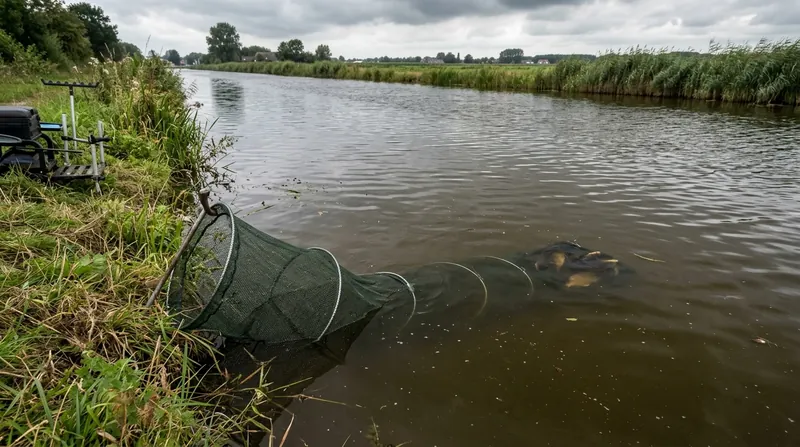 How a keepnet should lie: it starts above the water at the bank, then follows the bank down into the water
Always land a big bream with a landing net. Always hold a fish with wet hands. That way you do not damage its slime layer, which protects it against parasites and disease. Keep the line tight while unhooking, and gently push the hook out with a disgorger. If the hook is deep in the throat, cut the line as short as you can and put the fish back (Sportvisunie). Use an unhooking mat for bigger fish (Sportvisunie). Keep a fish out of the water as briefly as possible, and unhook it in the water if you can (Gezamenlijke Lijst).
Using a keepnet well. Research shows that a keepnet need not be bad for the fish. But the less you handle a fish, the smaller the chance of harm. So only use a keepnet when you really need one. Keep as much of it under water as you can, stretched out flat rather than upright. Make sure waves cannot catch it. Keep the fish in it as briefly as possible, do not put too many fish in it, and empty it gently (Keepnet code, Sportvisunie). What the VISpas says about keepnets is under the rules.
In a match, the fish must not be harmed when they are weighed and put back. Make sure there are enough weighing points, do not keep the fish in the air too long, and put each fish back as close as possible to where it was caught (Gezamenlijke Lijst).
Only put a fish back in the water where you caught it. A caught fish, dead or alive, can spread dangerous fish diseases (Gezamenlijke Lijst).
The biggest bream ever caught
The Dutch bream record is 77 centimetres. Edwin Welhuis caught it in August 2017. The world record is a bream of 6.01 kilograms, caught by Luis Kilian Rasmussen in Sweden in 1984. The longest bream we found as a record on a national list is 81 centimetres: the Swiss record from 2022.
36 cm A typical bream: the middle one of more than 100,000 bream of 20 cm or more measured in fish surveys
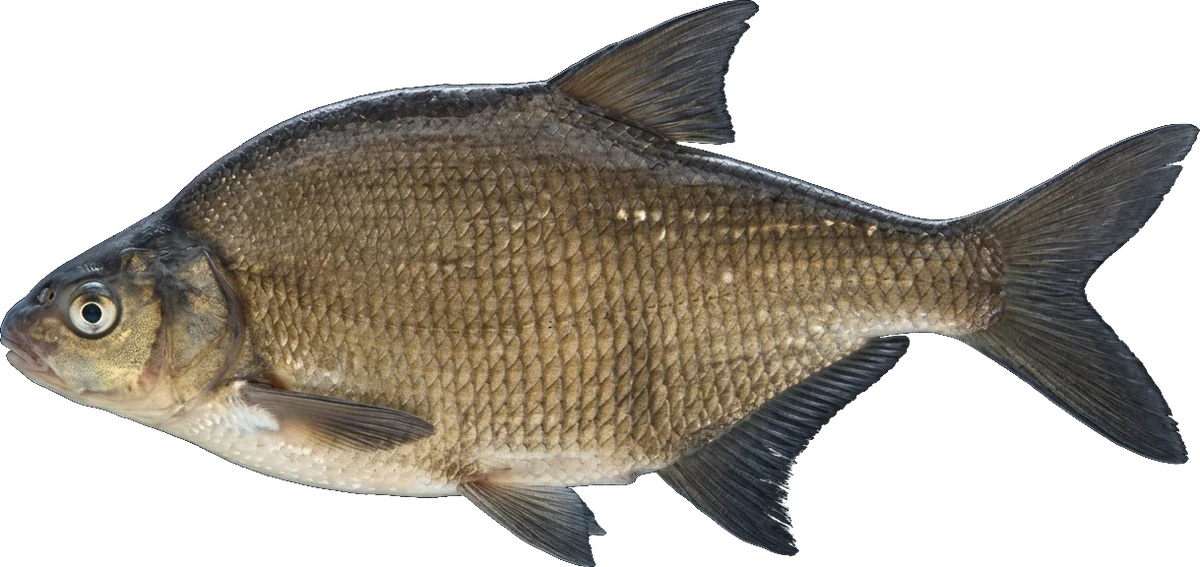
75 cm The longest of more than 560,000 bream measured in fish surveys
77 cm Dutch record (2017)
81 cm The longest we found as a record on a national list (Switzerland, 2022)
Dutch record
77 cm
Edwin Welhuis caught this bream on 13 August 2017 (Dutch record list). The list goes by length only and rounds down to whole centimetres (Sportvisunie). It shows the fish at 77 cm, with its weight: 7.28 kilograms. Welhuis caught the bream while carp fishing, at a pay fishery near Enschede. The length was read off an inflatable unhooking mat, and the fish went straight back (Beet). In the story itself he is called Veldhuis; the record list spells it Welhuis.
Before that, the record was 75 centimetres. Johan Westrik caught such a bream in 2002, and Jeroen Blom in 2015. The list then also held a heavier bream, of 9.1 kilograms and 72 centimetres, caught by Koen van Goor in 2014 (Beet, archive). In 2017 the list was renewed, and doubtful old records were looked at strictly (Sportvisserij Nederland). Today it goes by length only. According to the fishery, both record bream live in its water: the one of 77 centimetres, and the one of 9.1 kilograms from the old list (Fishing Adventure).
World record
6.01 kg
The IGFA, the international body for angling records, keeps the world record. Luis Kilian Rasmussen caught the bream of 6.01 kilograms (13 lb 3 oz) on 11 May 1984 in the Hagbyån, a stream in Sweden. IGFA gives only its weight, and it keeps no length record for bream.
National lists hold much heavier bream than the world record. The heaviest we found is the British record: 22 lb 11 oz, or 10.29 kilograms. Scot Crook caught it in 2012 at Ferry Lagoon, in England (British record list). The Dutch record bream also weighed more than the world record: 7.28 kilograms. These fish are not on IGFA's list. A fish only goes on it if it is submitted there and approved.
Longest on a national list
81 cm
The longest bream we found as a record on a national list is on the Swiss record list of the angling magazine Petri-Heil: 81 cm and 6.9 kilograms. Marco Rigassi caught it on 4 August 2022 in Lake Greifensee. He was drop-shotting for perch and first thought he had hooked a pike. He took the bream home to grill it. The list does not say how it measures length. The Swedish record is almost as long: 80 cm and 8.7 kilograms, caught in 2022 by Andreas Åkerlund. According to the Swedish list, that bream has grown in recent years and has broken its own weight record several times (Sportfiskarna).
Heinz Machacek, who also keeps the Austrian record list, keeps his own list of world records. On it, the longest bream caught on a rod is 89 centimetres, with no angler or water named. He gives the British record bream as more than 86 centimetres long; the British list gives only its weight (fishing-worldrecords.com).
At the top of this page, 82 cm and 6 kilograms are given as the greatest length and weight. Those figures come from FishBase, a large database of fish. The 82 cm comes from a Finnish book and belongs to a bream from the lake Vesijärvi in 1912, given a weight of 1.2 kilograms (FishBase). The two figures do not fit together: the Dutch record bream was shorter and weighed 7.28 kilograms. Machacek lists a bream from the same lake and year among fish not caught on a rod, at 11.5 kilograms (fishing-worldrecords.com). FishBase's 6 kilograms comes from a list of IGFA world records from 1991: the world record's weight, rounded (FishBase). English Wikipedia gives a maximum length of 90 cm and a record weight of more than 9 kg. The source it cites, the British committee's list of the 50 heaviest bream, gives weights only (Top 50 Bream).
Records by country
Every country keeps its own list, with its own rules. Some lists count length, others weight, so the numbers cannot always be compared.
| Country | Record | Angler | Where caught | Date | List |
|---|---|---|---|---|---|
| Netherlands | 7.28 kg · 77 cm | Edwin Welhuis | — | Aug 13, 2017 | Sportvisunie |
| Austria | 7.22 kg · 77 cm | Matthias Krassnitzer | Goggausee (Carinthia) | 2018 | Rekordfische Österreich |
| Denmark | 8.20 kg | Peter Juul Hansen | a lake in Jutland | Apr 16, 2007 | Danske Fiskerekorder |
| Denmark | 75 cm | Klaus Vestergaard | a clay pit | May 20, 2024 | Danske Fiskerekorder |
| Germany | 8.20 kg | J. Covali | a water near Krefeld | May 6, 2009 | Fisch & Fang |
| Germany | 8.20 kg | C. Clasen | a gravel pit near Nienburg | 2017 | Fisch & Fang |
| Hungary | 7.25 kg | Meskó Gábor | the Rába at Szentgotthárd | Aug 14, 2024 | MOHOSZ |
| Ireland | 6.07 kg | Bryan Robinson | Ballywillan Lough Fisheries (Co. Down, Northern Ireland) | Jun 24, 2012 | ISFC |
| Latvia | 6.70 kg | M. Bremze | Daugava | 2021 | LMSF |
| Norway | 6.01 kg | Morten Martiniussen | Sarpsborg | May 8, 2023 | Villmarksliv |
| Poland | 7.52 kg · 76.5 cm | Rafał Rajm | — | 2021 | Wiadomości Wędkarskie |
| Sweden | 8.70 kg · 80 cm | Andreas Åkerlund | Rögle dammar (Skåne) | May 19, 2022 | Sportfiskarna |
| Switzerland | 6.90 kg · 81 cm | Marco Rigassi | Lake Greifensee | Aug 4, 2022 | Petri-Heil |
| United Kingdom | 10.291 kg (22 lb 11 oz) | Scot Crook | Ferry Lagoon (Cambridgeshire) | 2012 | BRFC |
A dash means the list does not give it. Checked on October 17, 2026. A record can be broken at any time, so we check these lists at least once a year.
In the Netherlands
The bream is a native Dutch fish (Dutch Species Register). It lives in almost every kind of water, except small, shallow and clear waters such as the brooks on the higher sandy soils (RAVON). In 2008 it was the most common fish in the country after roach and perch (Visionair). On the IUCN Red List it is not threatened (Least Concern) (FishBase). Anglers love it, but commercial fishers get little for it (Deltares). An adult bream can live in brackish water, but its eggs die at much lower salt levels (Kennisdocument brasem). The Dutch biologist Redeke never saw a bream in the old Zuiderzee, but in the fresher IJsselmeer it lived in his day (Kennisdocument brasem).
What is 'bream-dominated' water?
Bream is typical of water that is very rich in nutrients, with few plants under water and a bloom of blue-green algae that does not go away. In such water bream can be more than half of all the fish, by weight. There are then often very many bream, but they grow poorly. 350 kilograms of bream per hectare is no exception there. Dutch fishery biologists call such water 'verbrasemd', bream-dominated (Deltares). The Dutch angling federation's knowledge document describes a type of fishing water named after the bream: the bream-zander type. It has hardly any water plants. In the shallow waters of this type, from May to September you often cannot see more than 10 centimetres into the water. Of the coarse fish there, 90 percent or more is often bream (Kennisdocument brasem).
Our own research sees it too: fish surveys catch bream more often in green, cloudy water. How we measured that is in the Lab, under water quality and fish.
Do bream make the water cloudy?
In the 1980s researchers assumed that bream keep water cloudy. The idea was that small bream eat the water fleas that would otherwise clear the algae from the water, and that older bream root up the bottom, so that no water plants can grow (Visionair). A trial with sixteen small ponds showed how much silt that rooting can stir up. For every 100 kilograms of bream per hectare, 46 grams of silt per square metre went into the water each day. And the effect of bream was twice as great as that of carp (Breukelaar et al.).
So in many places in the Netherlands people tried to clear a lake by removing bream and other fish. This is called active biological management. In the small lake Zwemlust, all fish that live on plankton or on the bottom were removed in 1987, about 1,000 kilograms per hectare. Then pike and rudd were stocked. In 1988 half of the bottom was covered with water plants, and in 1989 80 percent (Van Donk et al.). But with so many nutrients the water did not stay clear. In 1999 fish were removed again, mostly rudd (KNAW).
In the Duinigermeer in the north-west of Overijssel, more than 119 of the 150 kilograms of fish per hectare were removed, mostly bream and roach. In the spring of 1993 you could see the bottom all over the lake, and in May half of it was covered with stoneworts. In the spring of 1994 the water was clear again, but hardly any stoneworts came back. According to the study, three things played a part. The spring was colder than in 1993, with less sun. In early May the electric fish barrier failed and a passing boat damaged the catch chamber, so a lot of bream swam into the lake. And the wind stirred up the silty bottom. That year there was also a strong crop of young bream and roach. By the end of 1994 there was almost as much fish as before (Witteveen+Bos).
A study of 18 Dutch lakes found a clear effect only where more than 75 percent of the fish was removed in winter. And of six clear lakes that were followed for longer, four became cloudier again after four years (Meijer et al.). A review of more than 70 projects in Denmark and the Netherlands came to the same lesson. Mostly the water turned cloudy again within 10 years, unless fish were removed again. But only a few lakes had data over such a long time (Søndergaard et al.). The Dutch angling federation does point out that it was not the bream that made the water worse. The cause was the excess of nutrients in the water (Visionair).
The Veluwemeer and the IJsselmeer
On the Veluwemeer the water did turn clear. There commercial fishers took out a lot of bream for five years, from about 100 to 20 kilograms per hectare. After that the stonewort beds grew, the water became clearer and zebra mussels increased (Lammens et al.). The shift in 1996 was linked to that fishing for bream (Noordhuis et al.). How the lake changed is on the page of the Veluwemeer.
On the IJsselmeer the bream declined sharply: in the 1980s and 1990s, and again around 2005 (Wageningen Marine Research). Since 2006 researchers have caught few mature bream on the IJsselmeer and the Markermeer, and in 2014 and 2015 not a single one (CVO report 2026). In 2021 the minister wrote that the bream stock was in such bad shape that quick action was needed. For the stock to recover, the scientists' advice was to catch no bream at all. At the request of the Dutch parliament the minister did not follow that advice. A limited fishery with the seine, a large net, stayed possible. For a partial recovery, the scientists advised at most 20 tonnes of bream per season. In the 2019/2020 season, 146 to 175 tonnes had been landed. So the minister cut the number of days a seine fisher may fish to two (Tweede Kamer). That applied from the 2021/2022 season; before, it had been 7 per licence (CVO report 2026). Most of the bream fishery there is meant to stock live bream in other waters (Wageningen Marine Research).
In 2024 the amount of mature bream in the surveys was suddenly as high as in the 1990s again. But that came mostly from one haul of the net with a great many big bream. In 2025 it was lower again, though still higher than in the years 2006 to 2023. There are not yet as many bream of 40 centimetres and more as in the 1990s (CVO report 2026). More about the lake is on the page of the IJsselmeer.
Are bream getting bigger?
On many Dutch waters bream are getting bigger these days, Sportvisunie writes. Some anglers fish for big bream on purpose, sometimes of more than 70 centimetres (Sportvisunie). Where there are very many bream, there is little food per fish. If the bream stock is thinned out, there can be more food per fish, and then they can grow faster (Deltares). Whether that is why bream are getting bigger now, Sportvisunie does not say.
Can you eat bream?
You can, but in the Netherlands bream is not a popular food. It has a lot of bones and often tastes of the bottom. In the 1980s there were attempts to make the Dutch eat more bream, to keep its numbers down. Even recipes for bream fishcakes could not win them over. In Eastern Europe people think very differently about it, and in 2008 smoked bream was eaten on a small scale in the Netherlands (Kennisdocument brasem). It used to be different here. In 1765 the naturalist Martinus Houttuyn wrote that bream, fried or stewed, was "een aangenaam Geregt", a pleasant dish, in winter (Kennisdocument brasem).
The Dutch Nutrition Centre advises against regularly eating freshwater fish you caught yourself in Dutch waters, such as eel, perch and trout (Voedingscentrum). According to the Dutch government, you would take in too much PFAS (Rijksoverheid). Bream is not named there, but the advice covers self-caught freshwater fish in general. What you may take home under the VISpas is under the rules.
What our models found for Bream
Below is what our models see in the data. These are links: where one thing occurs, the other occurs more often. That is not a cause. Each model answers one question and may not say more than it measured. The label by the heading tells you which question — and how sure the answer is.
Where there are many A set, not a ranking Weak model
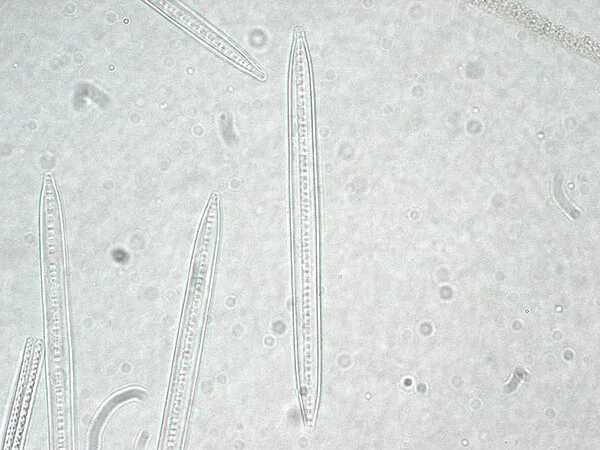 Diatoms (Bacillariaceae)
Plenty of bream goes with diatoms from the family Bacillariaceae. In our data that is mostly Nitzschia palea, a species that tolerates pollution well. Water mites (Limnesiidae), rotifers (Synchaetidae) and green algae from the family Scenedesmaceae belong to that picture too.
That fits what is known about bream. In turbid conditions, common bream can occur in large numbers. We count fewer bream where Pedinellaceae, Cyanothrichaceae or Treubariaceae set the tone, and where we find fish lice (Argulidae).
Where they grow big Strong model
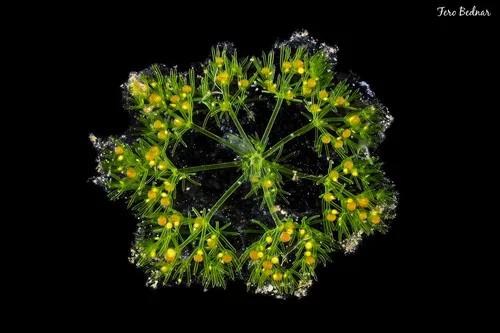 Stoneworts (Characeae)
This model counts only bream from 14 centimetres up: 248,759 measured fish. It leaves young fish out. It points clearly one way. Where stoneworts (Characeae) grow, bream are bigger on average. Where the diatom Aulacoseira granulata sets the tone, they are smaller.
Those two are opposites. Stoneworts grow in very clean, hard water and disappear once too much phosphate and nitrogen arrives. Aulacoseira granulata belongs to water with high nutrient and organic content.
That gives the most interesting result on this page. The water with the MOST bream is not the water with the BIGGEST bream. Bream have a reputation as a fish of murky, nutrient-rich water, and in numbers that holds. But they grow big in clear water with stoneworts.
One more name sits at the top of this model: silver bream, on the smaller side. That may be ecological. It may also be recognition: bream are easily confused with silver bream, especially when young. In water full of silver bream, not every small 'bream' is necessarily a bream. Which of the two it is, we cannot see.