The zander is the predator of big, murky water in the Netherlands: rivers, canals, harbours and large lakes. Zander fishing here mostly happens at dusk, with a soft lure worked along the bottom or a small dead fish. This page covers how to recognise a zander, where it holds, how to catch it and when you may fish for it. At the bottom of the page you can see what our models found in the data.
Identification
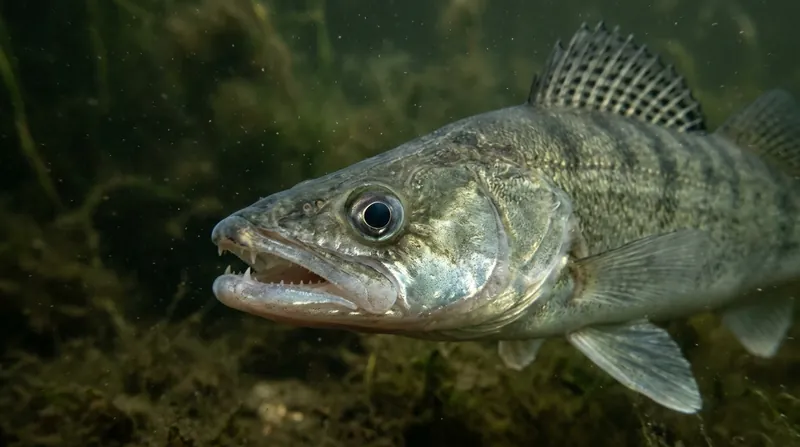 Pointed head, long fangs and a big, glassy eye
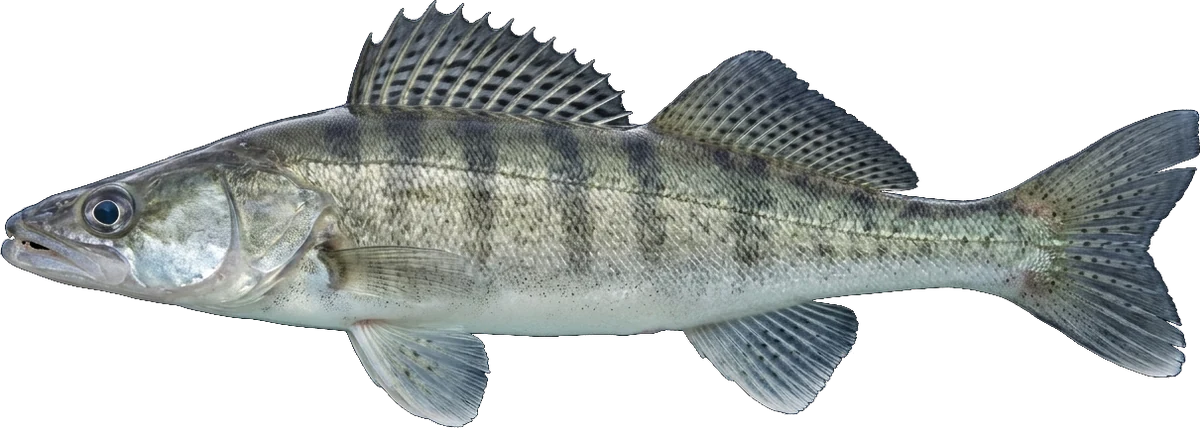
A zander is long and slim, with a pointed head and a big mouth full of sharp teeth (Wikipedia). At the front of each jaw sit one or two much larger fangs (FishBase). The eyes stand out: large and glassy, with a retina that reflects light. That is why it is also called glasoog, "glass eye", in Dutch (Wikipedia). Those eyes see well in dim light (Deltares).
Its colour depends on the water, from silvery grey to golden brown, with dark bars running down from the back. On older fish the bars fade. There are two dorsal fins, one behind the other: the front one has hard, sharp spines and the rear one is soft (Wikipedia). The dorsal fins and the tail carry rows of black spots, clearest on the front dorsal fin (Wikipedia).
Most zander are about 50 centimetres long (FishBase). A zander can pass a metre, but that is rare (RAVON).
Is the zander a cross between a pike and a perch?
No. The Dutch name, snoekbaars, means "pike-perch", and so does the other English name, pikeperch. But the zander is a species of its own. It belongs to the perch family, Percidae, like the perch (FishBase), and is not in the pike's family at all.
Zander, pike or perch?
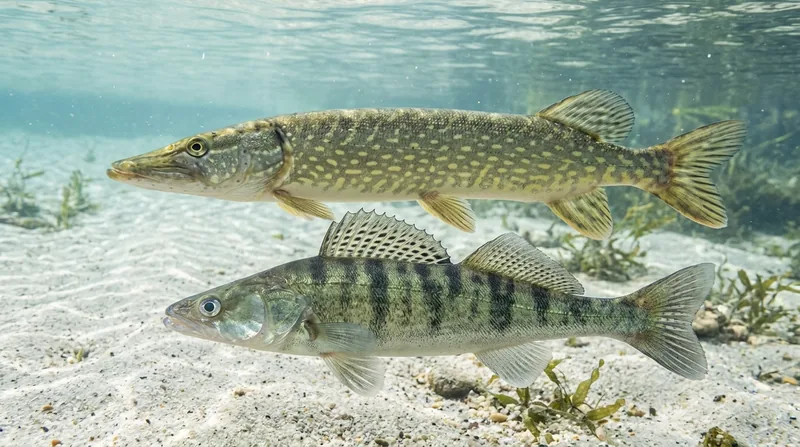 Pike above, zander below
Pike and zander are easy to tell apart. The pike has pale spots, the zander dark bars. The pike has one dorsal fin set far back, the zander two. And the pike's mouth is broad and flat, like a duck's bill. They also live apart: the pike among the plants, the zander in open, murky water. There is more under pike or zander on the pike page.
A young zander looks more like a perch. Check three things. The perch has a deeper body and bold dark bars. It has a black blotch at the back of its front dorsal fin. And the fins on its underside are yellow to red (FishBase). A zander has no red fins, is much slimmer and has fangs.
How it lives and spawns
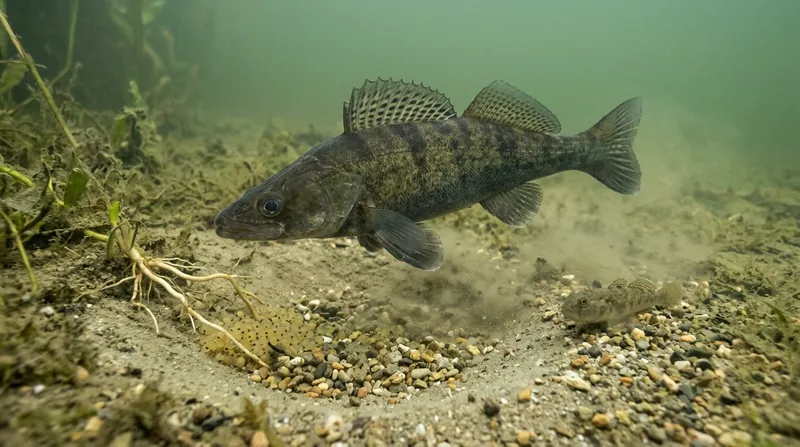 The male guards the nest and fans fresh water over the eggs
The zander hunts best in poor light. Its eyes are built for it, and murky water suits it well (Deltares). So it feeds mostly in the evening and in the morning (Wikipedia). Poor light is not the same as pitch dark, though. In our moon research, zander seem to bite slightly better at full moon than at new moon, perhaps because the night then gives just enough light to hunt by. The difference is small, and we are not yet sure it is real. It eats mainly fish that swim in shoals in open water (FishBase).
A young zander starts on plankton, such as water fleas. By the end of its first summer it can already switch to fish, preferably smelt and young perch (Deltares). From about 10 centimetres it eats only fish (RAVON), and its prey can be up to almost half its own length (Deltares).
In the Netherlands zander usually spawn in late April or early May, when the water is 12 to 15 degrees (Deltares). They move to shallower water along the banks for it (RAVON). The male makes a nest on the bottom: a shallow hollow about half a metre across, in sand or gravel. A male and a female spawn together, at dawn or at night (FishBase).
After that only the male stays. He chases off anything that eats the eggs, such as roach, perch and eel (Deltares), and gobies and crayfish too (VISpas conditions). With his pectoral fins he fans fresh water over the eggs, which keeps them supplied with oxygen and free of silt (Deltares).
A male caught off his nest, even briefly, leaves his eggs unguarded. That is why there is a closed season in spring; see closed season for zander.
Where zander hold
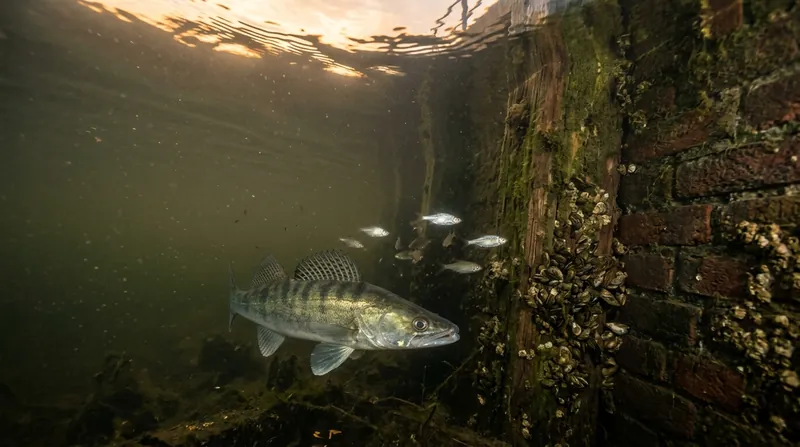 At dusk the zander hunts along quays and slopes
Zander like murky, nutrient-rich water without much weed: the big rivers and the larger lakes (RAVON), and canals and harbours as well. They cope with a little salt and also live in brackish lakes and estuaries (FishBase). Most of the time they stay near the bottom (Deltares).
Look for a change in depth. Zander look for cover: an underwater slope, or tree trunks and stumps lying on the bottom (Deltares). Think of the edge of a channel, a dyke or a sandbank. On the IJsselmeer the natural slopes draw zander and perch, and across the whole area they look for sandy bottom, while eel and bream prefer mud (Sportvisunie).
In canals and harbours, look for hard structure: quay walls, bridge pillars, locks, stone banks and harbour mouths. On the rivers they sit by the groynes, the stone dams that stick out into the river. Try around the tip of a groyne and in the calm water beside it. Note that on the Maas, the Lek, the Neder-Rijn and the Overijsselse Vecht you may not fish within 75 metres downstream of a weir (Uitvoeringsregeling visserij, article 28c).
Zander dislike bright light. By day they look for deep or shaded spots (Wikipedia). Clear water only suits them if it is deep enough to stay dim at the bottom (Deltares). At dusk they often move into shallower water to hunt, along the banks, the quays and the edges of sandbanks.
There is one exception in summer. A deep lake can then settle into layers, and the deepest water runs low on oxygen. Zander stay out of it (Deltares), so look for them higher up, along the edges.
Many zander anglers find that zander move around in small groups. They search the same spots again and again where they expect prey, and a group is often made up of fish of the same size (Beet). So when you catch one, keep fishing that spot straight away: a zander rarely comes alone.
In our data the zander often turns up together with two other fish, ruffe and silver bream. What else our models saw is at the bottom of this page. To get to know one big zander water, start with the IJsselmeer.
Zander fishing through the year
Watch three things above all: the time of year, the water temperature and the light. In cold water zander eat little: active feeding and digestion only really get going at 8 to 10 degrees (Deltares). Warm water is fine for them, as long as it holds enough oxygen.
Winter. Everything slows down. Zander sit deep and eat little. Fish slowly and close to the bottom: a shad hopped gently along it, vertical fishing from a boat, or a dead fish on the bottom. All three are explained under techniques. Expect fewer bites than in autumn.
March. The water warms and zander start feeding better. The law still lets you fish for them, but the IJsselmeer, the Markermeer and the IJmeer already have stricter rules from mid-March; see the closed season.
April and May. Spawning time, and the closed season. You may not fish for zander.
Late May and June. From the last Saturday of May you may fish for zander again. Spawning is not always over by then: it can run on into June (Deltares). A zander caught in shallow water at that time may be a male still guarding a nest, so put it back quickly. On the IJsselmeer, the Markermeer and the IJmeer you wait longer: lures and dead bait are banned there up to and including 30 June.
Summer. Fish when the light is low: at sunset, at dusk and early in the morning. That is when zander move shallower, along the banks, quays and sandbanks. By day, and certainly in clear water, look deeper. In a deep lake, not on the very bottom; see where zander hold. Note that fishing from two hours after sunset until one hour before sunrise counts as night fishing. It needs the separate NachtVIS permission and is only allowed on waters marked for it (VISpas conditions).
Autumn. The water cools and zander feed well. For many anglers this is the best time of the year. Fish the edges and slopes, starting at medium depth and going deeper as it gets colder.
Techniques and tackle
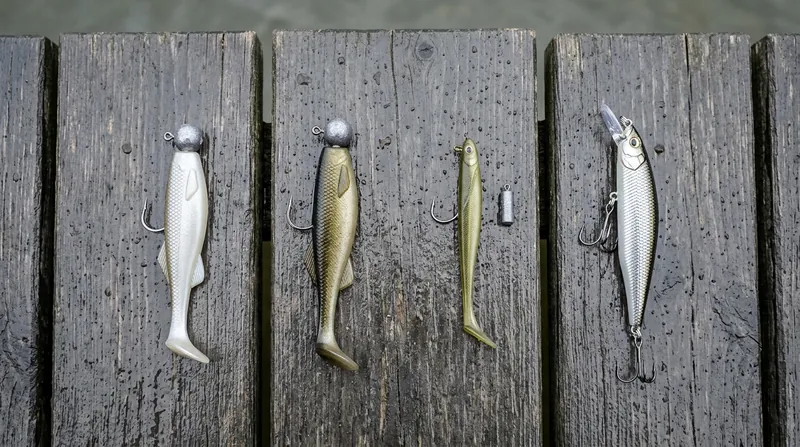 Shads on jig heads, a drop-shot lure and a deep-diving plug
The classic method is a shad: a soft lure shaped like a small fish, 8 to 15 centimetres long. It goes on a jig head, a hook with a lead head of 7 to 20 grams. Let it sink to the bottom, lift it with the rod and let it drop again. The bite often comes as the shad drops or lies still, and you feel it as a small tap. Strike at once.
From a boat you can fish vertically: lower the lure straight down and keep it just off the bottom, along channel edges and slopes. On a drop-shot rig the lead sits at the end of the line, with the hook a little above it. The lure then hangs almost still over the bottom. That helps when zander are biting poorly.
At dusk zander also take plugs: a deep diver, or a small plug of 8 to 12 centimetres. Retrieve it slowly along quays and slopes, just above the bottom. From two hours after sunset this needs the NachtVIS permission; see through the year.
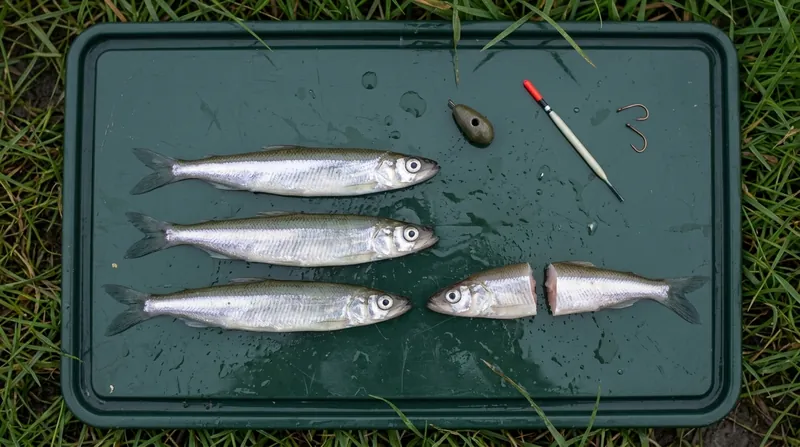 Fresh smelt, the favourite dead bait of many zander anglers
Among zander anglers, a small dead fish on the bottom has a name for catching the bigger zander. Dutch pike and catfish angler Albert Dekker caught zander by chance while pike fishing, and all of them were good-sized to big fish. He then fished for them on purpose, with dead bait lying still. He fishes this way in autumn and winter, and says it often works even better in the dark (Roofvisweb); mind the rules on night fishing. Why does dead bait work? Perhaps because a zander saves energy in cold water, and a dead fish on the bottom is an easy meal. We do not know that for sure.
Fresh smelt is by far the favourite dead bait of many zander anglers (Beet). That fits what zander eat: studies around the Baltic Sea found smelt, ruffe, perch and roach among the zander's prey (Wikipedia). So a small roach works too (Beet), and a ruffe is worth a try. A zander can handle big prey, but it prefers smaller prey than a pike does (Wikipedia). So keep the bait small, no longer than about 10 centimetres, or use a piece of fish. Zander often leave a mouthful that is too big (Roofvisweb).
Fish it on the bottom or under a light float. Zander are known as cautious feeders and often let go when they feel resistance (Beet, Roofvisweb), so use a running lead that slides freely on the line. Do not wait too long to strike, or the hook ends up deep.
A rod of 2.40 to 2.70 metres with a casting weight of 10 to 40 grams suits most zander fishing, with thin braided line. Braid hardly stretches, so you feel a small tap. Many zander waters hold pike as well, and a pike takes a shad just as readily; keep that in mind when you choose your trace. Bring long pliers for unhooking, and a landing net.
Closed season for zander
Every spring there is a closed season for zander. The reason is above, under spawning: the male guards his nest, and disturbance can cost him his eggs. Two rules apply at once. Every zander you catch must go straight back, and on most waters you may not fish with lures or dead bait. The table below shows what that means and when it ends this year.
- April 1 – May 29 Closed season: cannot be targeted On top of the release rule, lures, dead bait, pieces of fish and slaughter products are banned. Only artificial flies under 2.5 cm are still allowed, so in practice you cannot fish for this species.
- May 30 – March 31 now Open season The normal rules apply. You may keep a fish if it is long enough.
The closed season lasts until the last Saturday of May, and on that Saturday you may fish again. So the date moves every year: May 30, 2026 · May 29, 2027 · May 27, 2028. The legal minimum size is 42 cm (Uitvoeringsregeling visserij, art. 5b).
For most inland waters you need a VISpas; together with its list of waters it is your fishing permit. Its conditions add rules of their own on top of the law.
Can you fish for zander in March?
Yes, the law allows it. The zander's closed season only starts on 1 April, so in March you may fish with lures or dead bait, but check the VISplanner app: some waters are stricter. You may keep a zander of 42 to 70 centimetres if your permit allows it (Sportvisunie, VISblad). Watch two more things. A pike must go back, because the closed season for pike has already begun. And on the IJsselmeer, the Markermeer and the IJmeer, lures and dead bait are banned from 16 March (Sportvisunie, HSV Almere).
Can you fish for zander with worms in April?
No. Some anglers tried to get round the closed season with a worm on a drop-shot rig or a jig head. So since 2026 the VISpas conditions say that during this period you may not fish in a way that makes it likely you will catch a zander (Sportvisunie, VISblad). Actively fishing a drop-shot or a jig head with a worm is not allowed when you are in fact fishing for zander (VISblad). Coarse fishing with a worm lying still on the bottom or under a float is fine. So is fishing for catfish with a bunch of worms (VISpas conditions).
When does the zander season reopen?
On the last Saturday of May. The date moves every year; this year's is in the table above. The IJsselmeer, the Markermeer and the IJmeer take longer. In law those three are one water, "the IJsselmeer", its open harbours included (Reglement voor de binnenvisserij, article 1). There the closed season for zander runs up to and including 31 May (Uitvoeringsregeling visserij, article 61). Lures and dead bait stay banned there up to and including 30 June (Sportvisunie, HSV Almere). Other waters can have stricter rules too. So always check the rules for your water in the VISplanner app, or in the Gezamenlijke Lijst, the list of waters that comes with the VISpas.
How many zander may you keep?
By law a zander must be at least 42 centimetres long (Uitvoeringsregeling visserij, article 5b). The VISpas conditions go further. Since 2026 you may keep at most two zander, and only fish between 42 and 70 centimetres (VISblad). A zander over 70 centimetres always goes back, so the big fish stay in the water. Your permit or the water can be stricter still, and you may only keep fish to eat yourself, never to sell (VISpas conditions).
Unhooking and releasing zander
Many zander go back: too small, too big, or caught in the closed season. Be quick and careful. Wet your hands and hold the fish horizontally, with one hand under the belly. Mind the hard, sharp spines of the front dorsal fin and the sharp point on the edge of the gill cover (Wikipedia). Keep your fingers out of the mouth, too: the fangs are sharp.
Unhook with long pliers and keep the fish out of the water as briefly as possible; a photo is fine, but quick. Then hold it upright in the water until it swims off by itself.
Depth matters too. Bring a fish up fast from deep water and the gas in its swim bladder expands, which can injure it inside. We found no good research on this for the zander itself. There is research on the walleye, a North American fish closely related to the zander, and on a few other American fish. In most of those studies, far more fish died after release when they were caught deeper than about 10 metres (North Dakota Game and Fish). If you want to release a zander, avoid fishing deeper than about 10 metres.
The biggest zander ever caught
The Dutch record zander is 106 cm long. Andre Gießing caught it on the Hollands Diep in March 2022. The world record is an 11.48 kg zander, caught by Jürg Scherrer in the Swiss part of Lake Maggiore in 2016. The longest zander we found as a confirmed record on a list is 116 cm. It is on the Austrian list and was caught in 1990.
42 cm Minimum size: you may not keep a smaller zander
101 cm The longest of more than 40,000 zander measured in fish surveys
106 cm Dutch record (2022)
116 cm The longest confirmed record we found on a list (Austria, 1990)
Dutch record
106 cm
German angler Andre Gießing caught this zander on the Hollands Diep on 30 March 2022. His friend Bernd Kapust was steering the boat. They had a LiveScope on board, a sonar that shows fish under the boat in real time. On its screen they saw a huge zander. It was swimming four metres down, in water eight metres deep. For a quarter of an hour they followed it and kept offering it the lure. Then it bit. On the measuring board it came to 106 cm (Beet). The previous record was 105 cm, caught by Igor Vucenic in March 2020.
Gießing is not the only record holder to catch his fish this way. The Norwegian record from 2024 (Villmarksliv) and the Danish record from 2025 (Fisk & Fri) were also caught with such a live sonar.
The sources disagree about the year. The record list says 2022, and the news report from Sportvisserij Nederland says 2021. The account of the catch even says “Wednesday 30 March 2020”, but 30 March 2020 was a Monday. In 2022, 30 March did fall on a Wednesday, which fits the record list.
The Dutch record list goes by length only, in whole centimetres, so it gives no weight.
World record
11.48 kg
The world record is kept by the IGFA, the international body for angling records. Jürg Scherrer caught the 11.48 kg zander in June 2016 in Lake Maggiore, on the Swiss side of the lake. IGFA gives only the weight. According to the Swiss angling magazine Petri-Heil, the fish was 104 cm long. That is shorter than the Dutch record.
For length, IGFA keeps a separate world record: 97 cm, caught in 2020 on the Italian side of the same lake, by another angler. IGFA measures that length to the notch in the middle of the tail, not to its tip (IGFA rules). With the whole tail, such a fish is a few centimetres longer, but still shorter than the Dutch record. Some sites give the world record as 11.48 kg and 97 cm, but those figures belong to two different fish.
Many national lists hold a heavier zander than the world record, such as Germany (15.115 kg) and Hungary (14.96 kg). None of these fish is on the IGFA list: a fish only gets there if it is submitted and approved. A magazine can still call a fish a world record. In 2023, Petri-Heil wrote that Ivan Schifano had caught a new world record: a 110 cm zander, also from Lake Maggiore. The magazine gave 13.3 kg, the Swiss record list 14.3 kg. It is not on the IGFA list, where Jürg Scherrer's fish is still the record.
Longest on a record list
116 cm
The longest zander we found as a confirmed record on a list is on the Austrian record list: 116 cm and 18.70 kg. It is also the heaviest confirmed record we found. Friedrich Kraus caught it in 1990, in the Danube according to the list. The list is kept not by an angling body but by two people who collect data on record fish. They take their data from magazines, books and the internet. The list does not say how this fish was weighed or measured.
The same list has two longer zander: one of 118 cm and over 15 kg, and one of 125 cm and over 20 kg. Neither has an angler or a year. The list does not count the first, and calls the second questionable. We also cannot be sure that the Hungarian record is shorter. That fish weighed 14.96 kg. The Hungarian list gives 97 cm, but measures only to the start of the tail fin.
Where the Austrian fish was caught is not certain. A note on the record says that, according to the manager of a campsite on Lake Balaton in Hungary, it came from that lake. He wrote this in 2012 (horgasz.hu), and said he was not there himself. In his view, the fish was taken to the Danube because a record from Lake Balaton could not win a prize offered by tackle makers. In a comment under the record, one of the two people behind the list called this a rumour in 2014 and asked for proof. There is no reply.
FishBase, a large database on fish, gives 100 cm as the greatest length. That length is measured without the tail fin, so with it such a fish is a good deal longer. Its heaviest weight, 20 kg, comes from a French fish atlas from 2001. We found no confirmed record of 20 kg on any list; only the questionable Austrian fish is said to be heavier. English Wikipedia says a zander “can weigh up to 15 kg”, citing IGFA's rules. In those rules, 15 kg is the heaviest line class in which IGFA keeps zander line-class records: a strength of fishing line, not the weight of a fish. The Austrian and German records are both heavier.
Records by country
Every country keeps its own list, with its own rules. Some lists count length, others weight, so the numbers cannot always be compared.
| Country | Record | Angler | Where caught | Date | List |
|---|---|---|---|---|---|
| Netherlands | 106 cm | Andre Gießing | — | Mar 30, 2022 | Sportvisunie |
| Austria | 18.70 kg · 116 cm | Friedrich Kraus | Danube | 1990 | Rekordfische Österreich |
| Denmark | 11.25 kg · 95.5 cm | Martin Manley Blond-Sørensen | Arresø | Mar 29, 2025 | Danske Fiskerekorder |
| Finland | 101 cm | — | a lake | Oct 12, 2024 | Ennätyskalarekisteri |
| Germany | 15.115 kg | M. Pointinger | Danube | 2000 | Fisch & Fang |
| Hungary | 14.96 kg | Karajos László | Danube at Pilismarót | Jan 2, 2007 | MOHOSZ |
| Latvia | 11.80 kg | K. Kravčenko | Daugava | 2011 | LMSF |
| Norway | 12.24 kg · 100 cm | Sander Sørhaug | a lake in eastern Norway | May 15, 2024 | Villmarksliv |
| Poland | 14.20 kg · 108 cm | Dariusz Szwed | — | 2004 | Wiadomości Wędkarskie |
| Sweden | 12.53 kg · 97 cm | Leif Ivarsson | Stora Nätaren (Småland) | May 29, 2014 | Sportfiskarna |
| Switzerland | 14.30 kg · 110 cm | Ivan Schifano | Lake Maggiore | Sep 18, 2023 | Petri-Heil |
| United Kingdom | 9.667 kg (21 lb 5 oz) | James Benfield | River Severn at Tewkesbury | 2007 | BRFC |
A dash means the list does not give it. Checked on September 26, 2026. A record can be broken at any time, so we check these lists at least once a year.
In the Netherlands
The zander is not a native Dutch fish. It comes from eastern and central Europe (VISwijzer) and was stocked on a large scale in the Netherlands from the early twentieth century. It is now established here, and common (RAVON). The IUCN Red List has the zander as Least Concern (FishBase).
Zander do well in murky, nutrient-rich water. In such lakes they can become numerous and take the pike's place as the predator. Now that better water quality is making many waters clearer, zander numbers seem to be falling (RAVON).
Zander is also a popular food fish. In Dutch shops it comes from the IJsselmeer, from other countries or from fish farms. According to the VISwijzer, the Dutch seafood guide, the IJsselmeer stock is overfished. What our models see in zander water is below.
What our models found for Zander
Below is what our models see in the data. These are links: where one thing occurs, the other occurs more often. That is not a cause. Each model answers one question and may not say more than it measured. The label by the heading tells you which question — and how sure the answer is.
Where this species lives Strong model
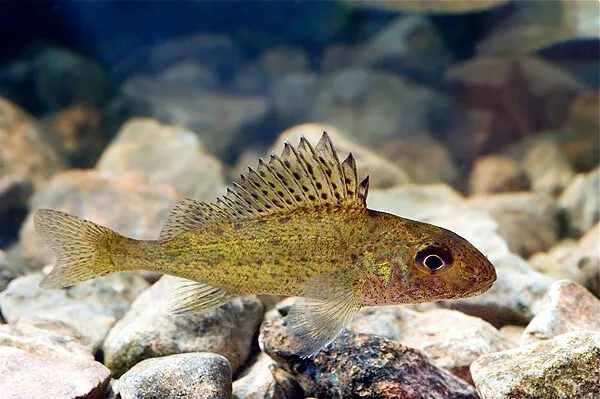 Ruffe (Gymnocephalus cernuus)
Ruffe is by far the strongest mark of zander water. Almost a quarter of this model hangs on that one fish. Also in the list are silver bream, opossum shrimps, a diatom from the family Skeletonemaceae, and asp.
That list describes one kind of water: murky, rich in nutrients, and not deep. Zander belong there. They hunt well when visibility is poor — unlike pike, which take the predator's place in clear water. The pike page carries that other side.
Both fish are built for low light. Ruffe has a mirror layer at the back of the eye and a very sensitive sensory line across the head, so it finds prey even when seeing no longer works. Zander has large eyes adapted to dim water.
Why ruffe sits so high, this model cannot say. Zander eat ruffe — stomach studies find it alongside perch and roach. But ruffe also simply live in the same water. We cannot separate those two here.
The shrimps and the diatom finish the picture. Behind the shrimps are two species: Limnomysis benedeni, a newcomer from the Black Sea region, and Neomysis integer, which belongs to brackish water. So the family says nothing about salt. The diatom does: it is Skeletonema subsalsum, and subsalsum means slightly salty. That points at the big, faintly brackish waters, not at a woodland pool.
One more thing worth noting. Bream carries almost a fifth of this model and still does not appear in the list above. Bream live in nearly every Dutch freshwater, so they do not separate zander water from anything else. Weighing heavily and saying something are not the same.
Where there are many A set, not a ranking Strong model
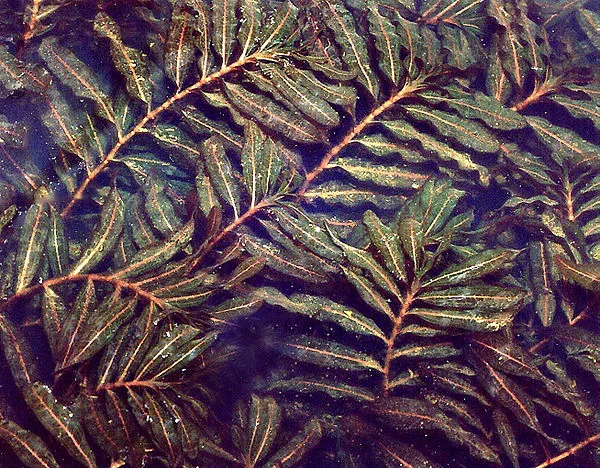 Pondweed family (Potamogetonaceae)
This model only looks at places where zander have already been caught. Plenty of zander goes with pondweeds (Potamogetonaceae), midge larvae (Chironomidae), thread-like blue-green algae from the family Pseudanabaenaceae, and a planktonic green alga from the family Ulotrichaceae.
The pondweed here is not the clear-water sign you would expect. In our data it is almost always fennel pondweed, the one species that copes with murky, nutrient-rich and faintly brackish water. The midge larvae belong to a soft, rich bottom. The blue-green algae are Limnothrix redekei and Pseudanabaena, the thread algae of murky Dutch lakes. Everything points the same way as above.
On the other side, we count fewer zander where diatoms from the family Chaetocerotaceae set the tone. In our data those are Chaetoceros, a genus of properly salt water. Faintly brackish suits zander; the sea does not. We also count fewer where we find leeches from the family Erpobdellidae, and for that we have no explanation.


