The wels catfish is the largest predatory fish in Europe's fresh water (WUR). In the Netherlands it lives in the big rivers, but also in lakes, polder waters and town canals. Catfish fishing here is mostly done in the evening and at night, with heavy tackle. This page covers how to recognise a wels, what it eats, where to find it, how to catch it and which rules apply, and how big it can grow. At the bottom you will find what our models see in the data.
Identification
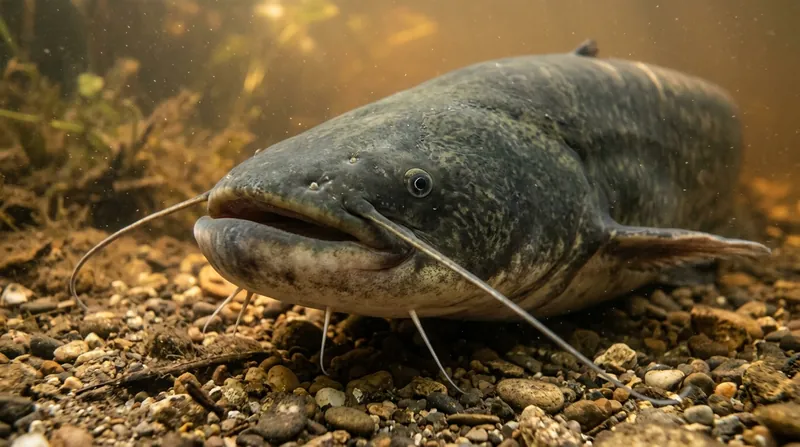 Two long barbels on the upper jaw, four short ones under the chin
A wels is easy to recognise. It has a broad, flat head with a very wide mouth and small eyes. Its body is long and smooth, with no scales (Kennisdocument meerval). It is black to brown, with marbled sides and an off-white belly (RAVON).
The barbels are the clearest feature: six in all. Two long ones sit on the upper jaw, and the fish can move them. Four short ones sit under the chin (Kennisdocument meerval; DAFV). The dorsal fin is tiny and set far forward. The anal fin underneath is the opposite: very long, running almost to the tail fin. A wels has no adipose fin (DAFV), the small fleshy fin without rays that some fish have on the back just before the tail. The bullhead catfish do have one (see below).
Its mouth holds thousands of tiny, backward-pointing teeth that feel like a rasp (Hét VISblad), so always handle a wels with a glove. Its eyes are small and it does not see well. But it tastes and smells with its barbels. And it hears very well: small bones between its swim bladder and inner ear amplify sound in the water (Sportvisunie).
Wels, bullhead catfish or African catfish?
A few other catfish live in Dutch water. They stay smaller or are much rarer. You can tell them apart by the barbels and the adipose fin (RAVON):
- Wels catfish: six barbels, no adipose fin.
- Bullhead catfish: the brown and black bullhead catfish have eight barbels and an adipose fin. Their tail fin is almost straight (RAVON, Kijk op Exoten).
- Channel catfish: also eight barbels and an adipose fin, but a deeply forked tail (RAVON). It is rare here: since the first record in 2008 there have been only scattered sightings (RAVON).
- African catfish: eight barbels and no adipose fin. Dutch winters are probably too cold for it to survive (RAVON).
- Burbot: just one barbel (RAVON).
A big wels is hard to mistake for anything else. Small ones need a closer look: they can resemble a burbot or a bullhead catfish (Kennisdocument meerval).
Behaviour, food and spawning
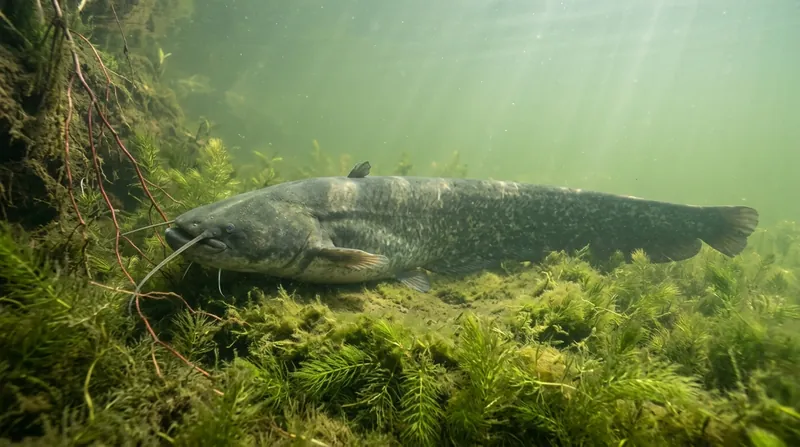 A male guards the nest in shallow water
The wels is mainly active at night. Tracking with transmitters in the Westeinderplassen and the river Maas showed it is most active between sunset and sunrise (RAVON 2016). The same held at the Lith weir on the Maas (WUR). By day it hides, preferably with a ‘roof’ over its head. In the Maas that means boats moored for scrapping, in the Westeinderplassen the floating reed beds, and on the Oude IJssel banks with overhanging grass (RAVON 2016). It is also very loyal to one spot. In the Maas, almost 90 per cent of detections came from within 1.5 kilometres of a fixed resting place (RAVON 2016).
What does a wels eat? Adults eat mostly fish, but also frogs, waterbirds and small mammals (RAVON; Kennisdocument meerval). A wels often seems to eat smaller fish than you would expect from such a big mouth (Kennisdocument meerval).
Researchers at Wageningen Marine Research looked at what catfish eat at the Lith weir. Of 90 fish examined, 24 had something in their stomach. It was mostly non-native species: the spiny-cheek crayfish and gobies from the Black Sea and Caspian region. There was only one migratory fish, an eel of about 35 cm. Most of these catfish were small, under 80 cm (WUR).
Our habitat model at the bottom of this page also links gobies with wels water. That model only sees that they live in the same water, not who eats whom. At Lith, gobies were found in catfish stomachs. Whether that is why catfish turn up more often in water with gobies, we have not measured.
Pigeons, and small dogs? Footage of catfish grabbing pigeons from the bank is famous. It happens on the River Tarn in France. Researchers there filmed dozens of attacks, and just over a quarter succeeded. The catfish swimming there were estimated at 0.9 to 1.5 metres long (Cucherousset et al. 2012). Wels were introduced to the Tarn in 1983. To the researchers' knowledge, the behaviour had not been reported where the species is native (Cucherousset et al. 2012).
Stories of catfish taking small dogs have been around for years (RAVON 2016). The German fish researcher Robert Arlinghaus says he has never seen any evidence for them (MDR). Stomach studies in the Czech Republic did find birds, frogs and a water vole (Vejřík et al. 2017).
Spawning. Wels spawn from May to July, in shallow water with plenty of plants (RAVON), once the water reaches 18 to 20 °C (Kennisdocument meerval). The male makes a nest by pressing plants and the bottom flat with his mouth. He then guards the eggs and keeps them clean with his tail (RAVON). At Lith, spawning probably fell at the end of June, soon after the water passed 18 °C (WUR). Spawning itself has not yet been recorded in the Netherlands, but young catfish are found (report for Rijkswaterstaat, 2021).
Growth. In the Westeinderplassen a wels grows slowly. Three catfish of about 35 cm were tagged there and recaught roughly ten years later at just over a metre: about 7 cm a year. In warmer southern European countries, 10 to 20 cm a year is normal (Rijnland). A 140 cm wels from the Westeinderplassen is estimated to be 25 to 30 years old (Sportvisunie).
Where to find wels
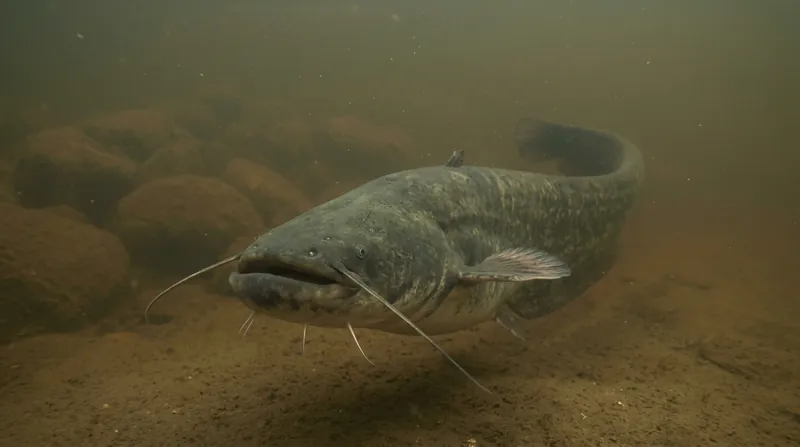 By day, in the calm water behind a groyne
Wels live in all the big rivers. Numbers are highest in the Maas and in the Rhine and Waal near the German border (report for Rijkswaterstaat, 2021). From the rivers they are spreading into smaller rivers and large streams (RAVON 2026). Catfish tracked from Lith swam as far as the Biesbosch and the Hollandsch Diep (WUR). In lakes the wels has increased less than in flowing water, and it is still scarce in canals (RAVON 2026).
Away from the rivers, the Westeinderplassen near Aalsmeer is the oldest wels water in the Netherlands (see In the Netherlands). The fish are spreading through the surrounding Rijnland waters too. There are plenty in the Braassemermeer, the Kagerplassen and the Ringvaart. And they turn up more and more near Haarlem, Amsterdam (the Nieuwe Meer), Alphen aan den Rijn and Leiden (Rijnland).
Where in the water? By day a wels lies in a calm, dark spot with a roof over its head (RAVON 2016). In a river that means deep holes and channels, often on the outside of a bend or just behind a groyne. A groyne is a stone dam that sticks out from the bank into the river (Roofvisweb). At Lith, catfish used deep holes in the Maas, one of them about 12 metres deep (WUR). In the Westeinderplassen they hide under the floating reed beds by day. At dusk they move out into open water to hunt (Nieuwe Meerbode).
Don't fish right below a weir: on the Maas, Lek, Neder-Rijn and Overijsselse Vecht it is not allowed within 75 metres (see the rules).
Wels fishing through the year
For wels, the season is all about water temperature. Below 10 °C they are barely active, and below 7 °C not at all. Once the water passes 10 °C, they become active again (RAVON 2016). At Lith, catfish were most present in late spring and summer, and that too depended mainly on water temperature (WUR).
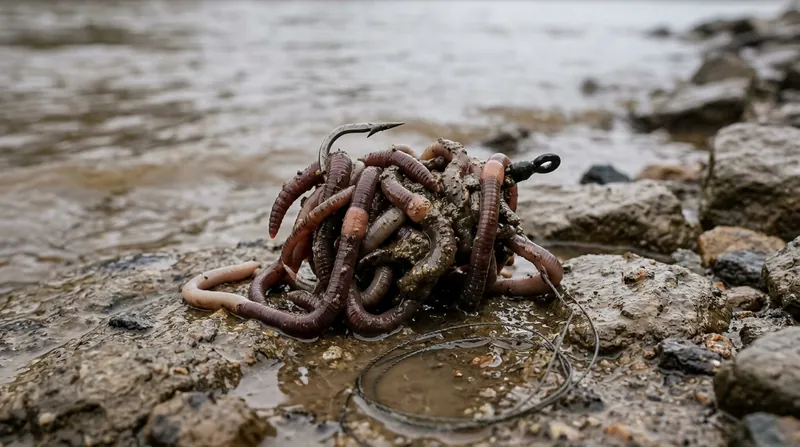 A bunch of lobworms: a bait still allowed in April and May
Spring. The water warms up in April and May. In the Westeinderplassen the fish leave the reed beds only once the water is above 10 °C (0297.nl). Note that from 1 April to the end of May you may not fish with a dead fish, a piece of fish or artificial lures (see the rules). Fishing for wels with a bunch of worms is allowed (Hét VISblad).
Summer. Wels are at their most active in summer, which is also when they spawn, from May to July. The angling code of conduct asks anglers not to fish for predators during spawning (Gedragscode welzijn vis). If you see a wels guarding a nest in shallow water, leave it alone in any case.
Autumn and winter. As the water cools, wels become less active. At Lith, almost all of them left in winter; the researchers think they wintered in the much deeper Maasplassen lakes (WUR). In the Westeinderplassen they spend the winter mostly under the reed beds (0297.nl).
The season chart further down this page shows, for each month, how often a reported catch is a wels, compared with the yearly average. So a busy fishing month does not count as a better season by itself. The chart is built from the catch reports on Sportvisunie's mijnvismaat.nl.
Methods and tackle
There are three ways to fish for wels: vertically from a boat or bellyboat, with bait on or just above the bottom, or with lures. All three call for heavy tackle.
Vertical fishing. You drift over a deep spot and lower your bait straight down, usually a big bunch of lobworms. With a fish finder you can sometimes see a catfish lying below you. If one rises, hold the bait still: a wels almost never takes a sinking bait (TotalFishing). Dutch records have been caught this way, from a bellyboat with a bunch of lobworms (Sportvisunie).
Clonking. You strike the water with a special wooden tool, the clonk stick. Catfish anglers say the sound draws the wels up, and a wels hears very well (see Identification). The method is said to come from Hungary. Experienced anglers say the fish get used to it where it is used a lot, so it works less well there (TotalFishing; TotalFishing).
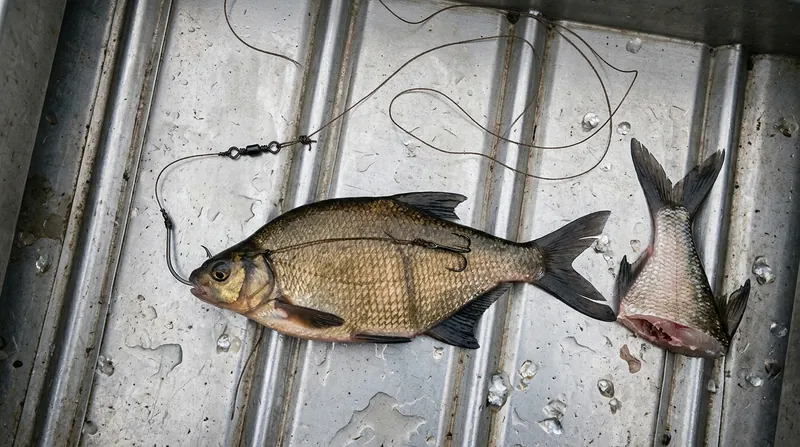 Dead bream as bait: whole, on a single hook and a treble, or a half
Bait on the bottom. From the bank, the bait usually lies still in one spot. A bunch of lobworms works here too, and not only for small catfish. But worms are soft, so on or near the bottom you soon have a bare hook (meerval.nl). An underwater float keeps the bait just off the bottom, so crayfish and crabs pick at it less (meerval.nl). Outside April and May you can also use a dead fish or a piece of fish. Bream is the favourite bait fish on many waters (meerval.nl). Squid is another well-known catfish bait (meerval.nl). Some anglers use pellets rich in fishmeal. Where catfish are not used to them, they do not always take them straight away (meerval.nl).
Lures. For lure fishing, anglers use big soft shads on a heavy jig head (Roofvisweb), plugs or heavy spoons (Raven). Lures are banned from 1 April to the end of May as well (see the rules).
Tackle. Catfish anglers' rule of thumb: never fish too light (meerval.nl). A wels fights long and hard. Heavy gear shortens the fight. It also makes it less likely that your line breaks and the fish swims off with a hook and a length of line in its mouth (meerval.nl). As a rough guide (meerval.nl):
- vertical from a boat: a short rod of 1.6 to 2.4 metres, casting weight 80 to 200 grams;
- bait from the bank: 2.8 to 3.3 metres, casting weight 250 to 300 grams;
- casting lures: 2.1 to 3.0 metres, casting weight 80 to 150 grams.
Use braided line of 0.25 to 0.50 mm, strong thick-wire hooks, swivels rated to at least 100 kilograms, and a reel with a good drag (meerval.nl; meerval.nl).
Landing. An ordinary landing net is not strong enough for a big wels. Catfish anglers land it by hand, gripping the lower jaw with a glove (meerval.nl; Sportvisunie). Check first that the fish has calmed down (Sportvisunie). Fish in pairs if you can: after a long fight you will be tired too (Roofvisweb).
Safety on the river. A big ship cannot simply swerve. A Rijkswaterstaat traffic controller warns bellyboat anglers who fish in the shipping channel or near locks and weirs: ‘you are literally playing with your life’ (Hét VISblad). You may not fish from a bellyboat in the channel of major shipping routes such as the Waal (VISpas conditions, condition 12). Groyne heads are slippery and big waves can wash over them (Roofvisweb).
Closed season and rules for wels
The wels has a closed season all year round (Uitvoeringsregeling visserij, article 5c). You may fish for it, but every wels you catch must go straight back into the same water (Reglement minimummaten en gesloten tijden, article 2). You may never take one, and you may not keep one with you either (Reglement minimummaten en gesloten tijden, article 3; Sportvisunie). So tying a wels on a rope, or keeping it in a sack or sling for a photo later, is not allowed. An older Dutch catfish handbook still describes how to tie one up (meerval.nl, 2016), but you may not. An angler who wanted to eat a wels lost his VISpas for several months and was fined heavily (Hét VISblad).
Why all year? Until 2012 the wels was a protected species. That year it came under the Dutch fisheries act. The ministry wrote that the wels had increased strongly but that its recovery was still fragile. A year-round closed season made targeted angling possible, while the duty to release protects the species' growth (Staatscourant 2012).
Bait in April and May. From 1 April to the last Saturday of May you may not fish with a dead fish, a piece of fish, slaughter waste or any artificial lure. Only artificial flies of 2.5 cm or less are allowed (Gezamenlijke Lijst; Reglement voor de binnenvisserij, article 6). Squid, shrimp, crabs and crayfish count as fish here (Sportvisunie). The ban does not apply on a few waters in Zeeland, and lures are allowed on the river Geul and its side streams (Reglement voor de binnenvisserij, article 6).
Note that in the law itself the ban runs to 31 May (Reglement voor de binnenvisserij, article 6). The exemption from the last Saturday of May names only pike, zander and perch (Uitvoeringsregeling visserij, article 61). Sportvisunie writes that from that Saturday you may fish with all baits again (Sportvisunie). To be on the safe side, wait until 1 June before fishing for wels with dead bait or lures.
Worms are not covered by this ban. But in those weeks the VISpas adds a rule of its own. You may not fish in a way that makes a zander catch likely. Examples are a jig head or a drop-shot rig baited with worms, fished actively. Fishing for wels with a bunch of worms is expressly allowed (VISpas conditions, condition 7). Dyed worms or maggots may never be with you while fishing (VISpas conditions, condition 8).
Live bait is banned. You may not use a live fish as bait (Besluit houders van dieren, article 1.18). A bait fish must be killed first (Gedragscode welzijn vis). Worms and maggots are fine (Gezamenlijke Lijst). You will sometimes see live bait in catfish videos from abroad; in the Netherlands it is not allowed.
Night fishing. For anglers, night runs from two hours after sunset to one hour before sunrise, so the first two hours after sunset do not count. With the VISpas, night fishing needs the NachtVIStoestemming (night permit), which is valid only on waters marked with a moon in the Gezamenlijke Lijst. On other waters, night fishing is allowed only with permission from whoever holds the fishing rights. You may stay at one spot for at most 3 × 24 hours (VISpas conditions, condition 23).
On the IJsselmeer. In law, the Markermeer and IJmeer count as part of the IJsselmeer (Reglement voor de binnenvisserij, article 1). Night fishing is banned there by law (Uitvoeringsregeling visserij, article 24). You may fish with at most two rods (Reglement voor de binnenvisserij, article 8). And the bait ban lasts longer: no dead fish, pieces of fish or lures from 16 March to 30 June. Worms are allowed (Gezamenlijke Lijst).
Rods and hooks. With the VISpas you fish with at most two rods. A third is allowed only with the Derde Hengeltoestemming, on waters where that is possible (VISpas conditions, conditions 3 and 4). Each rod may carry at most three single, double or treble hooks (Visserijwet, article 1). Never leave a baited rod unattended (VISpas conditions, condition 6).
Near weirs. On the Maas, Lek, Neder-Rijn and Overijsselse Vecht you may not fish within 75 metres downstream of a weir. Nor may you fish in a fish pass, or within 25 metres of its upper opening. This does not apply while the weir is out of use (Uitvoeringsregeling visserij, article 28c).
We found no rule on fish finders or clonking, either in the law, the VISpas conditions or the Gezamenlijke Lijst. Always check the Gezamenlijke Lijst for your water, though: it says, for example, whether you may fish there from a boat or at night.
Unhooking and releasing a wels
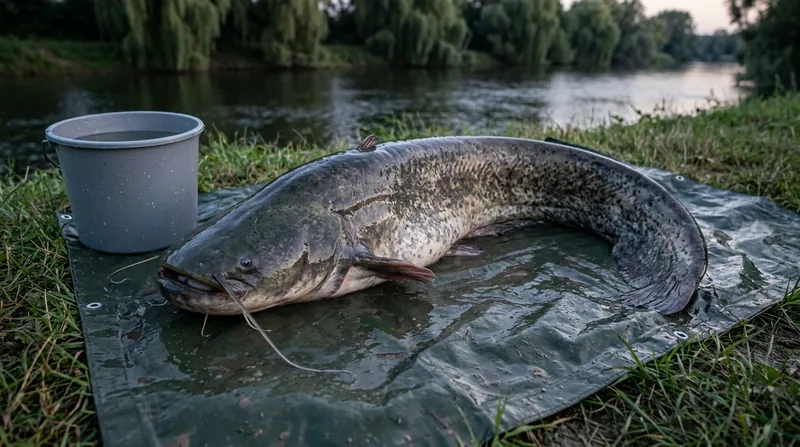 On a wet tarp, on grass, turned a quarter onto its side
A wels must go straight back, so unhook it in the water if you can (Sportvisunie; Gedragscode welzijn vis). Sportvisunie gives these tips (Sportvisunie; Hét VISblad):
- Take your time to tire the fish properly, and check it has calmed down before you grab it.
- Grip the lower jaw with a glove; ordinary work gloves from a DIY shop will do.
- Fishing from the bank? Lay the fish on a wet tarp and turn it a quarter onto its side. That calms it. Keep its time out of the water as short as possible.
- Always support big fish with two hands.
- Put the fish back and wait until it swims off by itself.
Put the tarp or mat on grass rather than stones, and never drag the fish over sand or stones (meerval.nl). Keep it wet with a bucket of water (Roofvisweb). Want to know how long it is? One experienced catfish angler leaves the fish stretched out in the water and lays his rod, exactly two metres long, beside it as a ruler (Hét VISblad).
The law says nothing about photos. It only says the fish must go back ‘immediately’. The VISpas conditions say you may photograph a fish that must go back, as long as it does not harm the fish's health. That explanation sits under the rule for eel, carp, grass carp and protected species (VISpas conditions, condition 15). If you take a photo, keep it very short: sit by the fish's head and lift it only slightly there (Hét VISblad).
Caught a wels with a yellow or white tag near the dorsal fin? It has been tagged for research. Report its length and location through Sportvisunie's ‘Meld je vangst’ page (Hét VISblad).
The biggest wels catfish ever caught
The Dutch wels catfish record is 251 centimetres. Greggor de Greef caught it on 28 July 2026 in a Dutch river. The IGFA world record is a catfish of 134.97 kilograms, caught by Attila Zsedely in 2010 in the River Po in Italy. The longest wels we found listed as a record is 292 centimetres: the Polish record from 2025.
66 cm A typical wels: the middle one of more than 300 catfish of 20 cm or more measured in fish surveys
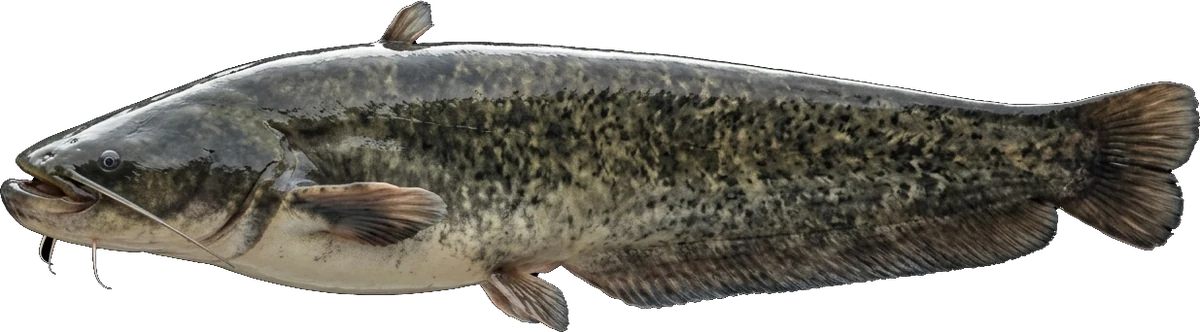
251 cm Dutch record (2026)
292 cm The longest we found listed as a record (Poland, 2025)
Dutch record
251 cm
Greggor de Greef caught the record fish on 28 July 2026, from a bellyboat on a river. It was not the Waal, but no source says which river it was. He spotted the fish on a live sonar screen and offered it a large soft-plastic shad. On the bank the tape read 251 cm. After a few photos the fish went back (Sportvisunie). It is the first wels on the Dutch list longer than 250 cm.
The record is growing fast. In 2016 it stood at 212 cm (Beet). Since May 2021 it has been beaten eight times and equalled once (Beet; Sportvisunie). Before De Greef, Mohammed Massaoudi held it with 249 cm, caught in the Waal on 24 May 2026 (Sportvisunie).
Not every big catfish in the news is on the list. ‘Big Mama’, a catfish in the Kempervennen lakes near Eindhoven, was filmed underwater for a TV report in 2015 and described as 2.55 metres long (Sportvisserij Nederland). Divers later estimated her at almost 2.50 metres (Duikersgids). She was never caught. A 2.36-metre catfish from the Oude IJssel (2019) was not measured with a tape: the angler lay down next to it with his arm stretched out (Beet). A 2.27-metre fish from a commercial fishing pond near Enschede (2019) is not on the list either (Hart van Nederland). For the record list, a catfish counts only if it was caught on a rod, measured against a tape or board on photo or video, and released alive.
World record
134.97 kg
The IGFA, the international body for angling records, keeps the world record: a catfish of 134.97 kilograms. Attila Zsedely caught it on 11 March 2010 in the River Po in Italy, and it has stood since 2010. The very first IGFA wels record came from the Netherlands, as it happens: Nel van Straaten caught a 9.98-kilogram fish near Hoogkarspel in 1987. Every IGFA wels record since has come from abroad. The record for the heaviest fish was broken four times between 2008 and 2010, each time in the Po.
For wels, IGFA keeps only a weight. It has no length record for the species (Outdoor Life), and it does not say why. It did leave species that grow longer than its 200 cm measuring board out of its new length records in 2022 (IGFA).
Longest on a record list
292 cm
The longest wels we found listed as a record is the Polish length record: 292 cm. It was caught in October 2025 during a competition on the Rybnik reservoir. The Polish list credits it to ‘Adrian Gontarz i Krzysztof Pyra’ (‘i’ is Polish for ‘and’): Gontarz held the rod and Pyra steered the boat (Wiadomości Wędkarskie). It was measured from the tip of the snout to the end of the tail fin (list rules), and never weighed (Outdoor Life).
We found no longer catfish in the news either. Long fish from Italy, France and Spain are on no list at all, because we found no national record list for those countries. Alessandro Biancardi's 285 cm catfish from the Po (2023) is one (Prima di tutto Mantova). One case stays open: the Hungarian list names a 265 cm catfish, but since 2024 it measures only to the base of the tail fin (MOHOSZ). If that rule was followed, the fish is longer with its tail. How much longer, we don't know, so we can't be sure it was shorter than the Polish one.
The top of this page gives 273 cm as the maximum length and 130 kilograms as the maximum weight. Those figures come from FishBase, a large database on fish. They belong to a catfish caught in the Rhône in France in October 2015 (Boulêtreau and Santoul, 2016). Longer catfish have been caught since. And the IGFA world record, from 2010, is heavier.
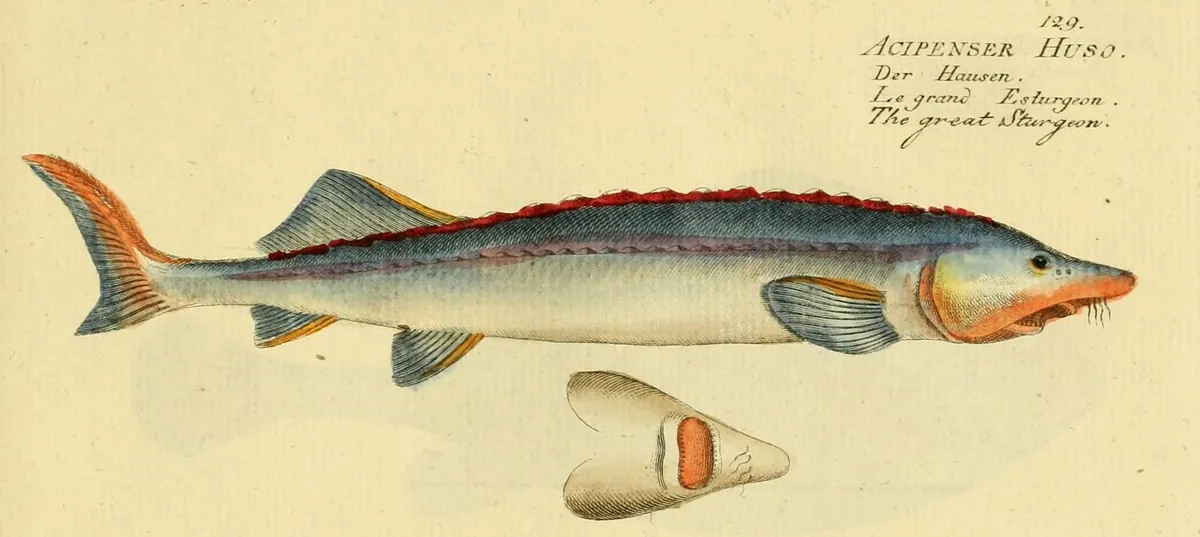
The legend
5 m
Books and websites often say the biggest wels ever caught was 5 metres long and weighed 306 kilograms, from the Dnieper in Ukraine. The story has been retold since the 18th century. In 2016 two French researchers traced where it came from. They found 39 sources, and half of them cited nothing at all (Boulêtreau and Santoul, 2016).
The story does not hold up. By the researchers' figures, a 5-metre catfish would weigh 600 kilograms or more, about twice as much as 306 kilograms. And the only old photograph of such a giant shows not a catfish but a sturgeon: the shape of the mouth gives it away. The researchers think of a beluga or a close relative (Boulêtreau and Santoul, 2016). Besides, 5 metres is more than one and a half times the longest wels on a record list.
English Wikipedia still says that in 1856 a writer described Dnieper catfish of over 5 metres and up to 400 kilograms. An anonymous editor added that sentence in 2008 (Wikipedia), and the article does not mention the 2016 study.
Records by country
Every country keeps its own list, with its own rules. Some lists count length, others weight, so the numbers cannot always be compared.
| Country | Record | Angler | Where caught | Date | List |
|---|---|---|---|---|---|
| Netherlands | 251 cm | Greggor de Greef | — | Jul 28, 2026 | Sportvisunie |
| Austria | 260 cm | Elvis Kisereu | the Neue Donau (Vienna) | 2024 | Rekordfische Österreich |
| Denmark | 32.927 kg | Morten Rasmussen | — | Jun 29, 2014 | Danske Fiskerekorder |
| Germany | 96.80 kg | S. Kneip | the Rhine | 2021 | Fisch & Fang |
| Hungary | 119.40 kg | Bányai Péter | Széki-tó (Devecser reservoir) | Jun 11, 2024 | MOHOSZ |
| Latvia | 96.36 kg · 242 cm | V. Putņins | Daugava | 2024 | LMSF |
| Poland | 105.50 kg | Władysław Bombik | — | 2017 | Wiadomości Wędkarskie |
| Poland | 292 cm | Adrian Gontarz i Krzysztof Pyra | Rybnik reservoir | 2025 | Wiadomości Wędkarskie |
| Sweden | 60.10 kg · 195 cm | Evert Rundblad | River Emån (Kalmar) | May 1, 1981 | Sportfiskarna |
| Switzerland | 90 kg · 240 cm | Ferati Jetmir | Lake Murten | Sep 30, 2015 | Petri-Heil |
| United Kingdom | 68.12 kg (150 lb 3 oz) | Shaun Ing | Chigborough Fisheries, Essex | 2024 | BRFC |
A dash means the list does not give it. Checked on October 1, 2026. A record can be broken at any time, so we check these lists at least once a year.
In the Netherlands
The wels is native to the Netherlands (Dutch Species Register). Bones from excavations show it already lived here some 6,000 years ago, in several places (RAVON 2026). From the 15th century, during the Little Ice Age, it disappeared from many places in north-west Europe. In the Netherlands it survived only in the Haarlemmermeer lake. In 1852 Lubach wrote that with the draining of that lake, the wels would ‘drop off the list of our native fishes altogether’. Yet it held on in the Westeinderplassen and the Ringvaart canal (RAVON 2026). By around 1950 the wels was close to extinction in the Netherlands (RAVON 2016).
The Westeinderplassen catfish are special. DNA studies show they form a separate, old group that differs strongly from other European wels. Since about 2000, fish from elsewhere live there too, and every young wels examined carried genes from outside the old group. So the original Westeinder wels is slowly disappearing, while the new genes have saved the population from dying out (RAVON 2026; Sportvisunie).
In 2022 the Westeinderplassen held an estimated 3,200-plus catfish longer than 25 cm, more than four times as many as ten years earlier (Rijnland). They rarely grow big there, seldom beyond one and a half metres (RAVON 2016).
The comeback. From the 1970s the wels turned up elsewhere too. Wels were stocked in Germany from 1965 and probably drifted down the Rhine. In 1976 hundreds of young catfish escaped from a fish farm near Lelystad. The Maas catfish probably came from a fish farm in Belgium. Anglers have also released wels illegally in several places (RAVON 2026).
According to RAVON, the wels is spreading so well because of warmer water. Since 1990 the Rhine and Maas have been warmer than 20 °C on about 90 days a year. That is roughly three times as many as in 1910, and it helps the fish breed and grow. The strong rise of non-native bottom animals, such as crayfish and the round goby, may also have played a part. They are an important part of the wels's diet (RAVON 2026). Whether the river catfish descend from escaped and stocked fish, or arrived on their own, is not yet known. Wageningen proposes DNA research to find out (WUR).
Threatened? The wels is not on the Dutch Red List of fish: it is listed as ‘currently not threatened’ (Dutch Species Register). Worldwide it is not threatened either: the IUCN lists it as Least Concern (FishBase).
Effects on other fish. In France, where the wels was introduced, catfish can eat a lot of migratory fish. In one fish pass on the Garonne, a few catfish ate 14 of 39 tagged salmon in 2016 (Boulêtreau et al. 2018). That has not been shown in the Netherlands. At Lith the researchers found no evidence that catfish eat much migratory fish there. But few migratory fish passed, and most of the catfish were small (WUR). A 2021 report for Rijkswaterstaat says it cannot yet be determined whether catfish harm migratory fish in the Netherlands (Claus et al. 2021).
Murky, nutrient-rich water with little oxygen is no problem for a wels (Claus et al. 2021). The German fish researcher Robert Arlinghaus says a wels is in principle a sign of a natural ecosystem with small and large animals. But the species is not demanding, so a wels does not prove that the water is in especially good ecological health (MDR).
What our models found for Wels Catfish
Below is what our models see in the data. These are links: where one thing occurs, the other occurs more often. That is not a cause. Each model answers one question and may not say more than it measured. The label by the heading tells you which question — and how sure the answer is.
Where this species lives A set, not a ranking Strong model
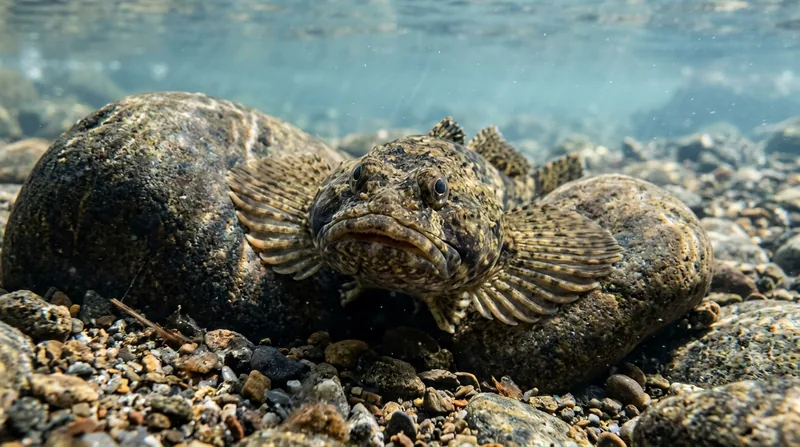 Bullheads (Cottidae)
This model recognises wels water by water insects and small bottom fish. The banded demoiselle (Calopterygidae) and the white-legged damselfly (Platycnemididae) belong to it. Then water mites from the families Lebertiidae and Hygrobatidae, and caddisflies from the families Psychomyiidae and Hydroptilidae. Plenty of organic matter on the bottom fits the same picture.
Some of them belong to flowing water: the two damselflies, the water mites from the family Lebertiidae and the caddisflies from the family Psychomyiidae. That matches where the wels belongs: large and medium size lowland rivers, backwaters and well vegetated lakes. That is exactly the water this list describes.
Small bottom fish sit in the list too: bitterling, bullheads (Cottidae), gobies (Gobiidae), the round goby and the three-spined stickleback. There is even a fish leech (Piscicolidae). It reads like a menu, and that is a temptation to resist. Adult wels do eat fish, but this model only measures that those fish occur in the same water. Who eats whom, we cannot see.
One more thing, and it is worth knowing for every model on this site. Two signals are in here twice. The bitterling appears under its current name Rhodeus amarus AND under Rhodeus sericeus. Rhodeus sericeus is a leftover from the times when the European bitterling and its Siberian relative were treated as one species. And the gobies appear as a family and again as the round goby. So this model holds fewer separate signals than it holds names.