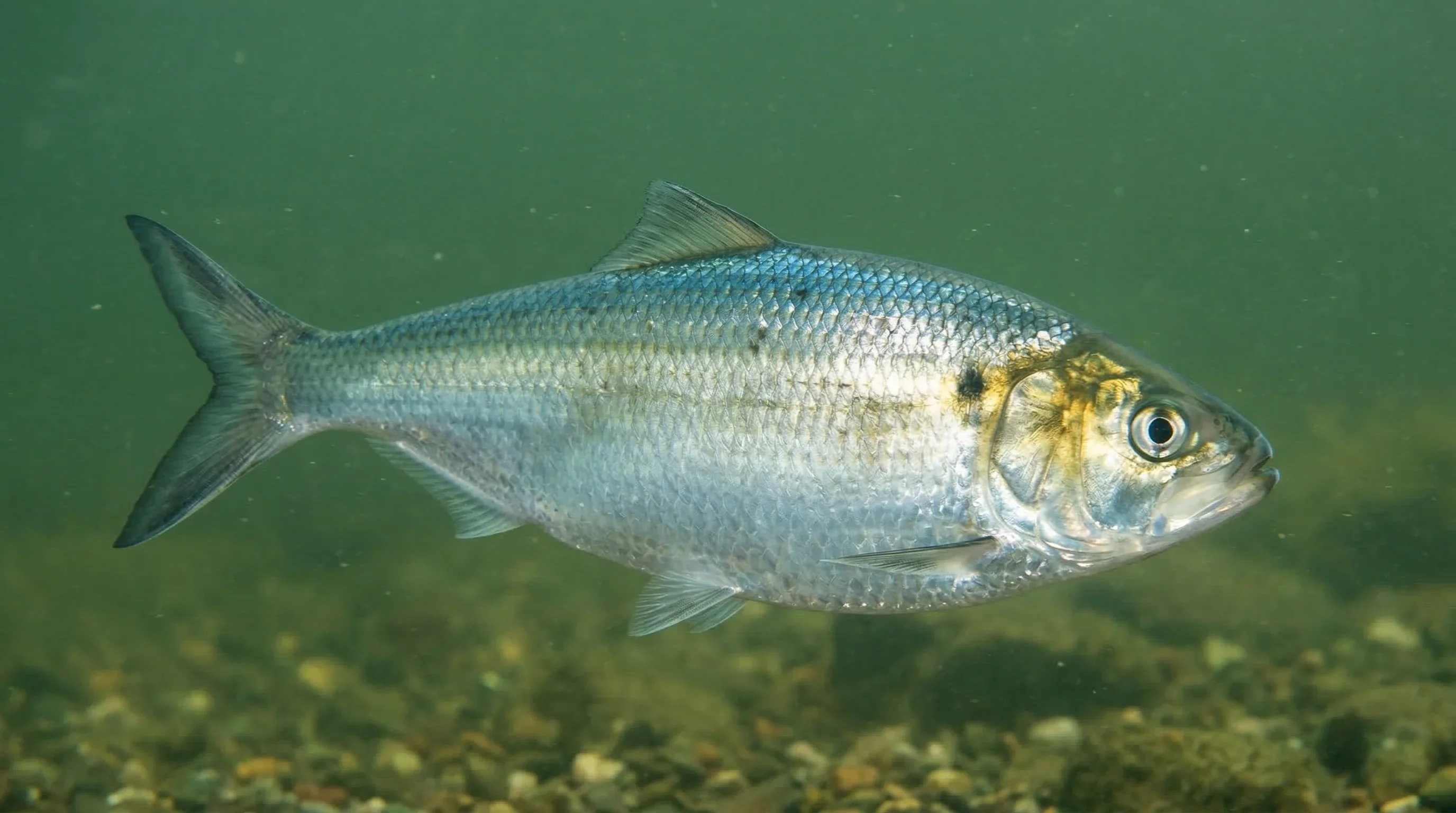
The pike is the best-known predator in Dutch fresh water, and pike fishing in the Netherlands is possible almost anywhere: village ditch, big lake or river. This page covers how to recognise a pike, where it holds, how to catch it and when you may fish for it, with our catch data at the bottom.
Identification
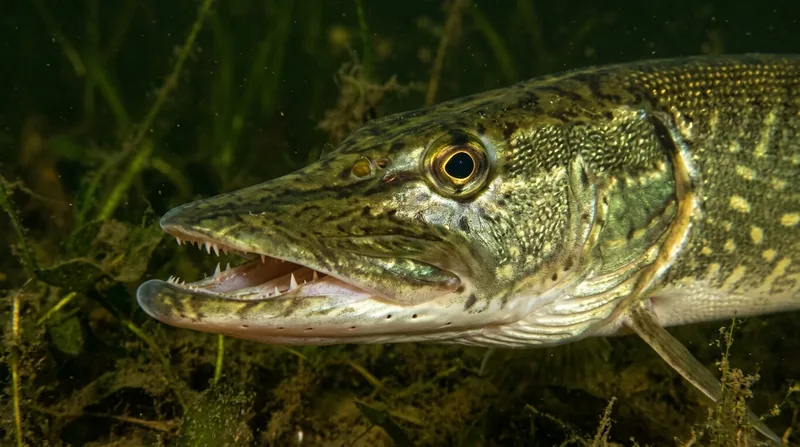 The pike's head: duckbill snout, backward teeth, golden eye
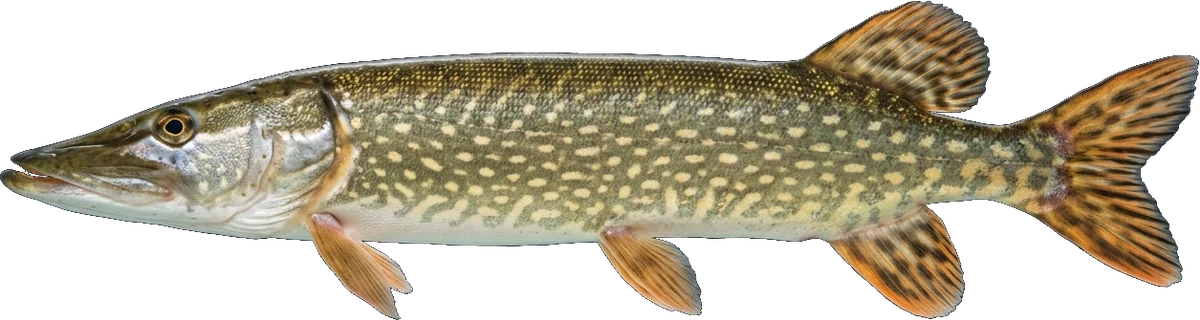
You know a pike by its head. The snout is broad and flat, like a duck's bill, with the lower jaw a little longer than the upper. The mouth holds rows of sharp teeth pointing backwards, towards the throat. Under each side of the lower jaw sits a row of small pores, usually five, which feel vibrations in the water. The eye is large and round, with a golden-yellow iris.
The body is long and narrow: dark green to olive above, creamy white below, with pale oval spots in loose rows along the flanks that hide it among water plants. The dorsal and anal fins sit far back, just in front of the tail and opposite each other, so a pike can go from standstill to full speed in one stroke. Young pike show pale vertical bars instead of spots.
Females grow much larger than males; almost every pike over a metre is a female. According to FishBase a female can reach about one and a half metres.
Pike or zander?
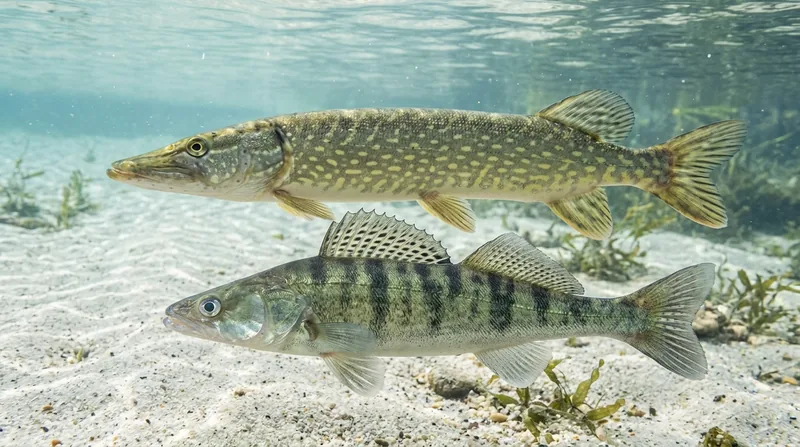 Pike above, zander below
Beginners often mix up pike and zander (snoekbaars in Dutch). Look at the flank first: the pike has pale spots, the zander dark vertical bars. Then the back: the pike has one soft dorsal fin, set far back; the zander has two, the front one spiny. The pike's mouth is broad and flat, the zander's narrower and pointed, with two large fangs. The zander also has a higher back and a big glassy eye for hunting at dusk and in murky water.
And they live apart: the pike among the plants and along the bank, the zander in open, deeper, cloudier water such as canals, harbours and the big rivers.
How it lives and spawns
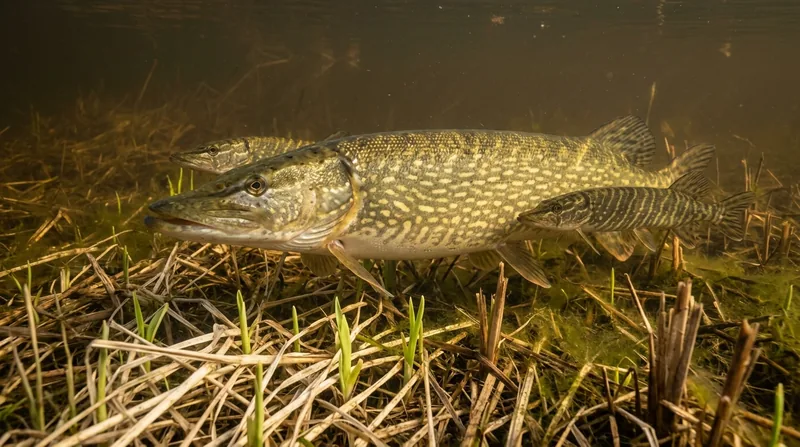 Spawning: one big female, a couple of small males, a few decimetres of water
The pike hunts alone. It lies still among the plants or along a reed edge, waits for a fish to pass and shoots forward in one strike. It eats mostly fish: roach, bream, perch and smaller pike; a good-sized bream is no problem. Now and then it takes a frog or a crayfish.
Spawning is the remarkable part of its year. Pike spawn very early: usually in March and April, sometimes as early as February. Spawning gets going once the water is around nine to twelve degrees. They move into very shallow water for it: flooded grass, last year's reed stubble, a ditch a few decimetres deep. One large female is followed by a few much smaller males. She scatters sticky eggs over the plants as she swims, and that is the end of it: pike do not guard their eggs or young. A few weeks later the fry hatch, eat water fleas and small insects, and soon each other.
That shallow spawning water is why the closed season starts so early. See closed season for pike.
Where pike hold
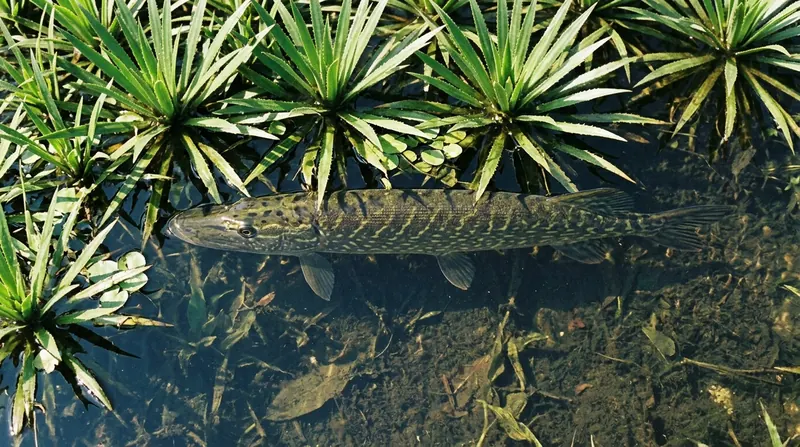 Water soldier: cover and a view
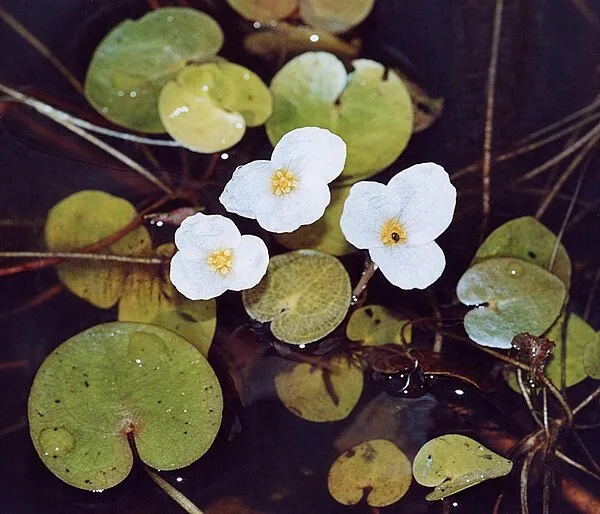
Do not look for pike in open water; look for them next to something. A pike wants cover and prey coming past. The reed edge is the classic spot, the pike lying in the margin with its head pointing out. Beds of water soldier and other plants are as good, especially the outer edge where the weed stops and the water deepens. Any change from shallow to deep is worth a cast: a shelf dropping into a channel, the side of a hole, the foot of a steep bank.
In town water and canals look for hard structure: bridge pilings, jetties, harbour mouths, the corner of a quay. In rivers pike sit in the slack water between the groynes, not in the current. In winter, with the plants gone, polder pike move to the wider, deeper ditches and the deep water near a pumping station.
What our models pick out of the catch data is mainly the weedy water; what they saw is at the bottom of this page. For one big water with harbours, sandbanks and channels, look at the IJsselmeer.
Pike fishing through the year
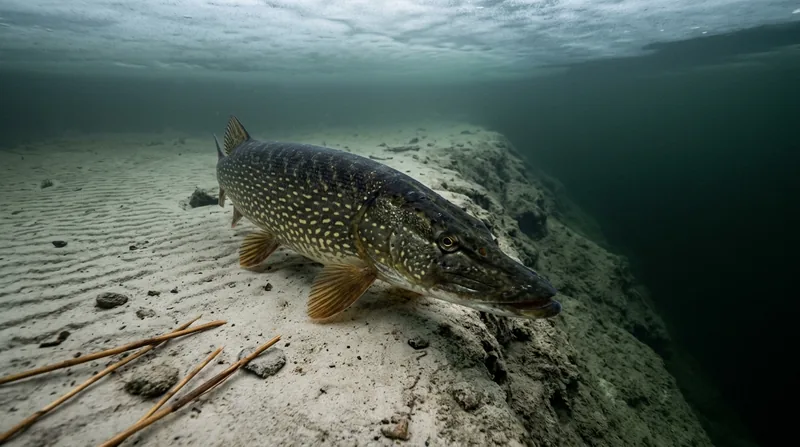 Winter: deep, slow, and often the heaviest fish of the year
What decides whether pike feed? Mostly the season and the water temperature. The pike is a cold-water fish: most active as the water cools in autumn and winter, eating little when it is warm. Air pressure and cloud matter far less than people claim. Look at the time of year and the water temperature first, and at the sky last.
After the closed season. In June the pike has finished spawning and is back in the shallows, thin and hungry. Fish shallow, with a lure worked slowly over the weed.
Summer. Warm water is hard on pike: it holds less oxygen, and a big pike suffers most. It lies on the cool side of a weed bed or a little deeper and hunts at dawn and dusk, so fish those hours. A summer pike recovers badly: play it fast, keep it out of the water briefly and put it straight back; if the water is really warm, wait a day. How to do it is under unhooking and releasing.
Autumn. The water cools and the long feeding run begins: the best time of the year, and the time of the big fish. Big plugs, swimbaits and large shads along the weed edges, then deeper as the weed dies.
Winter. Everything slows. The pike lies deep and moves little; a dead bait on the bottom, still or twitched very slowly, beats a fast plug. Fish the deep edges and holes, and in the polder the wider ditches. A winter pike is often a heavy pike: the females are already full of roe.
Spring. The pike moves into its shallow spawning water and the closed season begins. What you may and may not do is below.
Techniques and tackle
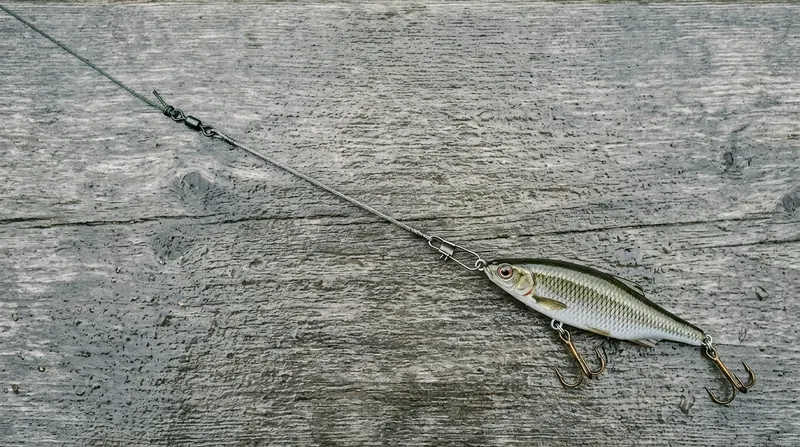 Always a bite-proof trace between line and lure
Spinning with lures is the most common method; which lure depends on the season, see above. Big shads and other soft baits work almost always. Jerkbaits are the classic shallow-water pike plugs: short taps with the rod tip and the plug darts left and right. Spinners and spoons suit the ditch, topwater lures warm summer mornings over the weed. Fly fishing for pike is growing: a big streamer on a heavy fly rod, shallow, in spring and summer.
A rod of 2.40 to 2.70 metres with a casting weight of 40 to 80 grams covers most pike fishing, with a sturdy reel and braided line. Always fish a bite-proof trace between line and lure: pike teeth cut ordinary line with ease. The material is up to you, as long as it is pike-proof.
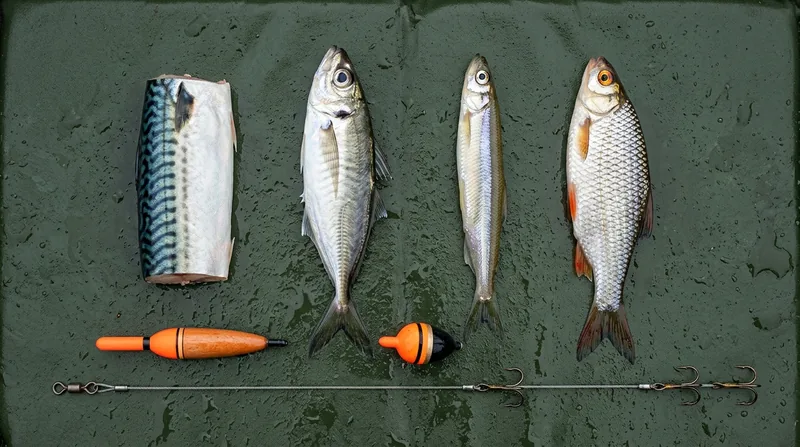 Dead bait for pike: sea fish from the fishmonger, a roach, and a wire trace with two trebles
Dead bait is the second method, and in winter often the better one: a dead roach, sprat or mackerel on a trace with two trebles, on or just above the bottom, with a float or bite alarm. Strike quickly, before the pike swallows the bait deep.
There are two ways to present a dead bait, and the difference shows up in what you catch. A bait lying still on the bottom, on a running lead, more often brings the bigger pike. The lead slides freely on the line, so the pike feels no resistance. A bait hanging just off the bottom under a float usually brings the smaller ones.
Many anglers push a piece of balsa wood into the bait so it lifts just clear of the bottom. The bait shows up better that way. It is also harder for the Chinese mitten crab to reach: flat on the bottom, a bait is simple for it to steal.
Always bring long pliers or forceps; never unhook a pike with your fingers, and why is under unhooking and releasing. A landing net with a large rubber mesh spares the fins and slime.
Closed season for pike
Every spring there is a closed season for pike. The reason is above, under spawning: the pike lies in a few decimetres of water over flooded grass and old reeds, and a fish caught there loses its eggs or abandons its spawning spot. So it is protected from just before spawning until well after, in two steps: first you may still fish, but every pike must go back; then a ban on lures and dead bait comes on top. The exact dates are in the table below.
- March 1 – March 31 Closed season: catch and release You may fish, and you may use lures, but every fish you catch goes straight back.
- April 1 – May 29 Closed season: cannot be targeted On top of the release rule, lures, dead bait, pieces of fish and slaughter products are banned. Only artificial flies under 2.5 cm are still allowed, so in practice you cannot fish for this species.
- May 30 – February 28 now Open season The normal rules apply. You may keep a fish if it is long enough.
The closed season lasts until the last Saturday of May, and on that Saturday you may fish again. So the date moves every year: May 30, 2026 · May 29, 2027 · May 27, 2028. The legal minimum size is 45 cm (Uitvoeringsregeling visserij, art. 5b).
Outside the closed season a minimum size applies: a pike under 45 centimetres always goes back (Uitvoeringsregeling visserij, article 5b). But the law is not the whole story. To fish in the Netherlands you need the VISpas, the national permit, and its conditions go further: at most one pike, and only a fish between 45 and 80 centimetres, so a big pike goes back too. On many waters you may not keep pike at all, at any time of year; in Friesland, for example, every pike must be released. Always check the Gezamenlijke Lijst van Nederlandse Viswateren, the list of waters that comes with the VISpas, or the VISplanner app for the water you fish.
Can you fish for pike in March?
Yes. In March the closed season for pike has started, but the ban on lures and dead bait has not; that begins in April. So you may fish with lures as usual, and every pike you catch goes straight back into the same water. Once the bait ban starts, pike fishing is over in practice: all that remains is an artificial fly under 2.5 centimetres.
Two rules: during the closed season every pike goes straight back, and outside it you check your water's conditions before keeping one. In doubt, release.
Unhooking and releasing pike
A pike has hundreds of teeth in rows, curving backwards towards the throat. What goes into the mouth does not come out the same way, a finger included. So long pliers are standard kit, not an extra: unhook with long pliers or forceps and keep your fingers out of the mouth.
To hold a pike, use the gill-cover grip. Lift the gill cover slightly, slide your fingers behind it and feel for the hard edge: the bony arch of the lower jaw. Grip that between thumb and fingers and stay off the red gills. They are soft, they bleed easily, and they do not heal. Support the belly with the other hand and hold the fish horizontally; never hang a big pike vertically from the jaw alone, because its own weight then pulls on its spine and organs.
Hard to explain, easy to see. In this video from Vissen Doe Je Zo!, Daniël of Sportvisunie shows the gill grip step by step. It is in Dutch, but the handling speaks for itself.
Bring an unhooking mat, especially for big fish: wet mat, wet hands, pliers and camera ready before the fish is on the bank. Keep air time short, take the photo low over the mat, then hold the fish upright in the water until it swims off by itself. In summer all of this counts double. Pike is a cold-water fish: in warm water it needs more oxygen, while the water holds less. After a hard fight it takes far longer to recover.
The biggest pike ever caught
The Dutch record pike is 138 cm long. Siegfried Schön caught it in October 2019. The world record is a 25 kg pike, caught by Lothar Louis in Germany in 1986. The longest pike we found on an official record list is 153.67 cm, caught in Canada in 2004.
45 cm Minimum size: you may not keep a smaller pike
120 cm The longest of more than 75,000 pike measured in fish surveys
128 cm World record for length (IGFA, 2025)
138 cm Dutch record (2019)
153.67 cm The longest we found on a record list (Canada, 2004)
Dutch record
138 cm
Siegfried Schön caught this pike in October 2019, alone in a small boat, on a lure. Schön was born in Germany, lives in Belgium and fishes mostly in the Netherlands. The fish was so long that he had to photograph it on the measuring tape in his phone's panorama mode. Then he released it. He has not said where he caught it. The previous record was 134 cm, caught by Nico Molkens in March 2017 (Sportvisserij Nederland).
The Dutch record list goes by length only, in whole centimetres. A fish counts if it was caught on a rod, hooked in the mouth and released alive into the same water. Weight plays no part.
World record
25 kg
The world record is kept by the IGFA, the international body for angling records. Lothar Louis caught the 25 kg pike in October 1986 on a spoon, in a gravel pit near Greffern. The village lies on the Rhine, right on the French border. The fish was weighed on a butcher's certified scale, with witnesses present. The German record list of Fisch & Fang has the same fish at number 1, but gives 12 October and a gravel pit near Bühl, a nearby town. IGFA has 16 October, and publishes only the weight. According to pike expert Jan Eggers, the fish was 136 cm long.
For length, IGFA keeps a separate world record: 128 cm, caught in the Lena River in Russia in 2025. That is shorter than the Dutch record. A fish only reaches the IGFA list if it is submitted there and approved.
Longest on a record list
153.67 cm
The longest pike we found on an official record list is 153.67 cm (60.5 inches). Gary Weber caught it in 2004 in Apisko Lake, a remote lake in the Canadian province of Manitoba. It is the record on the Master Angler list kept by Travel Manitoba, the province's tourism agency (Hunt Fish Manitoba). That list goes by length only. You send in a photo of the whole fish lying flat on a ruler or measuring board, from the tip of the head to the tip of the tail. The list gives no weight.
You will often read online that the longest pike was 152 cm long and weighed 28 kg. Those figures sat on English Wikipedia without a source from 2013 to 2017, and were removed.
The legend
5.70 m
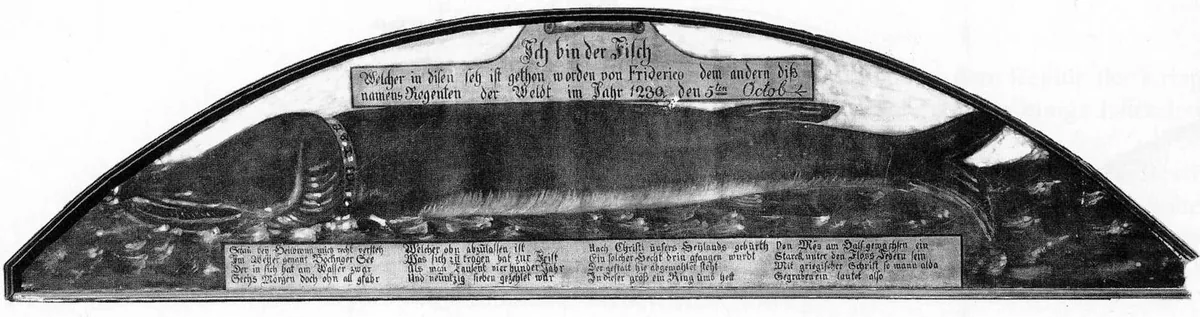
The most famous giant-pike story dates from 1497. A pike 5.70 metres long and weighing 350 pounds was said to have been caught in a lake near Kaiserslautern. Around its neck was a copper ring, saying that Emperor Frederick II had put the fish into the lake himself in 1230. That would have made it 267 years old. Heilbronn told the same story about a lake near that town.
For centuries, scholars repeated it as fact. It is not true. Two days before the date on the ring, the emperor was in southern Italy (Wikipedia). And 5.70 metres is almost four times the length of the longest pike above. According to FishBase, a pike also lives no more than about 30 years.
Records by country
Every country keeps its own list, with its own rules. Some lists count length, others weight, so the numbers cannot always be compared.
| Country | Record | Angler | Where caught | Date | List |
|---|---|---|---|---|---|
| Netherlands | 138 cm | Siegfried Schön | — | Oct 13, 2019 | Sportvisunie |
| Canada (Manitoba) | 153.67 cm (60.5 in) | Gary Weber | Apisko Lake | 2004 | Travel Manitoba |
| Denmark | 22.16 kg | Per Krarup | a lake on Zealand | Sep 19, 2017 | Danske Fiskerekorder |
| Denmark | 133 cm | Daniel Stormly | a lake on Zealand | May 21, 2025 | Danske Fiskerekorder |
| Finland | 132 cm | — | Ähtärinjärvi | Oct 1, 2024 | Ennätyskalarekisteri |
| Germany | 25 kg | Lothar Louis | gravel pit near Bühl | Oct 12, 1986 | Fisch & Fang |
| Ireland | 19.39 kg (42 lb 12 oz) | Larry Kelly | White Lough | Sep 25, 2005 | ISFC |
| Poland | 20.80 kg · 130 cm | Marian Palawczyk | — | 1970 | Wiadomości Wędkarskie |
| Sweden | 21.07 kg · 128 cm | Fredrik Johansson | Lake Vättern | Apr 1, 2016 | Sportfiskarna |
| Switzerland | 22 kg · 137 cm | Eros Pelli | Lake Lugano | May 24, 2003 | Petri-Heil |
| United Kingdom | 21.46 kg (47 lb 5 oz) | Lloyd Watson | Chew Valley Lake | 2024 | BRFC |
A dash means the list does not give it. Checked on September 26, 2026. A record can be broken at any time, so we check these lists at least once a year.
In the Netherlands
Pike live in almost all Dutch fresh water: polder ditches, lakes, canals and the big rivers; only salt water is without them. Even a narrow ditch can hold a big pike, because it needs cover and food, not space. Worldwide the species is doing well: the IUCN Red List has it as Least Concern.
Pike belong to still or slow water with plants: lakes, ponds, ditches, the quiet parts of a river. In a fast, bare current you will rarely find one. In the Netherlands the pike therefore also serves as a gauge of clear, weedy water. How that shows in our own data, and where it does not fit, is at the bottom of this page.
Want to keep a pike? First read closed season for pike: it has the minimum size and the rule that on many waters every pike must be released.
What our models found for Pike
Below is what our models see in the data. These are links: where one thing occurs, the other occurs more often. That is not a cause. Each model answers one question and may not say more than it measured. The label by the heading tells you which question — and how sure the answer is.
Where there are many A set, not a ranking Weak model
 Frogbit family (Hydrocharitaceae)
Plenty of pike goes with weedy water. The frogbit family (Hydrocharitaceae) is in that picture — water soldier and frogbit — along with bankside plants from the carrot family (Apiaceae) and small mud snails (Hydrobiidae). Where green algae from the family Oocystaceae set the tone, we count fewer pike.
Researchers have described that split for forty years. A shallow lake can be clear, with submerged plants, pike and perch. Or murky, with algae and bream. It does not drift slowly from one to the other. Each state holds itself in place, until the lake tips. Then the new state holds just as firmly. That is why turning it back is so hard. Dutch restoration work has used this: there, pike and water plants are the yardstick for clear water.
Our model did not know any of that. It saw where pike had been caught and what else lived in that water. From the plant side, it arrives at the same split.
One thing does not fit, and it is worth saying. Not all algae point the same way: with blue-green algae from the family Nostocaceae we count more pike, not fewer. We found no explanation for that.
Where they grow big Weak model
 Zebra mussels (Dreissenidae)
This model spots water with bigger pike only slightly more often than chance. Take it lightly.
The clearest signal is silver bream: where there is a lot of it, pike are smaller on average. That is the same split again, now read off the fish instead of the plants — bream belong to murky water. Top of the list is a small snail from the family Acroloxidae that lives on plants and stones, also on the smaller side. We found no literature on that one.
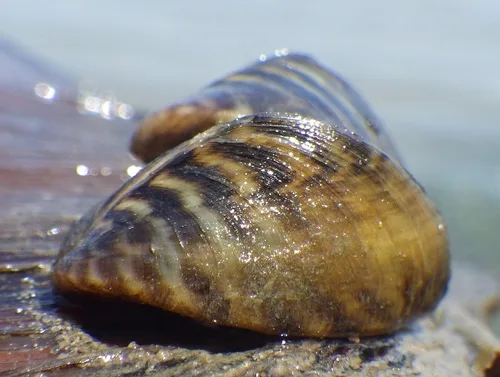
The other way round: where zebra mussels (Dreissenidae) lie on the bottom, pike run bigger. Zebra mussels filter the water and make it clearer. Whether that is why the pike are bigger, we did not measure. It is a plausible explanation and no more.