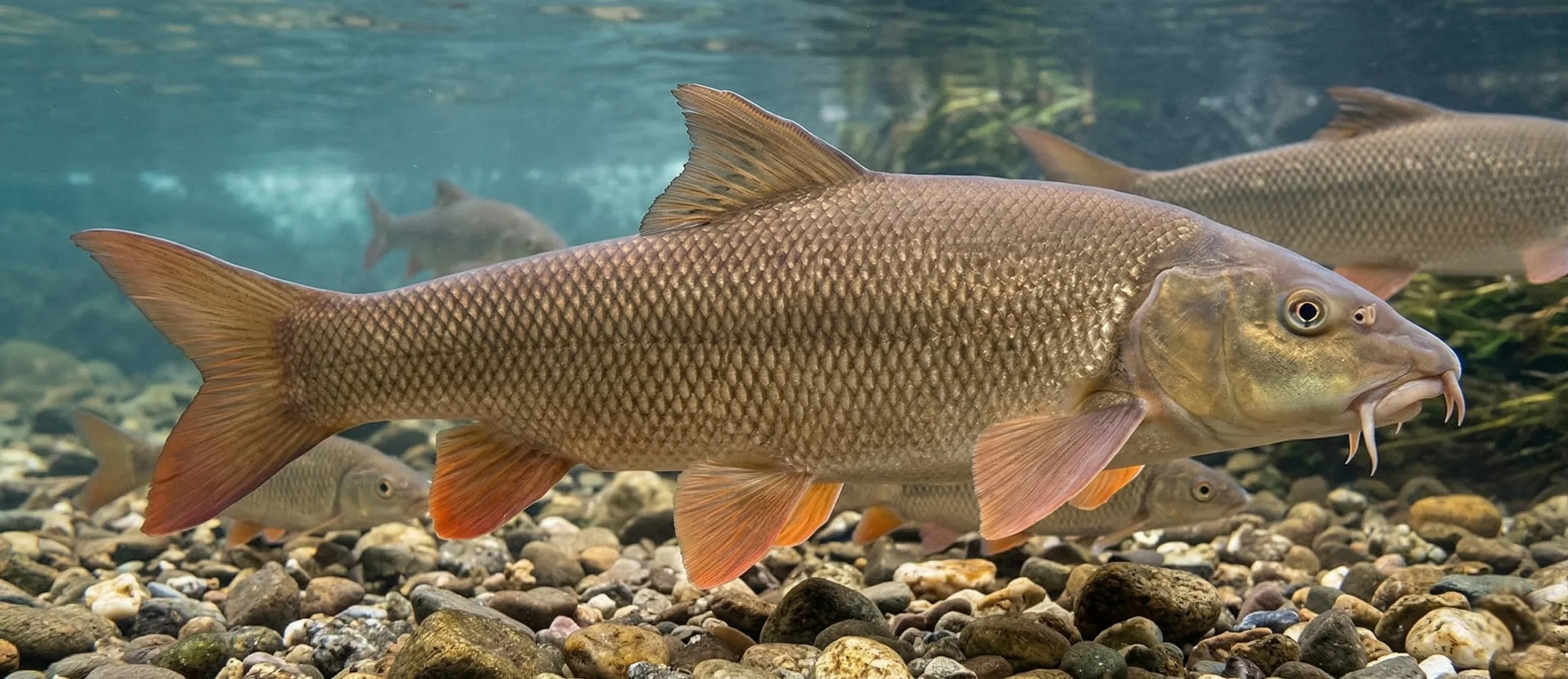
Identification
The common dace is a slim, streamlined fish that closely resembles the roach but is narrower and more elongated. The back is dark grey-green, the flanks silvery with a subtle yellow tinge. The mouth is small and slightly inferior. The key difference from roach: the dace has a concave (inward-curving) edge to the anal fin, while the roach has a convex (outward-curving) anal fin. The eyes are also smaller and more upward-facing. In the Netherlands, they are typically caught at 12-20 cm, with specimens up to 25 cm.
Behavior & ecology
The common dace is a distinctly flow-loving fish that thrives best in clear, fast-flowing streams and rivers with gravel bottoms. It is a schooling fish that forages in groups on insect larvae, small crustaceans and algae. Dace are fast swimmers at home in the riffles that chub and gudgeon also inhabit. They spawn early in spring (March-April) over gravel in shallow, flowing water. The species is sensitive to water pollution and siltation and is considered an indicator of good water quality.
Fishing techniques
The dace is a niche species mainly targeted by specialist coarse and stream anglers:
- Light match fishing — stick float in the current with a single maggot or caster; let the rig drift with the flow
- Fly fishing — small dry flies (size 16-20) on a 3-4 wt rod; highly sporting in clear stream water
- Trotting — centrepin reel with a light rig in the current; a traditional technique that works well in Dutch streams
Use light tackle: 0.10-0.14 mm hooklength, hook size 16-20. Dace bite fast in flowing water — concentration and a quick strike are essential.
In the Netherlands
The common dace is native to the Netherlands but has a limited distribution. The species is mainly found in the streams of Limburg, Brabant, the Veluwe and Overijssel, and in the larger rivers. Stream restoration projects and water quality improvements have allowed the dace to return to some locations in recent decades. The dace has a year-round closed season and may not be kept. The dace is on the Red List as 'vulnerable' and serves as an indicator species for the ecological health of streams.
What our models found for Common dace
Below is what our models see in the data. These are links: where one thing occurs, the other occurs more often. That is not a cause. Each model answers one question and may not say more than it measured. The label by the heading tells you which question — and how sure the answer is.
Where this species lives A set, not a ranking Strong model
 Chub (Leuciscus cephalus)
No winner can be picked here, but the list is remarkably pure: everything in it belongs to running water. The chub, the stone loach, the gudgeon, the banded demoiselle (Calopterygidae), caddisflies of the family Hydropsychidae and blackflies (Simuliidae).
But the real mark of this list is the water mites. FIVE families are in it: Sperchontidae, Lebertiidae, Hygrobatidae, Pionidae and Torrenticolidae. That last name says it itself — it refers to fast-flowing water. No other fish on this site carries more than two.
FishBase puts the dace in moderate to fast-flowing large streams and rivers with rock or gravel bottom, where it swims in shoals just below the surface. Nutrient level and the three-spined stickleback are in the model too.
Where there are many A set, not a ranking Weak model
There is little to take from this model. One feature clears the floor: horseflies (Tabanidae), whose larvae live in wet bankside soil. Where there are more of them, we count more dace. Beyond that this model says nothing.