Identification
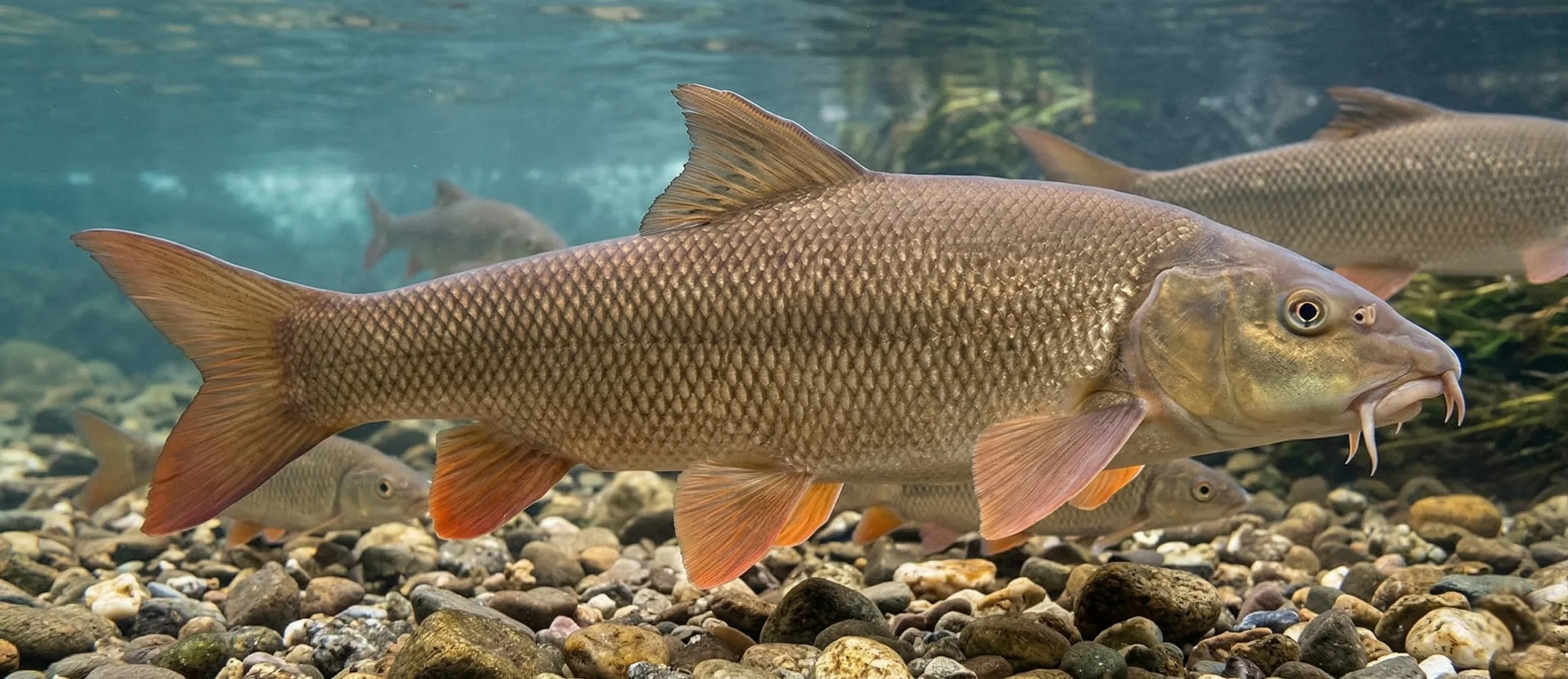
The Prussian carp closely resembles the crucian carp and is often confused with it. The body is deep and laterally compressed, with large, silvery scales. The back is dark olive-green to grey-brown, the flanks silvery-grey and the belly white to slightly yellowish. The key difference from the crucian carp: the Prussian carp has a slightly forked (indented) tail fin, while the crucian carp has a straight-cut or slightly convex tail fin. The Prussian carp also averages larger — specimens of 30-40 cm are common, whereas crucian carp rarely exceed 25 cm.
Behavior & ecology
The Prussian carp originates from East Asia and has spread extensively across Europe in recent decades. In the Netherlands it is a common fish in still and slow-flowing waters. A remarkable trait: Prussian carp populations often consist largely of females that reproduce through gynogenesis — they use sperm from other cyprinids (common carp, crucian carp, bream) to activate their eggs, without incorporating the male's DNA. This makes the Prussian carp an extremely successful colonizer.
Prussian carp are omnivores feeding on aquatic plants, algae, insect larvae, worms and small crustaceans. They are tolerant of low oxygen levels and can survive in waters where many other fish species cannot.
Fishing techniques
The Prussian carp is a fun bycatch when coarse fishing and is caught using the same methods as other small cyprinids:
- Match fishing — light float (1-3 gram) with maggot, caster or corn on the hook; fish just above the bottom
- Method feeder — small method feeder with a mini boilie, pellet or corn as hookbait; effective in ponds
- Pole fishing — margin or 6-11 meter pole with light rigs; ideal for pond and urban water fishing
Use fine tackle: 0.12-0.16 mm mainline, hook size 14-18.
In the Netherlands
The Prussian carp is a non-native species that is now found throughout virtually all of the Netherlands, from city ponds to polder ditches. The species has spread explosively thanks to gynogenetic reproduction and tolerance for poor water quality. There is no closed season or minimum size. Although not considered native, the species is so established that eradication is unrealistic. In some waters, the Prussian carp displaces the native crucian carp, which is an ecological concern.
What our models found for Prussian carp
Below is what our models see in the data. These are links: where one thing occurs, the other occurs more often. That is not a cause. Each model answers one question and may not say more than it measured. The label by the heading tells you which question — and how sure the answer is.
Where this species lives Strong model
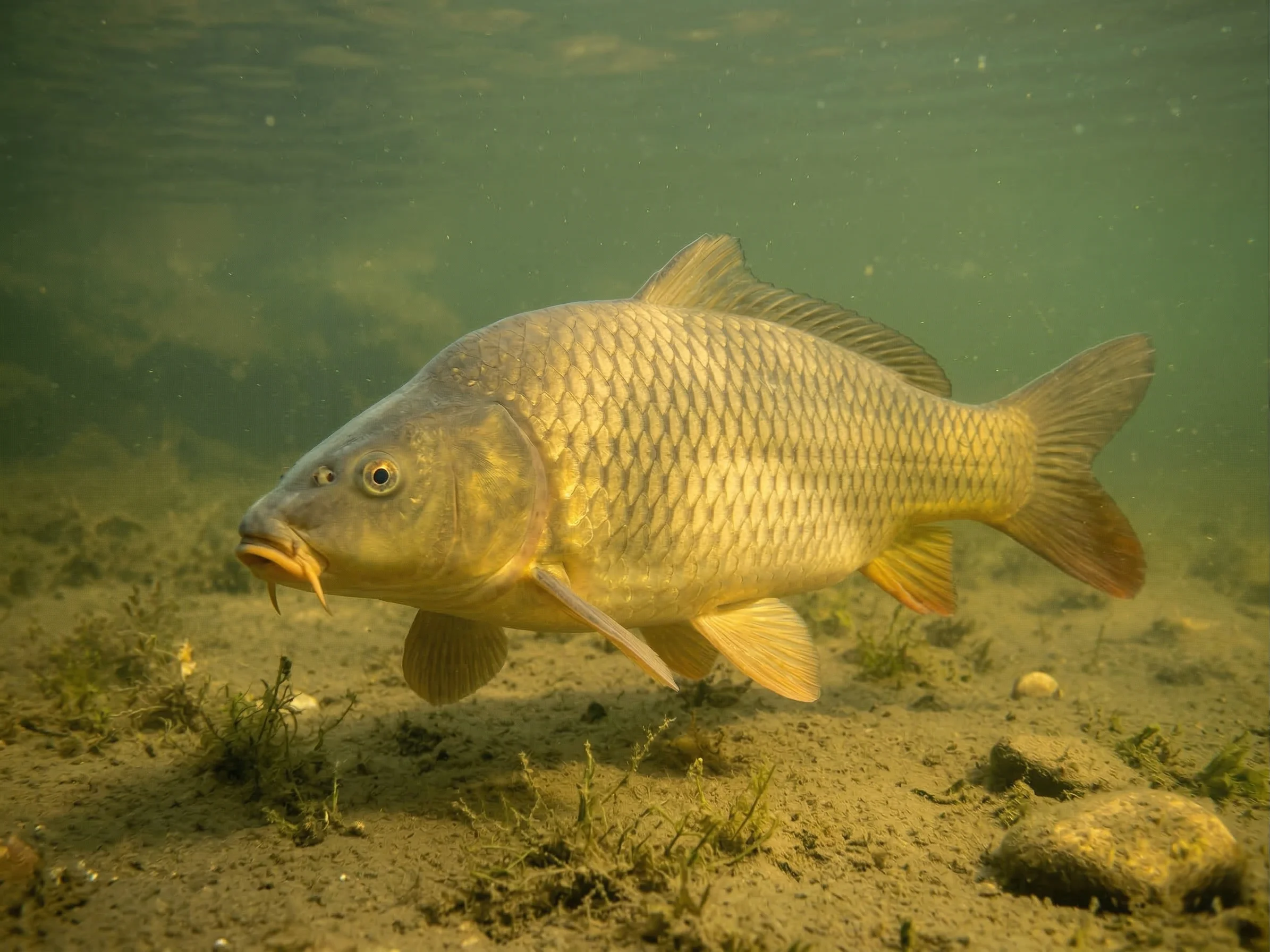 Common carp (Cyprinus carpio)
For the Prussian carp one name dominates everything: the common carp. In this model it weighs three times as much as the next name. The carp appears in two columns, as a species and as a subspecies, and the page adds them together.
FishBase gives two explanations, and they do not rule each other out. The Prussian carp is stocked together with common carp and transported throughout Europe. And it breeds using carp sperm without the eggs actually being fertilised: only females come out, clones of the mother. So it needs the carp to reproduce, but keeps none of the carp's genes.
All we measured is that the two often sit in the same water. Which of those two explanations it comes from, or both, our model does not say.
The rest of the list is simply nutrient-rich water: bream, perch family, zander, sticklebacks, ruffe and eel. Nutrient level is in there itself, and on the bank common reed (Poaceae) and sedges and club-rushes (Cyperaceae).
Where there are many A set, not a ranking Weak model
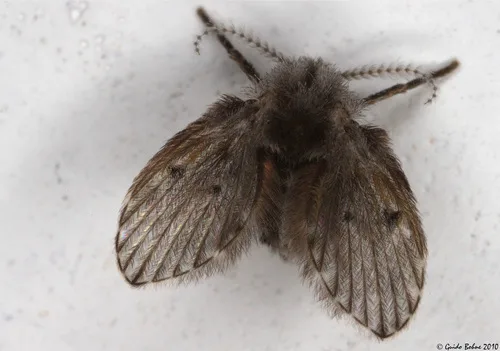 Moth flies (Psychodidae)
This model is weak, and it is mostly a list of where the Prussian carp is NOT. We count fewer where there are caddisflies (Limnephilidae), flatworms (Planariidae), spongeflies (Sisyridae) — whose larvae eat freshwater sponges — and water mites of the family Eylaidae.
On the other side sit small moss beetles (Hydraenidae), moth flies (Psychodidae) and the brown shrimp (Crangonidae). That last one belongs to brackish water, and FishBase does put the Prussian carp in fresh AND brackish water.