Identification
The rudd is one of the most beautiful coarse fish species in the Netherlands. The bright red fins and orange to golden eyes make this fish instantly recognizable. The body is deeper and more laterally compressed than roach, with a golden-green sheen on the flanks. The key difference from roach is the upward-facing mouth — the lower jaw protrudes beyond the upper jaw, betraying its preference for surface feeding. Roach have a more downward-pointing mouth. Additionally, rudd have 40-43 scales along the lateral line (roach: 42-45) and distinctly brighter, more vivid red fins.
Behavior & ecology
The rudd is the specialist of shallow, vegetated water. Where roach is a generalist that survives anywhere, the rudd explicitly chooses waters with dense aquatic vegetation. With its upward-facing mouth, it preferably forages at the surface and in mid-water: insects that fall on the water, floating plant material, and algae.
The rudd is more herbivorous than roach, eating aquatic plants and soft plant stems alongside insects. Spawning takes place from May to June in densely vegetated, shallow water. Rudd are most active in warm, calm weather — on warm summer mornings you can regularly see them foraging at the surface among the reeds and water lilies.
Fishing techniques
Rudd require a light, finesse approach. The most effective methods:
- Surface fishing: The method for rudd in summer. Bread flake or a small dry fly on the surface, among the aquatic plants. Exciting and visual.
- Light float fishing: A fine waggler, set shallow (mid-water to just below the surface). Small hook (size 16-20) with one or two maggots or a caster.
- Bait: Maggots and casters as the foundation. Bread flake is selective for rudd at the surface. Hemp seed as feed works excellently. In spring, small red worms are effective.
- Fly fishing: With small dry flies or nymphs on light fly tackle. An underrated method that can be remarkably effective on plant-rich ponds.
Always fish near aquatic plants: reed beds, water lilies, and pondweed. Use a light rod (3.30-3.90m) with fine line (0.10-0.14mm).
In the Netherlands
Rudd are found throughout the Netherlands but have a clear preference for plant-rich waters. Ponds, ditches, polder waters, and urban waters with sufficient vegetation are typical rudd waters. The species is less dominant in large, open canals and rivers where roach and bream prevail. There is no closed season. Rudd grow smaller than roach and are less numerous, but are appreciated by many anglers for their beautiful appearance and sporting bite.
What our models found for Rudd
Below is what our models see in the data. These are links: where one thing occurs, the other occurs more often. That is not a cause. Each model answers one question and may not say more than it measured. The label by the heading tells you which question — and how sure the answer is.
Where there are many A set, not a ranking Weak model
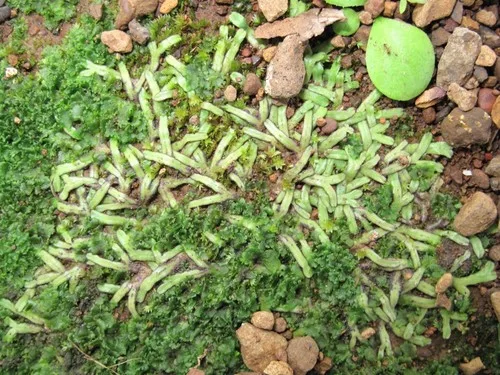 Floating crystalwort (Ricciaceae)
Plenty of rudd goes with single-celled algae from the families Heterocapsaceae and Phacidae, the diatom Eunotia (Eunotiaceae), the green alga water net (Hydrodictyaceae) and golden algae (Mallomonadaceae). A beetle sits in the list too: the water-lily beetle (Chrysomelidae). It lives on the floating leaves of water lilies.
We count fewer rudd where the floating liverwort crystalwort (Ricciaceae) grows. Also where phantom crane flies (Ptychopteridae) and water mites of the family Hydrachnidae live, and where the white-legged damselfly (Platycnemididae) flies. That damselfly belongs to running water, and the rudd does not.
Where they grow big Weak model
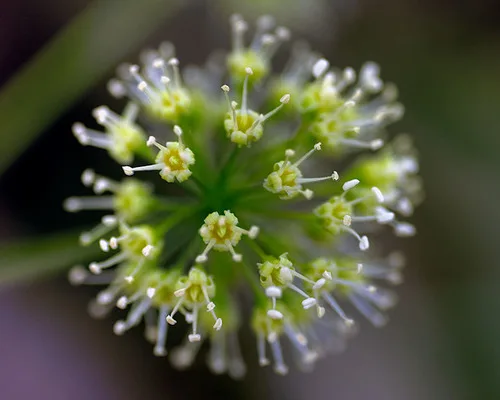 Marsh pennywort (Araliaceae)
Top of the list are cryptomonads (Cryptomonadaceae), and they go with SMALLER rudd. Then come single-celled algae from the family Chrysochromulinaceae, marsh pennywort (Araliaceae) and weevils (Brachyceridae). All three go with BIGGER fish.
Those weevils are worth a look. In our data they are two species: the azolla weevil and the duckweed weevil. The azolla weevil lives on water fern, the duckweed weevil on duckweed. They are animals of a floating plant cover.
Together with the pennywort, and with the water-lily beetle above, they all point at the same kind of water. FishBase duly calls the rudd a fish of nutrient-rich, well vegetated lowland water that feeds on plankton, terrestrial insects and plant material. Whether rudd eat those beetles, we do not know — we do not measure that.
Smaller rudd also go with cranefly larvae (Pediciidae), the bitterling and the diatom Eunotia. The water scorpion, a water bug (Nepidae), and the tree black alder (Betulaceae) sit there too. Eunotia is striking: that diatom sits with plenty of rudd AND with smaller rudd. Many and big are not the same water here.


