Identification
The stone loach is a small, elongated bottom-dwelling fish of 8 to 15 cm (maximum 21 cm). The body is round in cross-section (not flattened like a goby) with a broad, flat head and six short barbels around the mouth — three pairs of sensory organs used to locate food on the bottom. The color is yellow-brown to grey-brown with irregular dark spots and marbling. The belly is lighter. The stone loach resembles the spined loach but lacks the characteristic spine below the eye and has fewer barbels.
Behavior & ecology
The stone loach is a nocturnal bottom fish that spends daylight hours hiding under stones, among gravel, or in bank vegetation. It feeds on small invertebrates: midge larvae, mayflies, caddisflies, and worms. The species has a strong preference for flowing, clear water with a gravel bottom — typical stream habitat. The stone loach requires well-oxygenated water and quickly disappears from polluted or stagnant conditions. Spawning occurs in spring, with eggs deposited on stones and gravel.
In the Netherlands
The stone loach is an indicator for healthy stream ecosystems. In the Netherlands, it occurs primarily in the streams of the eastern and southern provinces: the Veluwe, Achterhoek, Twente, Noord-Brabant, and Limburg. Stream restoration projects have improved its distribution over recent decades. The species is protected under Dutch nature conservation law and has no significance for sport fishing. The presence of stone loach is a positive signal for ecological stream quality — where stone loach live, the water is clean and the substrate natural.
What our models found for Stone loach
Below is what our models see in the data. These are links: where one thing occurs, the other occurs more often. That is not a cause. Each model answers one question and may not say more than it measured. The label by the heading tells you which question — and how sure the answer is.
Where this species lives A set, not a ranking Strong model
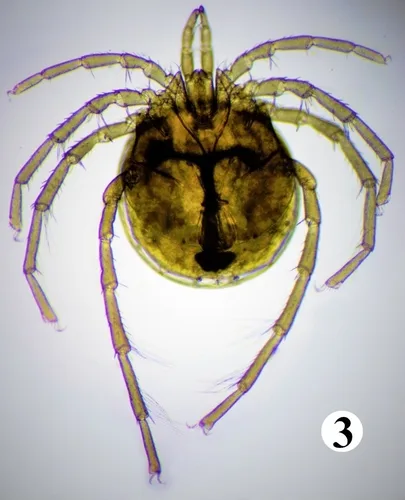 Water mites (Lebertiidae)
No winner can be picked here either, but the list is strikingly consistent: nearly everything in it belongs to running water. The gudgeon is in it, and water mites of the families Lebertiidae and Hygrobatidae. Then two damselflies of running water: the banded demoiselle (Calopterygidae) and the white-legged damselfly (Platycnemididae). And blackflies (Simuliidae), stoneflies (Nemouridae) and caddisflies of the family Hydropsychidae, which spin a catching net in the current.
That fits exactly. FishBase puts the stone loach in flowing stretches of streams and medium-sized rivers with gravel to stone bottom and adds that it is sensitive to pollution and low oxygen — its presence there counts as a sign of good water quality.
One feature we deliberately leave alone: average maximum wind speed sits high in this model. What the wind does in a cell depends mostly on WHERE that cell is — on the coast or inland. So we read nothing about the stone loach into it.
Where there are many A set, not a ranking Strong model
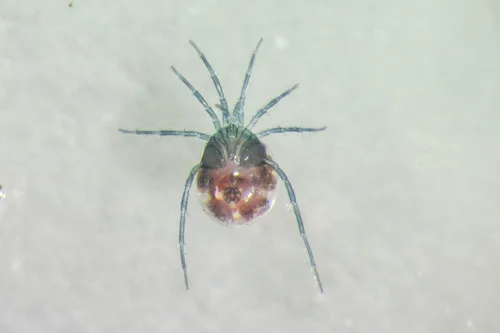 Water mites (Hygrobatidae)
This model says the same as the last one. Water mites of the family Hygrobatidae and the black alder (Betulaceae) go with water where we count many stone loach.
Purple loosestrife (Lythraceae), reed and other grasses (Poaceae) and golden algae (Ochromonadaceae) go with water where we count fewer.
Those two sides are the same story. The water mites live in running water; loosestrife and reed stand along still, overgrown banks.


