Identification
The whiting is a slender cod-family fish of 20 to 35 cm (up to 70 cm maximum). The body is elongated and silvery with a lighter belly and a brownish-green back. Characteristic are the three dorsal fins and two anal fins — typical of the cod family. Unlike cod and pouting, the whiting has no or only a very small chin barbel. A conspicuous dark spot at the base of the pectoral fin is a good identification mark. The lateral line runs as a dark line along the flank.
Behavior & ecology
The whiting is an active hunter that lives in schools in coastal waters and estuaries. It feeds on shrimp, small fish (sprat, herring, sand eel), and polychaete worms. Young whiting seek shelter among jellyfish — swimming between the tentacles where they are protected from larger predators. The species moves to shallower coastal waters in autumn and winter, making it accessible to anglers from piers and breakwaters. In summer, it retreats to deeper water.
Fishing techniques
Whiting is a popular target for sea anglers, especially in autumn and winter. The most effective method is a paternoster rig with two to three hooks (size 4–8) baited with pieces of shrimp, ragworm, or lugworm. Fish from piers, harbor walls, breakwaters, or from a boat. A light sea rod with a sensitive tip is ideal — whiting bite eagerly and rarely need to be struck. The best periods are November and December, at temperatures around 6–12°C. Whiting is also caught as bycatch when fishing for cod or pouting.
In the Netherlands
Whiting occurs along the entire Dutch coast, in the North Sea, Wadden Sea, and in canals connected to the sea. The species is most abundant in winter months when schools move close inshore. Whiting is an important link in the marine food web — as a predator of shrimp and as prey for larger cod species, seals, and seabirds. There is no minimum size or quota for recreational anglers, but responsible release of undersized fish is recommended.
What our models found for Whiting
Below is what our models see in the data. These are links: where one thing occurs, the other occurs more often. That is not a cause. Each model answers one question and may not say more than it measured. The label by the heading tells you which question — and how sure the answer is.
Where there are many A set, not a ranking Strong model
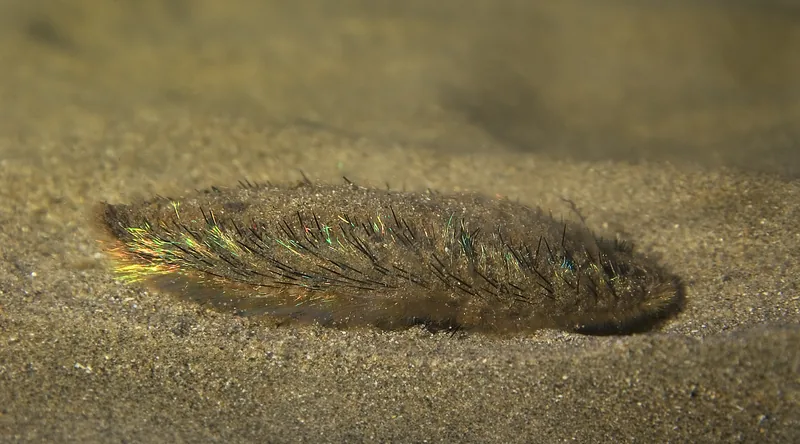 Sea mouse (Aphroditidae)
This model has only three features, and all three point the same way. Plenty of whiting goes with depth, swimming crabs (Polybiidae) and the sea mouse (Aphroditidae), a thick bristle worm.
Two of those are simply on the menu. FishBase says whiting feed on shrimps, crabs, molluscs, small fish, polychaetes and cephalopods. So a swimming crab and a bristle worm are both prey. And the depth fits too: young whiting stay inshore for their first year and only then move to the open sea.
That sea mouse is worth following. It appears in twelve of our sea models, and in ten of them it goes with FEWER fish — plaice, cod, sea bass, turbot, brill and more. Only for whiting and dab does it go with MORE. Why those two run the other way, we do not know.


