Identification
The pouting (bib) is a small cod-family fish of 15 to 25 cm (maximum 40 cm) with a notably deep, laterally compressed body — distinctly deeper-bodied than cod or whiting. The color is coppery brown to golden-brown with three to four dark vertical bars, especially in younger fish. Characteristic are the three dorsal fins, two anal fins, and a sturdy chin barbel — longer than that of the whiting. A dark spot at the base of the pectoral fin is a good identification mark. The mouth is relatively small compared to cod.
Behavior & ecology
The pouting is a bottom fish that lives in schools around hard structures: wrecks, piers, breakwaters, harbor walls, and riprap. It feeds on shrimp, small crabs, polychaete worms, and small fish. The species is more coastal than cod and is also found in canals and harbors with sea connections — wherever hard substrate and current come together. Pouting moves to shallower coastal water in autumn. The species spawns from January to April in deeper water.
Fishing techniques
Pouting is a commonly caught fish when sea fishing from piers, breakwaters, and harbor walls. The most effective method is a paternoster with two or three hooks (size 6–10) baited with pieces of shrimp, lugworm, or ragworm. A simple bottom rig also works well. Pouting are greedy feeders that take the bait without hesitation — often multiple fish per cast. The best periods are autumn and early winter (September–December). A light sea rod is sufficient — pouting are not heavy fighters but provide fun sport on light tackle.
In the Netherlands
Pouting occurs along the entire Dutch coast and penetrates further into canals and harbors than most other cod species. The species is ecologically important as prey for larger fish such as cod and sea bass. For anglers, pouting is a reliable catch, especially in autumn — on many piers it is the most commonly caught sea fish. Pouting is not protected and the population along the Dutch coast is relatively stable.
What our models found for Pouting
Below is what our models see in the data. These are links: where one thing occurs, the other occurs more often. That is not a cause. Each model answers one question and may not say more than it measured. The label by the heading tells you which question — and how sure the answer is.
Where this species lives A set, not a ranking Strong model
 Poor cod (Trisopterus minutus)
This model names no winner: the names sit too close together to put one on top. What it does show is the company.
The poor cod is part of it, a close relative of the pouting. Then gobies and sand gobies, the brown shrimp (Crangonidae), flounder, whiting, sole, bullheads, cod, the dragonet and plaice. It is the whole coastal cast of the southern North Sea together.
FishBase says the pouting lives mostly on the outer shelf and moves inshore to spawn, and that young fish swim in large schools.
Where there are many A set, not a ranking Strong model
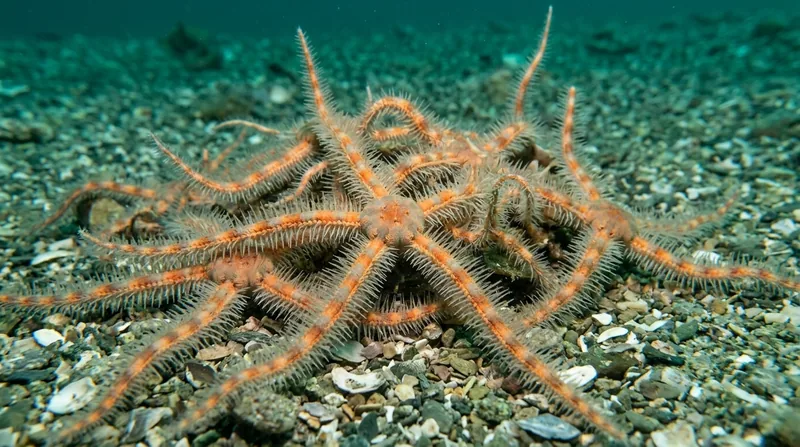 Brittle stars (Ophiotrichidae)
Plenty of pouting goes with brittle stars (Ophiotrichidae), starfish (Asteriidae), swimming crabs (Polybiidae) and depth. We count fewer with the sand star (Astropectinidae), the compass jellyfish (Pelagiidae), the sea mouse (Aphroditidae), the masked crab (Corystidae) and the shore crab (Carcinidae).
Those crabs are a puzzle. According to FishBase the pouting feeds mainly on bottom crustaceans, so you would expect crabs to point the same way. They do not: the swimming crab goes with MORE pouting, the shore crab and the masked crab with FEWER. Food does not explain that. More likely they mark different kinds of bottom — but that is our idea, not our measurement.


