Identification
The nine-spined stickleback is even smaller than its three-spined cousin — adults average just 5 to 6 cm. The body is slender and elongated, with 7 to 12 short spines along the back (despite the name, there are rarely exactly ten). Unlike the three-spined stickleback, this species lacks the prominent bony lateral plates. The color is olive-green to brown with dark crossbars. During spawning season, males turn jet black with white-edged pelvic fins.
Behavior & ecology
The nine-spined stickleback lives hidden among dense aquatic vegetation, feeding on small crustaceans, midge larvae, and water fleas. It is shyer than its three-spined relative and avoids open water. Like its cousin, the male builds a nest for reproduction, but it hangs among water plants rather than sitting on the bottom. The species tolerates low-oxygen and acidic conditions, allowing it to survive in peat ditches and marshes where other fish species cannot.
In the Netherlands
The nine-spined stickleback occurs throughout the Netherlands but is less common than the three-spined species. It prefers shallow, densely vegetated waters: peat ditches, polder channels, marshlands, and small ponds. The species serves as an indicator for waters with rich bank-side vegetation. It has no closed season and no minimum size, and is not a target for anglers. In the food web, it serves as prey for pike and other predators, but its hidden lifestyle makes it less vulnerable than the three-spined stickleback.
What our models found for Nine-spined stickleback
Below is what our models see in the data. These are links: where one thing occurs, the other occurs more often. That is not a cause. Each model answers one question and may not say more than it measured. The label by the heading tells you which question — and how sure the answer is.
Where this species lives Strong model
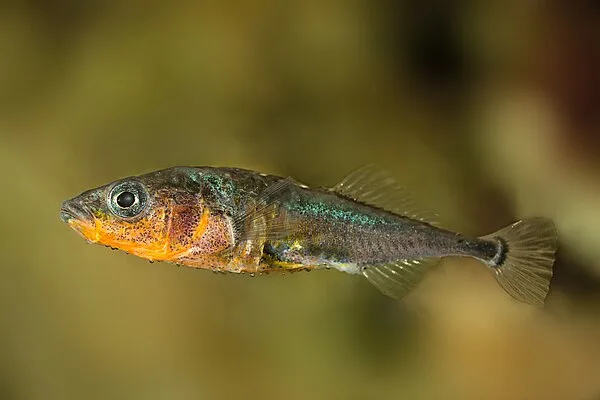 Three-spined stickleback (Gasterosteus aculeatus)
One name dominates: the three-spined stickleback, nearly three times as heavy as the next. So the two sticklebacks are usually in the same water.
After that comes small, weedy water: the stone loach, spined loaches, the gudgeon, sunbleak, carp and pike. Further down alderflies (Sialidae), leeches of the family Erpobdellidae and china-mark moths (Crambidae), whose caterpillars live under water. Nutrient level and organic matter count too.
FishBase puts the nine-spined stickleback in shallow vegetated areas of lakes, ponds and pools of sluggish streams, and sometimes in open water over sand. That is exactly what this list shows.
Where there are many Weak model
This model is weak. One feature goes with MORE nine-spined stickleback: stoneworts (Characeae), plants of clear, hard water.
The rest points the other way. We count fewer with moth flies (Psychodidae), yellow iris (Iridaceae), purple loosestrife (Lythraceae), soldier flies (Stratiomyidae) and — just as for the three-spined stickleback — with the diving bell spider (Dictynidae). Why that spider sits on the low side for both sticklebacks, we do not know.


