Identification
The common dab is a small flatfish of 15 to 25 cm (up to 40 cm maximum) from the family Pleuronectidae (right-eye flounders). The body is oval and strongly laterally compressed, with both eyes on the right side — the upper surface is light brown with small dark spots, the underside white. The most distinctive difference from plaice is the rougher skin: dab scales have small spines that are clearly felt when stroking from head to tail. The lateral line makes a sharp curve above the pectoral fin. The dab lacks the conspicuous orange spots that characterize plaice.
Behavior & ecology
The dab is a bottom fish that lives on sandy and fine-gravel seabeds in the North Sea, from shallow coastal waters to 150 meters depth. It feeds on polychaete worms, small crustaceans, shrimp, and thin-shelled bivalves — food it filters or picks from the sand. The species is less sedentary than plaice and migrates seasonally: to shallower coastal water in spring, to deeper water in autumn and winter. The dab spawns from March to May in 50 to 150 meters deep water. Young dab grow up in shallow coastal waters and estuaries.
Fishing techniques
Dab is a welcome bycatch for sea anglers, especially when beach fishing and pier angling. The most effective method is a simple bottom rig with one or two hooks (size 4–8) and a lead weight holding the bait on the seabed. Use lugworm, ragworm, or small pieces of shrimp as bait — dab have a small mouth, so keep bait small. A light sea rod is sufficient — sea fish take the bait eagerly. The best periods are spring (April–June) and autumn (October–December). Fish preferably on sandy beach sections, shallow sandbanks, or from breakwaters.
In the Netherlands
The dab is one of the most common flatfish in the North Sea and is found along the entire Dutch coast. The species is ecologically important as a food source for seabirds, seals, and larger fish. Commercially, dab is caught as bycatch in beam trawl fisheries, but for sport fishing it is primarily a welcome bycatch when sea fishing. The dab is not protected — the population is relatively stable, although the species is sensitive to bottom disturbance from trawl nets.
What our models found for Common dab
Below is what our models see in the data. These are links: where one thing occurs, the other occurs more often. That is not a cause. Each model answers one question and may not say more than it measured. The label by the heading tells you which question — and how sure the answer is.
Where there are many A set, not a ranking Strong model
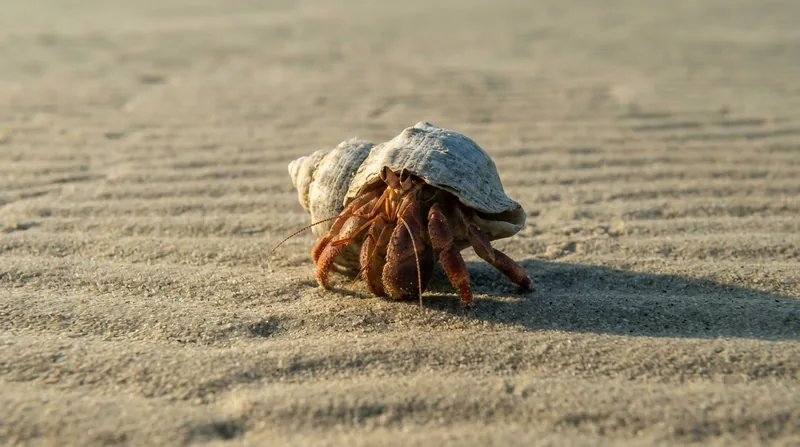 Hermit crabs (Paguridae)
Plenty of dab goes with the brown shrimp (Crangonidae), starfish (Asteriidae), the sea mouse (Aphroditidae), depth and a warmer bottom. We count fewer dab with hermit crabs (Paguridae) and the common cuttlefish (Sepiidae).
The shrimp fits what the dab eats. FishBase says the dab feeds mainly on crustaceans and small fishes. Where the shrimps are, the dab is.
The comparison with plaice is more interesting, because the two flatfish share the same ground. Three features point the same way for both: hermit crabs towards fewer, starfish towards more, depth towards more.
One feature turns around. The sea mouse — a thick bristle worm — goes with MORE dab and with FEWER plaice. That is rare: across our sea models the sea mouse nearly always goes with fewer fish, and only for dab and whiting with more. Neither fish eats it. So it looks more like a kind of bottom than like food. But that is our idea; all we measured is that it tells the two apart.


