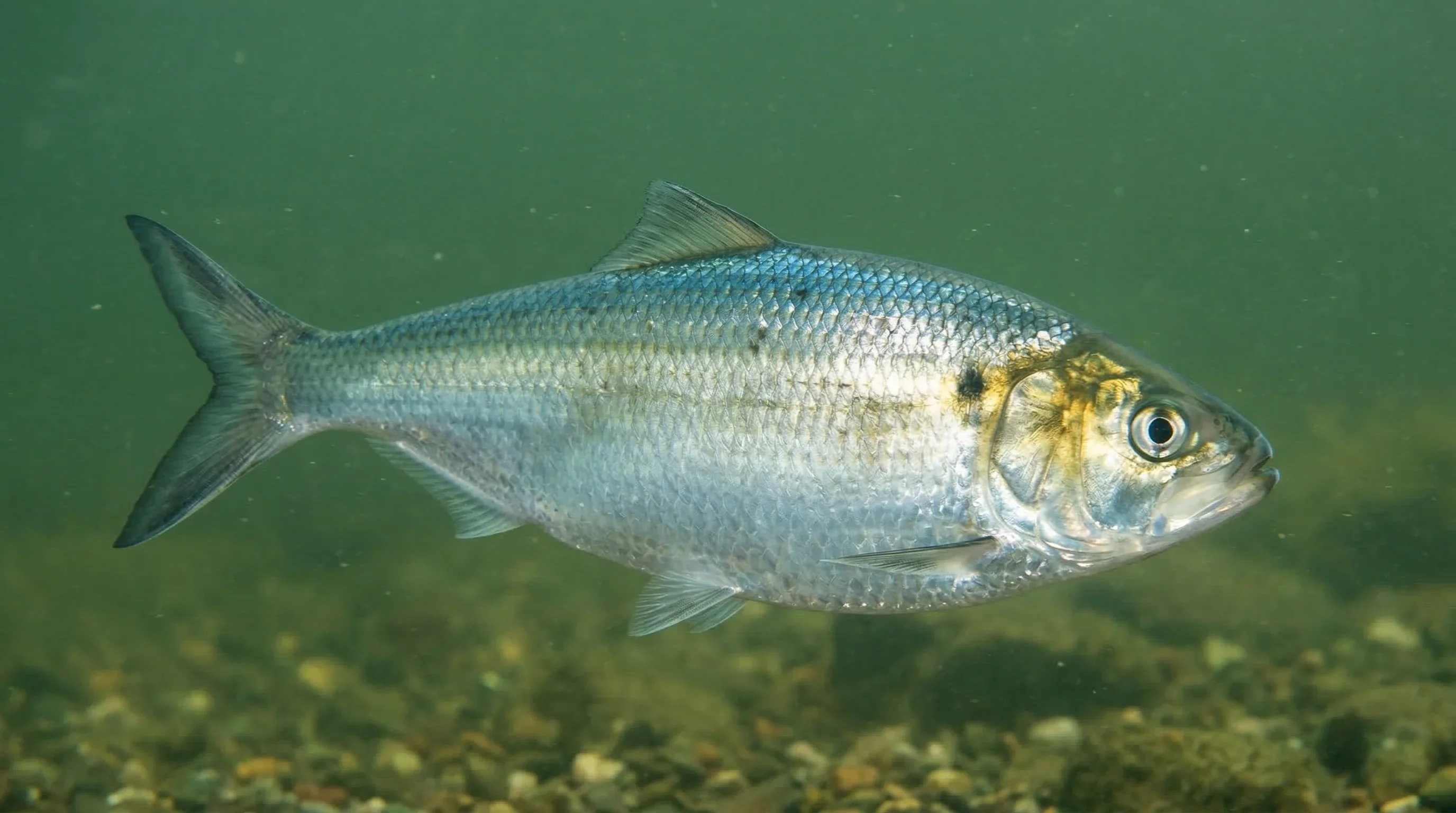
The European sea bass (zeebaars in Dutch) is the best-known predator on the Dutch coast, and sea bass fishing is possible all along it: from piers and groynes, in the surf off the beach and in the tidal inlets of Zeeland. It is strong, fights hard and hits lures without hesitating. This page covers how to recognise one, where and when to catch it, how to fish for it and which rules apply. At the bottom you will find what our models see in the data.
Identification
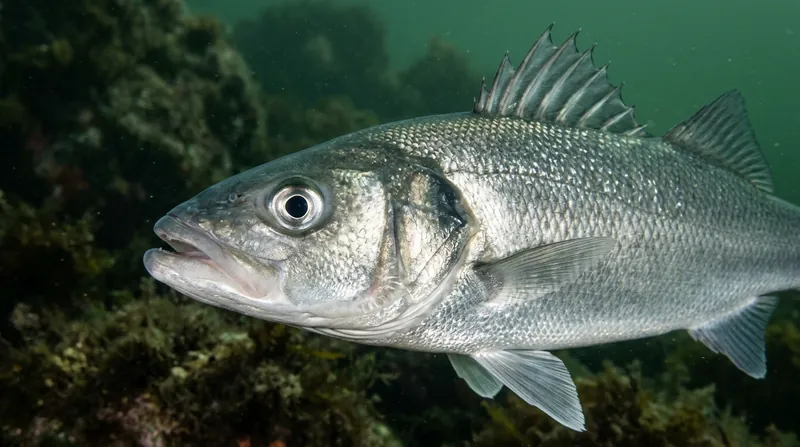 Two separate dorsal fins, and sharp edges around the head
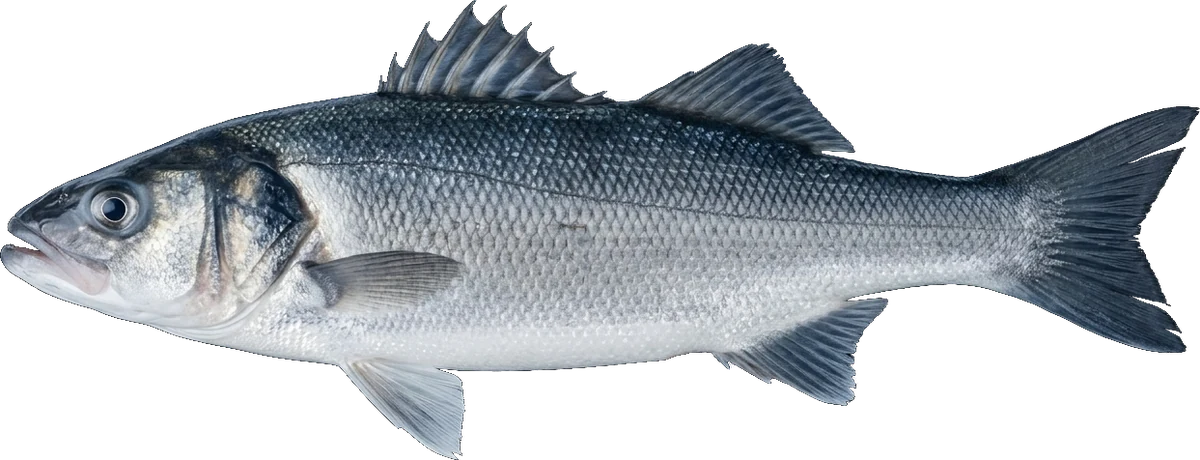
A sea bass is a solid, silver fish with large scales, a dark grey to bluish back and a white belly. Look at the back: it has two dorsal fins, clearly apart. The front one has eight or nine stiff spines, the rear one is soft (MarLIN).
Mind your hands. The front dorsal spines are sharp, and the gill cover ends in two flat, sharp points (FishBase). Along the lower edge of the cheek, just in front of the gill cover, runs a row of small forward-pointing spikes (MarLIN). Grab a sea bass carelessly and it will cut you.
Young sea bass often have dark spots on the back and upper sides, which have normally gone by the time the fish is a year old (Animal Diversity Web). According to FishBase a sea bass can grow past a metre, weigh twelve kilos and live thirty years. Most are far smaller: around fifty centimetres is a common size.
How sea bass live and move
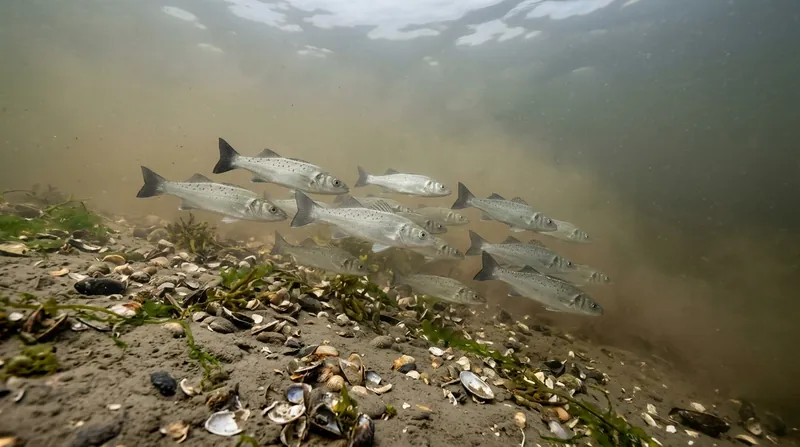 Young sea bass grow up in estuaries and shallow coastal water
Sea bass live in shallow coastal water, usually less than ten metres deep, over almost any bottom. In summer they move into estuaries and tidal inlets, sometimes some way up a river (MarLIN). As the water cools they head offshore, and they spend the winter in deeper water (FishBase). Young fish swim in shoals; adults travel in smaller groups. Sea bass eat mostly shrimps and shellfish, and fish too, taking more fish as they grow (FishBase).
The key fact: sea bass grow slowly. They only mature at four to six years old, at 35 to 49 centimetres (Graham et al., 2023), so a fifty-centimetre fish is already years old. That is why the rules for this fish are strict. They spawn offshore, in groups, somewhere between February and June. Researchers think the water has to be at least nine degrees. The eggs and larvae then drift for two to four months towards the coast (Graham et al., 2023), where the young grow up in shallow water and estuaries.
Our own data shows this. Most of the sea bass in our data come from the Westerschelde, and a large share of them from a young-fish survey. Wageningen Marine Research has fished there every autumn since 1970 with a light shrimp net, to count young flatfish, especially sole and plaice, and shrimp (BODC, Thünen Institute). Young sea bass end up in that net too. Of the thousands of sea bass measured in the Westerschelde, almost every one was under 30 centimetres. But a net like that is built for small fish. It shows that many young sea bass grow up there, not that there are no big ones.
Where to catch sea bass
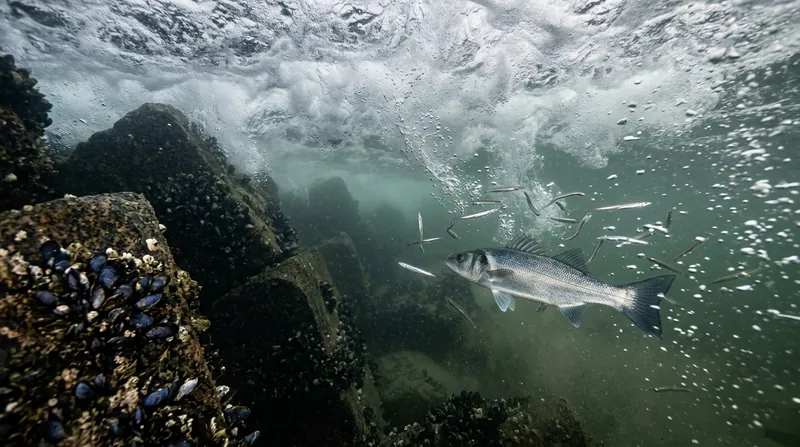 Where the stones break the waves, sea bass hunt
Look for moving water hitting something: the current along a pier, groyne or harbour wall, the outflow from a sluice, or the surf along a beach. Shrimps, small crabs and small fish get knocked about there, and that is where sea bass hunt. Stone dykes covered in mussels and weed are good too, as are the edges of sandbanks and mussel beds, and channels the tide runs through.
You can catch sea bass along the whole Dutch coast, from the Westerschelde to the Wadden Sea. Zeeland is the best-known area: the Oosterschelde with its stone dykes and strong currents, the Westerschelde and the dams of the Delta Works. The piers and harbour walls along the North and South Holland coast and the mouth of the Nieuwe Waterweg are well-known spots as well.
When to catch sea bass
What matters most is the time of year and the water temperature. Sea bass are a warm-season fish: they come inshore as the sea warms up and leave again as it cools (FishBase).
Spring. As the sea warms, the first sea bass return to the coast. Fish shallow, along stones, dykes and in the surf. Late winter and early spring are the closed season; the exact dates are under the rules.
Summer and autumn. This is sea bass time. From summer well into autumn they are close enough to catch from the shore.
Winter. In late autumn the water cools, most sea bass move to deeper water offshore, and few are caught from the coast.
Lures, bait and tackle
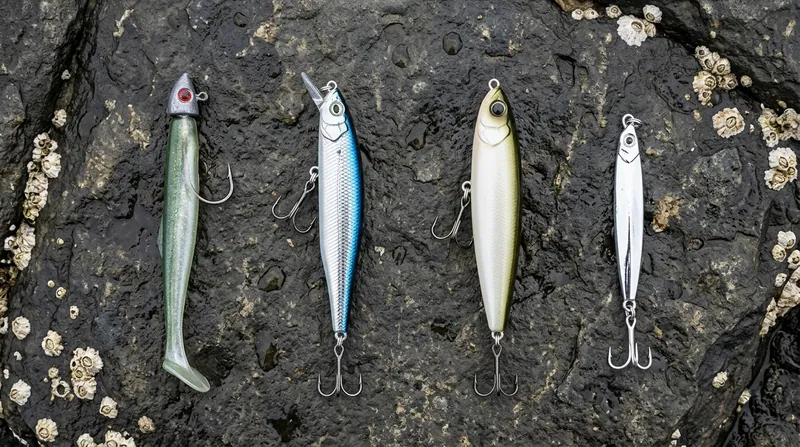 Soft sand eel, slim minnow, surface lure and metal jig: the usual four
Spinning with lures is the best-known way to catch sea bass. Four lure types cover most situations:
- A soft plastic lure on a jig head, often shaped like a sand eel. Works almost anywhere: near the bottom, along stones, in the current.
- A slim minnow that runs just below the surface, for the surf and over sandbanks.
- A surface lure without a lip, walked across the top. In calm water a sea bass can smash it.
- A metal casting jig: small and heavy, for distance when the fish are hunting far out.
Sea bass take a lure greedily; you will usually feel the hit straight away. For most shore fishing a 2.70–3 m rod casting roughly 10–40 g works, with a saltwater-proof reel and thin braid. Rinse everything in fresh water afterwards: salt eats metal.
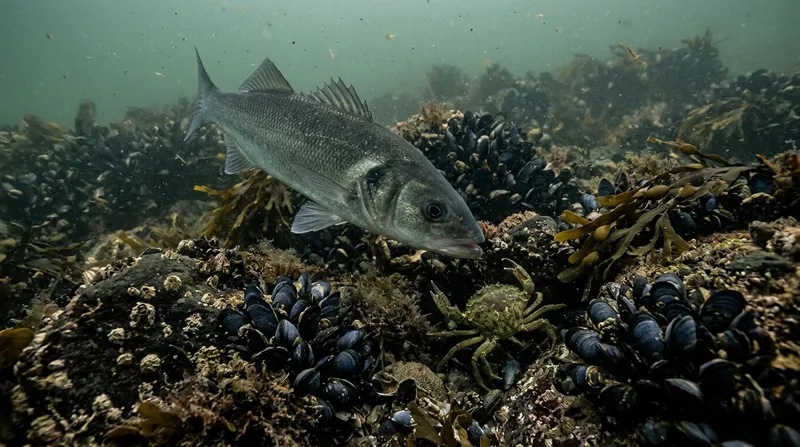 A shore crab among the mussels. A soft shore crab makes a good sea bass bait
Bait is fished mostly on the bottom, on a ledger or paternoster rig, or under a float along the stones. Good baits are ragworm and lugworm, a fresh shrimp, or a soft crab: a shore crab that has just moulted and still has a soft shell. Fly fishing works too, in shallow water, with a streamer that looks like a small fish or a shrimp.
Rules: closed season, minimum size and bag limit
Sea bass rules are stricter than for most sea fish, for the reason above: the fish grows slowly and matures late. Between 2010 and 2018 the stock in the North Sea and the Channel fell sharply, because too few young fish were coming through and too many were being caught. That led to emergency measures in 2015 (Graham et al., 2023). Things are improving: for 2026 the recreational bag limit went up from two to three sea bass per day (EAA). The stock is still not in good shape, though (VISwijzer).
How many you may keep, how long they must be and when you may not fish for them is in the table below. The EU sets these rules again every December, and the table says so itself when they are out of date.
- February 1 – March 31 Closed season: no fishing You may not fish for this species in this period. If you catch one by accident, put it back straight away.
- April 1 – January 31 now Open season You may keep up to 3 per day, if each one is long enough.
The minimum size is 42 cm. These are the rules for 2026. The EU sets them again every December.
Can you fish for sea bass in February?
No. During the closed season, in 2026 from 1 February to 31 March, the Dutch authority RVO says you may not fish for sea bass. If you hook one while fishing for something else, put it straight back. You may read elsewhere that catch-and-release is allowed in those months. We follow RVO, which is stricter, because it is the Dutch government.
How many sea bass can you keep?
In 2026, up to three per person per day, in January and from 1 April to 31 December, each at least 42 centimetres long (RVO). A smaller fish always goes back.
Register in the RecFishing app
Since January 2026, anyone aged 14 or over who fishes at sea or in Dutch coastal waters must register in the EU's RecFishing app. Coastal waters include the Wadden Sea, the Oosterschelde and the Westerschelde. Log every sea bass you catch, released ones too, within 24 hours (RVO). This applies to visitors as well.
Why February and March?
The closed season is there to protect fish that are about to spawn (Dawson et al., 2024). But researchers are not sure the timing is right. In the North Sea the water often only reaches nine degrees in late April or May (Graham et al., 2023). And in two Welsh estuaries, almost all young sea bass had been spawned after the fishery reopened (Dawson et al., 2024). That changes nothing about the rules. It does mean that a big sea bass caught in April or May may still be due to spawn.
Releasing sea bass
Many sea bass go back: too small, closed season, or you already have enough. Be quick. Wet your hands and hold the fish level, with one hand under the belly. Sea bass have no big teeth, so you can hold one by the lower lip, as long as you support its body. Keep clear of the dorsal spines and the sharp edges around the head.
Unhook with pliers and keep the fish out of the water as briefly as you can. Then hold it upright in the water until it swims off. And remember the app: released sea bass go into RecFishing too.
The biggest sea bass ever caught
The Netherlands keeps two sea bass records, one for length and one for weight. The length record is 94 cm: J. Jansen caught that fish in October 1988. The weight record is 8.97 kg: J. Folkers caught that fish in September 1998. The world record is a 10.89 kg (24 lb) sea bass, caught by Morgan Walsh in Ireland on 31 December 2025. None of the official record lists we checked holds a sea bass longer than 94 cm.
42 cm Minimum size: you may not keep a smaller sea bass
64 cm World record for length (IGFA, 2014)
81 cm The longest of more than 7,000 sea bass measured in fish surveys
94 cm Dutch record for length (1988)
Dutch record
94 cm
8.97 kg
Dutch sea-fish records are kept by the NCRZ, the Dutch committee for sea-fish records. Its list has one record for length and one for weight. For sea bass, these are two different fish. J. Jansen caught the longest, at 94 cm, in October 1988. J. Folkers caught the heaviest, at 8.97 kg, in September 1998. The list does not say where either fish was caught. None of the record lists we checked holds a sea bass longer than 94 cm.
A fish only counts if it was caught on a rod in Dutch sea water and hooked in the mouth. The Oosterschelde and the Westerschelde count. Lake Grevelingen and the Veerse Meer do not, because they are inland water. For a weight record, the fish must be weighed on land. For a length record, you send in photos of the fish on a measuring tape.
There is one more 94 cm sea bass from the Netherlands. Georges Vermeiren caught it in September 1986 at Wemmeldinge, on the Oosterschelde. It weighed 7.9 kg. It is not on the Dutch list. It is on a list of the Belgian sea anglers' federation BCSA: the one for catches in northern European seas. It was also an IGFA world record from 1986 to 1989: IGFA keeps separate records for each strength of fishing line.
The NCRZ keeps a separate list for Dutch anglers fishing elsewhere in Europe. The heaviest sea bass on it weighed 6.58 kg, caught at Nieuwpoort in Belgium in June 2015. So it is lighter than the record from Dutch water, but heavier than the Belgian record in the table below. That is possible because each list only holds the fish submitted to it.
World record
10.89 kg
The world record is kept by the IGFA, the international body for angling records. Morgan Walsh caught the 10.89 kg sea bass from the Irish shore on 31 December 2025, on a lure. The fight took five minutes. He weighed the fish on a certified scale and then released it (IGFA). The previous world record, 10.13 kg, was caught in France by Philippe Boulet in 1999. Walsh's fish is not yet on the Irish record list, where the record is an 8.08 kg sea bass from 2000.
For length, IGFA keeps a separate world record: 64 cm, caught in Morocco in 2014. That is far shorter than the Dutch length record. A fish only reaches the IGFA list if it is submitted there and approved. The French record list, for example, has a 10.33 kg sea bass caught on Corsica in 1990. It is heavier than the previous world record, but IGFA does not list it.
FishBase, a large database on fish, gives 103 cm and 12 kg as the largest sizes for sea bass. For the 12 kg, FishBase cites a German zoology textbook from 1991. For the 103 cm, it cites IGFA's database up to 2001. We could not find that length there: IGFA gives no length with a weight record. None of the record lists we checked holds a sea bass that long or that heavy.
Records by country
Every country keeps its own list, with its own rules. Some lists count length, others weight, so the numbers cannot always be compared.
| Country | Record | Angler | Where caught | Date | List |
|---|---|---|---|---|---|
| Netherlands | 94 cm | J. Jansen | — | Oct 18, 1988 | NCRZ |
| Netherlands | 8.97 kg | J. Folkers | — | Sep 28, 1998 | NCRZ |
| Belgium | 6.50 kg · 84 cm | A. Broeckmans | from a boat out of Blankenberge | May 3, 2008 | BCSA Boat Angling |
| Denmark | 5.426 kg | Rene Morgenweck | Agger | Aug 31, 2014 | Danske Fiskerekorder |
| Denmark | 73 cm | Franz Dieter Kleinkapel | Børsmose Strand | Oct 22, 2012 | Danske Fiskerekorder |
| France | 10.33 kg | Guy Caamano | Corsica, from the shore | Dec 22, 1990 | FFPM |
| Ireland | 8.08 kg (17 lb 13 oz) | Emmet Naughton | Doughmore Strand | Oct 21, 2000 | ISFC |
| Norway | 6.60 kg · 87 cm | Artur Klavins | Bergen | Aug 17, 2024 | Villmarksliv |
| Sweden | 6.10 kg · 85 cm | Damir Vojie | Videbergs hamn, Kattegat | Dec 22, 1991 | Sportfiskarna |
| United Kingdom | 8.958 kg (19 lb 12 oz) | John Stephenson | Portsmouth Dockyard, from the shore | 2012 | BRFC |
| United Kingdom | 8.876 kg (19 lb 9 oz 2 dr) | P McEwan | off Herne Bay, Kent, from a boat | 1987 | BRFC |
A dash means the list does not give it. Checked on September 26, 2026. A record can be broken at any time, so we check these lists at least once a year.
In the Netherlands
Sea bass occur along the whole Dutch coast and sometimes stray into fresh water. They are a fish of warmer seas, and according to the VISwijzer the stock is shifting north as the ocean warms. The IUCN Red List rates the species Near Threatened (FishBase).
The sea bass in shops and restaurants is almost always farmed: according to the VISwijzer, 96% of the sea bass we eat comes from farms, mostly in the Mediterranean, and Turkey is by far the largest producer. The sea bass off the Dutch coast is a wild fish that grows slowly, and you may keep only a few a day. What our models see in sea bass water is below.
What our models found for European Seabass
Below is what our models see in the data. These are links: where one thing occurs, the other occurs more often. That is not a cause. Each model answers one question and may not say more than it measured. The label by the heading tells you which question — and how sure the answer is.
Where this species lives Strong model
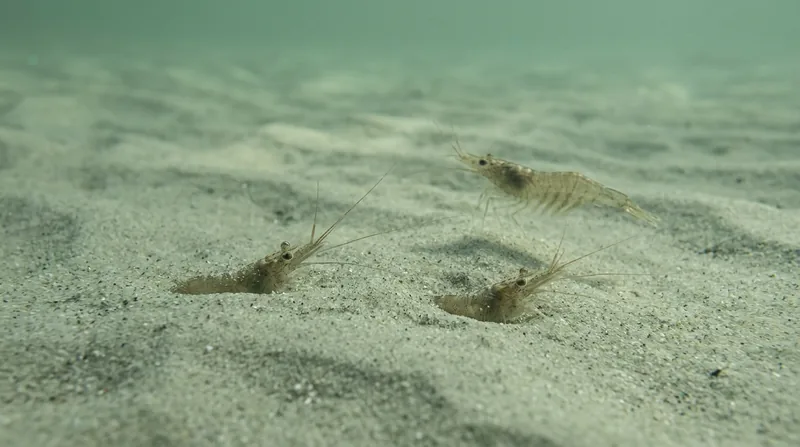 Brown shrimp (Crangonidae)
The strongest mark of sea bass water is the brown shrimp: almost a fifth of this model hangs on it. The shore crab comes next. That is striking, because sea bass feed chiefly on shrimps and molluscs. The strongest signal for where this fish lives is its own food.
What this model cannot say is whether that is cause or consequence. Sea bass eat shrimp, but shrimp and sea bass also both favour the same kind of water: shallow, sandy coastal ground. We cannot separate those two here.
Small coastal fish fill out the list: sand gobies (Pomatoschistus) and gobies (Gobiidae), pipefish (Syngnathus and Syngnathidae), the shorthorn sculpin and pouting. The gobies and the pipefish each appear twice, as a genus and as a family — so those are two signals, not four.
One name says nothing: gurnards (Triglidae) sit in most sea cells, so they separate sea bass water from nothing. The sand star (Astropectinidae) is a different case. It sits on the negative side below, in the numbers — the same animal, a different model, the same line between shallow coastal water and deeper sea floor.
Where there are many A set, not a ranking Strong model
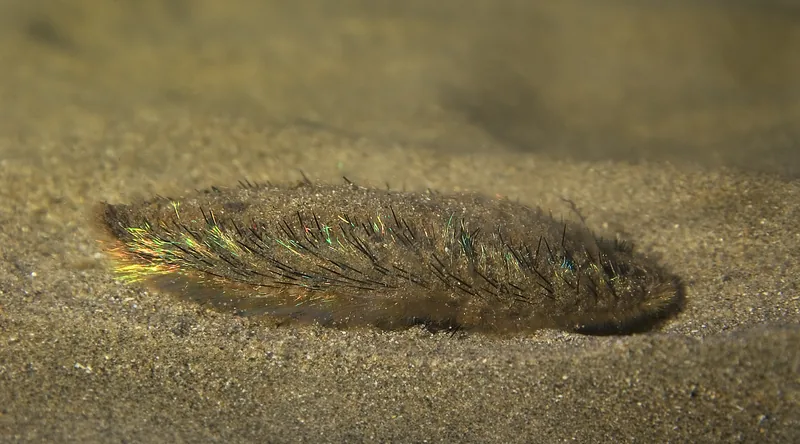 Sea mouse (Aphroditidae)
Two features in this model are not animals. With a warmer bottom we count MORE sea bass, and with more depth fewer. Shallow and warm, in other words.
That is exactly how this fish spends its year. Sea bass enter coastal waters and river mouths in summer, and move offshore in colder weather. In winter they sit deep. Two columns holding temperature and depth pull out that whole migration.
On the animal side, the striped venus clam (Veneridae) goes with plenty of sea bass, and so does the common cuttlefish (Sepiidae). We count fewer sea bass where mussel (Mytilidae), common whelk (Buccinidae), shore crab (Carcinidae), bobtail squid (Sepiolidae), small hermit crab (Diogenidae), moon snail (Naticidae), sand star (Astropectinidae) and sea mouse (Aphroditidae) live.
At first sight that is odd. Sea bass feed chiefly on shrimps and molluscs, so you would expect molluscs on the other side. We read it this way: these particular species belong to the deeper, cooler bottom — the water sea bass leave in season. The list then marks the water, not the menu. We have not measured that.