Identification
The monkey goby (also called whitefin gudgeon in Dutch) is a small goby of 10 to 15 cm with an elongated, cylindrical body. The color is light brown to sandy with faint dark spots along the flank. Distinctive are the whitish edges on the pectoral fins. The head is relatively narrow and pointed compared to the round goby. Like all gobies, it has the typical sucker disc formed from fused pelvic fins. The distinction from the round goby: the monkey goby is slimmer, lighter in color, and lacks the black spot on the first dorsal fin.
Behavior & ecology
The monkey goby is a bottom fish that lives on sandy and gravelly substrates in flowing water. It feeds on small invertebrates, insect larvae, and snails. The species is less aggressively territorial than the round goby and is often outcompeted to suboptimal habitat. During spawning, the male guards a nest cavity under stones. The monkey goby originally inhabits the lower reaches of rivers around the Black Sea and Caspian Sea region.
In the Netherlands
The monkey goby is an invasive exotic that reached the Netherlands via shipping routes from the Ponto-Caspian region — just like the round goby and tubenose goby. The species was first recorded in the major rivers around 2005 and now occurs in the Rhine, Meuse, Waal, and their harbors and side channels. Its spread has been less explosive than that of the round goby. The impact on native bottom fish (particularly the bullhead) is a concern, although the monkey goby is less dominant than its round goby cousin.
What our models found for Monkey goby
Below is what our models see in the data. These are links: where one thing occurs, the other occurs more often. That is not a cause. Each model answers one question and may not say more than it measured. The label by the heading tells you which question — and how sure the answer is.
Where this species lives Strong model
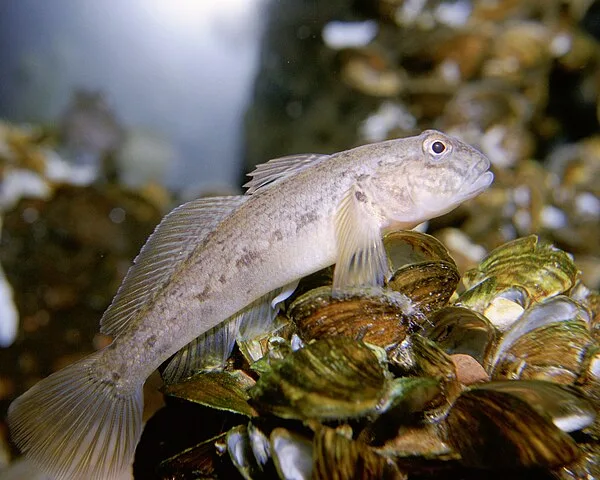 Round goby (Neogobius melanostomus)
The round goby comes first, a good half again as heavy as the next name. Then the tubenose goby, the asp, the bleak and the ide.
The monkey goby and the round goby both come from the Black Sea region and both arrived here along the rivers. Where we count one we usually count the other — but what one does to the other, we have not measured.
Further down sit the zander, the Asian clam (Cyrenidae), river snails (Viviparidae), opossum shrimps (Mysidae), the spined loach and the gudgeon. Organic matter and nutrient level count too. Here as well part of the list is newcomers: the clam and the opossum shrimp belong to the same wave as the gobies themselves.


