Identification
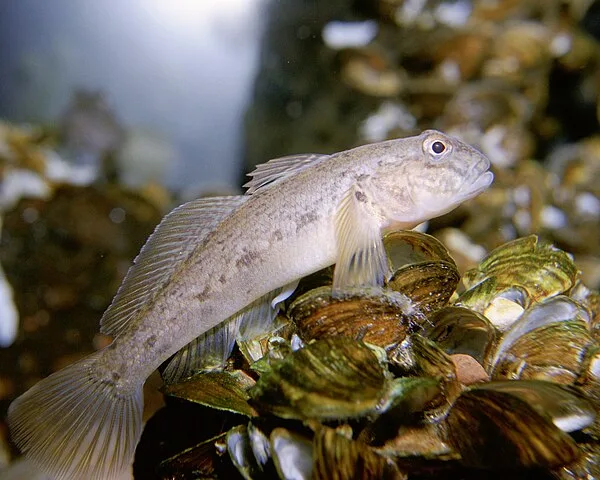
The bighead goby (Kessler's goby) is the largest of the Ponto-Caspian gobies in the Netherlands, reaching up to 22 cm. The body is robust and stocky with a notably broad, flattened head. The color is dark brown to grey-brown with faint dark spots and bands. The pectoral fins are large and the body feels rough due to small scales. Characteristic is the heavy build — distinctly more massive than the round goby. Like all gobies, it has fused pelvic fins forming a sucker disc. The distinction from the round goby: the bighead goby is larger, more broadly built, and lacks the black spot on the first dorsal fin.
Behavior & ecology
The bighead goby is an aggressive bottom fish that lives on hard substrates in flowing water — riprap, quay walls, and gravel banks in large rivers. It feeds on invertebrates, snails, and small crustaceans, and its powerful jaws can crack mussels. The species is territorial and displaces other bottom fish from the best hiding spots. Originally from the lower reaches of rivers around the Black Sea and Caspian Sea, where it occupies the fastest-flowing sections.
In the Netherlands
The bighead goby is the fourth Ponto-Caspian goby species in the Netherlands and was first recorded in the major rivers around 2007. The species is most strongly tied to the main current of rivers — it prefers the strongest flow and hardest substrate of all invasive gobies. With 61% of observations in rivers, it is decidedly rheophilic. The impact on native bottom fish, particularly the protected bullhead, is considerable: the bighead goby is larger and more aggressive than the other invasive gobies and can directly displace the bullhead from its hiding spots.
What our models found for Bighead goby
Below is what our models see in the data. These are links: where one thing occurs, the other occurs more often. That is not a cause. Each model answers one question and may not say more than it measured. The label by the heading tells you which question — and how sure the answer is.
Where this species lives Strong model
 Round goby (Neogobius melanostomus)
As with the monkey goby, the round goby comes first by a distance. Then the asp, the monkey goby itself, organic matter and the ide. So the three gobies all appear in each other's lists.
This model has one feature the other gobies do not: water level, in seventh place. That is a river measure. The bighead goby is above all a fish of the big rivers.
The tubenose goby, the zander, the perch, mayflies (Caenidae) and the spined loach are in the list as well. And again a row of newcomers: the Asian clam (Cyrenidae), American crayfish (Cambaridae), the Caspian mud shrimp (Corophiidae) and the American amphipod (Crangonyctidae).


